
NEW
Font size
S
M
L
XL
 Worksheets
Muscles of the Head & Neck Part 2
Total questions: 24
Worksheet time: 12mins
Name
Class
Date
1.
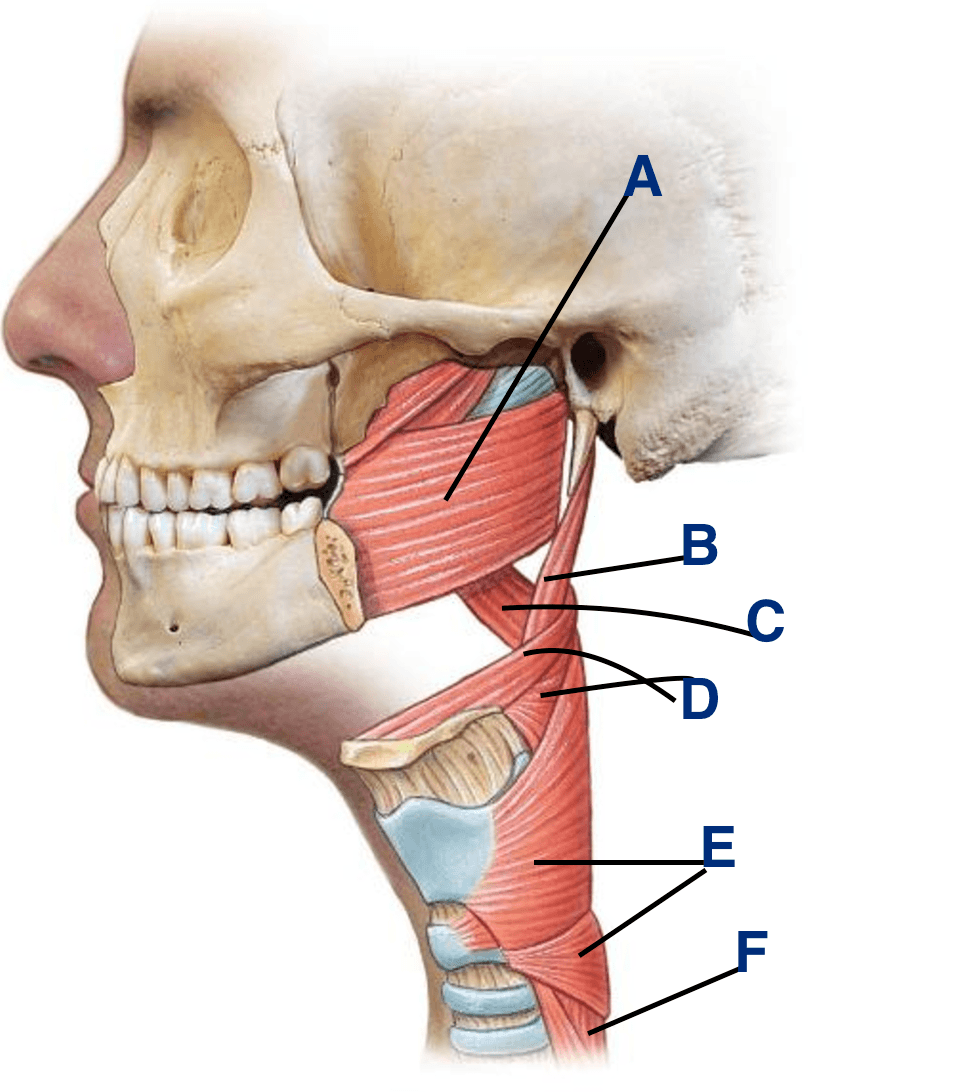
Which of the following labels are the pharyngeal constrictors? Indicate by letters, the superior, middle and inferior pharyngeal constrictors respectively.
*Pharyngeal constrictors help with forcing the food into the esophagus, an involuntary process.
*Pharyngeal constrictors help with forcing the food into the esophagus, an involuntary process.
a)
A, B, & C
b)
A, B, & D
c)
A, D, & E
d)
A, D, & F
2.
True or False?
Pharyngeal constrictors make up the outer layer aka as the circular layer.
Pharyngeal constrictors make up the outer layer aka as the circular layer.
a)
True
b)
False
3.
Which of the following muscles of the throat make up the inner layer (aka longitudinal muscles)?
*Hint: These would also be classified as the assisting muscles.
1. Superior Pharyngeal
2. Stylopharyngeus
3. Palatopharngeus
4. Middle Pharyngeal
5. Inferior Pharyngeal
*Hint: These would also be classified as the assisting muscles.
1. Superior Pharyngeal
2. Stylopharyngeus
3. Palatopharngeus
4. Middle Pharyngeal
5. Inferior Pharyngeal
a)
2 & 3 only
b)
1, 4, & 5
c)
1, 2, & 3
d)
1 & 3 only
4.
Which of the following muscles of the throat are NOT innervated via the vagus nerve (i.e. innervated via the glossopharyngeal nerve)?
1. Superior Pharyngeal
2. Stylopharyngeus
3. Palatopharngeus
4. Middle Pharyngeal
5. Inferior Pharyngeal
1. Superior Pharyngeal
2. Stylopharyngeus
3. Palatopharngeus
4. Middle Pharyngeal
5. Inferior Pharyngeal
a)
4 only
b)
1, 3, 4, & 5
c)
1, 2, & 3
d)
2 only
5.
Which of the following muscles of the throat are innervated via the vagus nerve (i.e. NOT innervated by the glossopharyngeal nerve)?
1. Superior Pharyngeal
2. Stylopharyngeus
3. Palatopharngeus
4. Middle Pharyngeal
5. Inferior Pharyngeal
1. Superior Pharyngeal
2. Stylopharyngeus
3. Palatopharngeus
4. Middle Pharyngeal
5. Inferior Pharyngeal
a)
4 only
b)
1, 3, 4, & 5
c)
1, 2, & 3
d)
2 only
6.
True or False?
When we ingest food the throat muscles help with closing of the nasopharynx so food does not travel into the respiratory system. This makes sense since the nasopharynx and the oral pharynx are connected.
When we ingest food the throat muscles help with closing of the nasopharynx so food does not travel into the respiratory system. This makes sense since the nasopharynx and the oral pharynx are connected.
a)
True
b)
False
7.
When swallowing, the throat muscles open this tube. This tube allows the pressure in the middle ear to equalize with the pressure of the nasal pharynx which is atmospheric pressure. Which of the following correspond to this tube?
a)
Auditory Tube
b)
Eustachian Tube
c)
Two of the above
d)
Internal Auditory Metis
8.
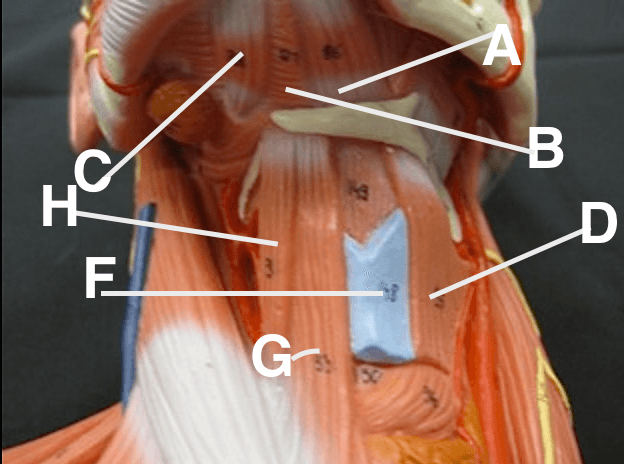
In the model illustrated, which of the following are the suprahyoid muscles? These muscles are responsible for raising the larynx or depressing the mandible.
*There are more suprahyoid muscles, but in relation to this image which are the ones that are labelled?
*There are more suprahyoid muscles, but in relation to this image which are the ones that are labelled?
a)
A, B, & H
b)
A, B, & C
c)
D, G, & H
d)
None of the above
9.
Label the Geniohyoid, Mylohyoid, & the anterior belly of the Digastric respectively.
a)
A, B, & H
b)
A, B, & C
c)
D, G, & H
d)
None of the above
10.
Label the Thyrohyoid, Sternohyoid, & the superior belly of the Omohyoid respectively.
* These are some examples of the infrahyoid muscles which help depress the larynx during swallowing and speaking.
* These are some examples of the infrahyoid muscles which help depress the larynx during swallowing and speaking.
a)
A, B, & H
b)
A, B, & C
c)
D, G, & H
d)
F, G, & H
11.
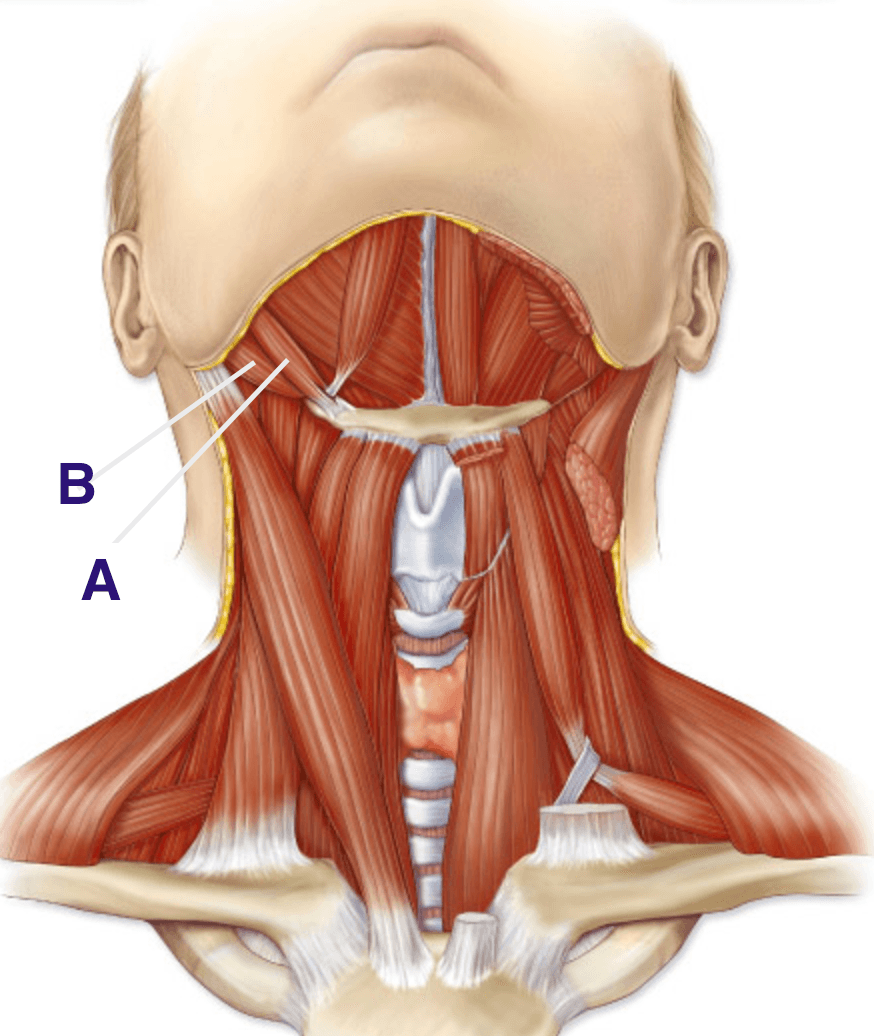
Name the following suprahyoid muscles respectively from A to B.
a)
Stylohyoid, Posterior Digastric belly
b)
Stylohyoid, Sternocliedomastoid
c)
Posterior Digastric Belly, Stylohyoid
d)
Superior Omohyoid, Sternocliedomastoid
12.
True or False?
The Digastric bellies and the Omohyoid bellies use a stirrup (aka trochlea).
The Digastric bellies and the Omohyoid bellies use a stirrup (aka trochlea).
a)
True
b)
False
13.
Which of the following are false statements?
1. The mylohyoid is a superficial muscle on the geniohyoid.
2. Posterior belly of the digastric is attached to the mastoid process of the temporal bone.
3. Omohyoid orginates from the superior border of the scapula medial to the suprascapular notch.
4. The stylohyoid originates from the mastoid process.
1. The mylohyoid is a superficial muscle on the geniohyoid.
2. Posterior belly of the digastric is attached to the mastoid process of the temporal bone.
3. Omohyoid orginates from the superior border of the scapula medial to the suprascapular notch.
4. The stylohyoid originates from the mastoid process.
a)
1, 2, & 3
b)
1 & 3
c)
2 & 4
d)
4 Only
14.
Which of the following functions are associated with the group of muscles listed below?
1. Thyrohyoid
2. Sternothyroid
3. Sternohyoid
4. Omohyoid Bellies
1. Thyrohyoid
2. Sternothyroid
3. Sternohyoid
4. Omohyoid Bellies
a)
Depress the larynx
b)
Elevate the larynx
c)
Elevate the hyoid bone
d)
Two of the above
15.
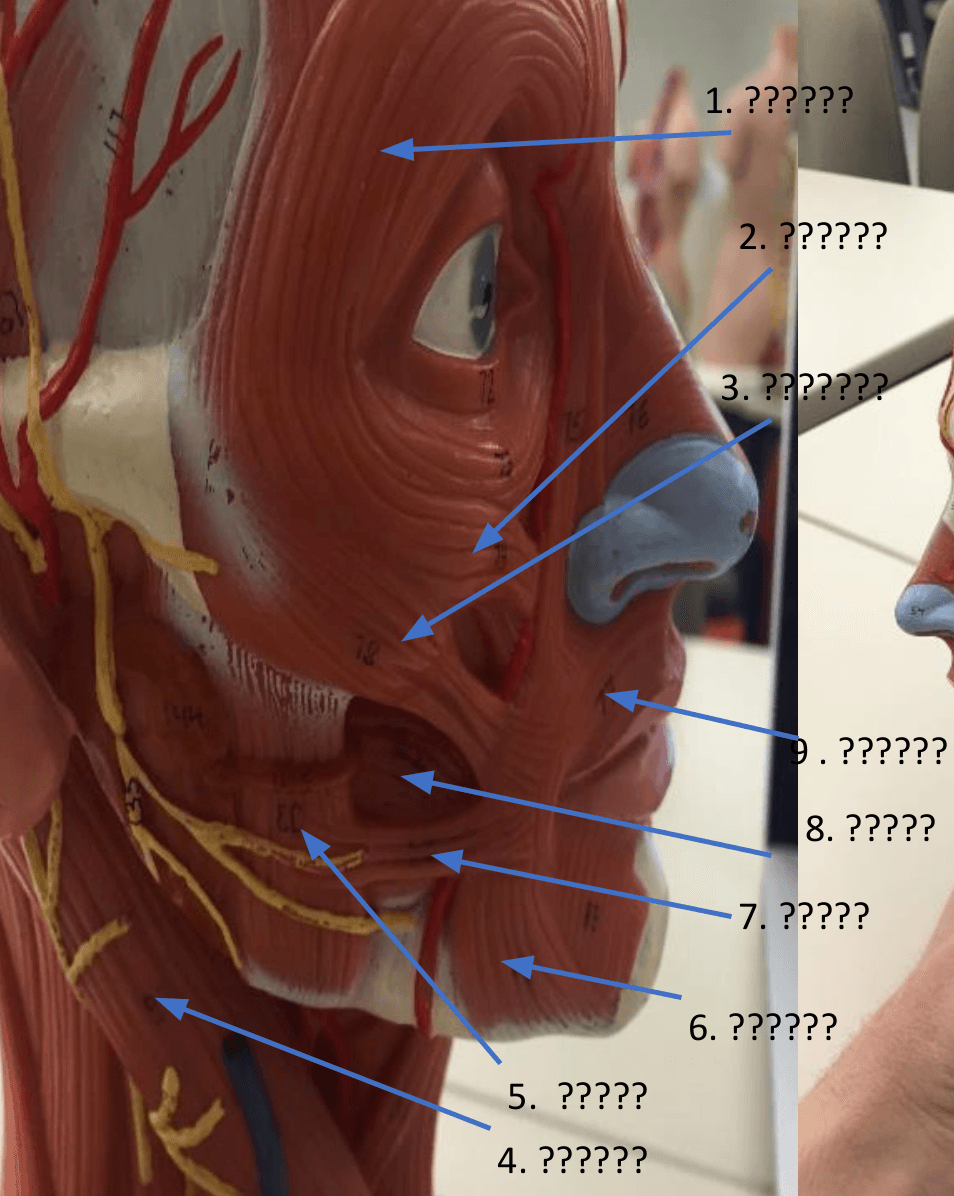
This structure flexes the neck and rotates the head to the opposite side and it is innervated via the accessory nerve or cervical roots. Which label corresponds to this structure?
a)
4
b)
5
c)
7
d)
None of the above
16.
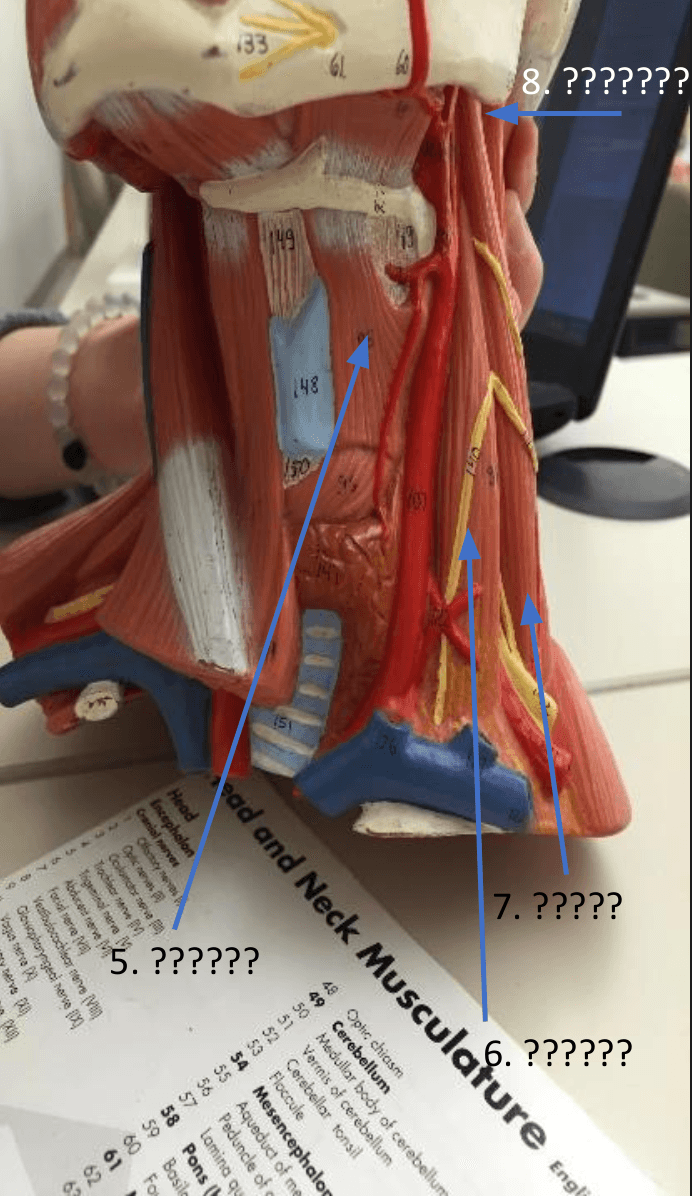
Which of the following labels correspond to the anterior, middle, & posterior scalenes respectively?
a)
5, 6, & 8
b)
6, 7, &, 8
c)
8, 7, &, 6
d)
5, 7, &, 8
17.
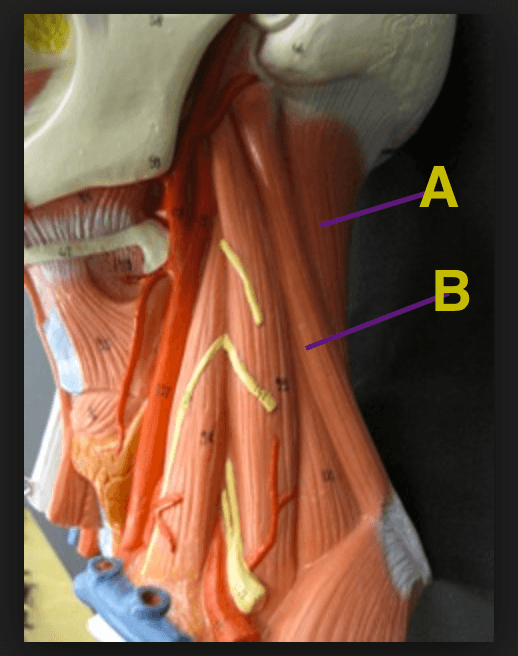
Label A and B respectively.
a)
Splenius Capitis & Levitator Scapulae
b)
Middle Scalene & Posterior Scalene
c)
Levitator Scapulae & Posterior Scalene
d)
Middle Scalene & Splenius Capitis
18.
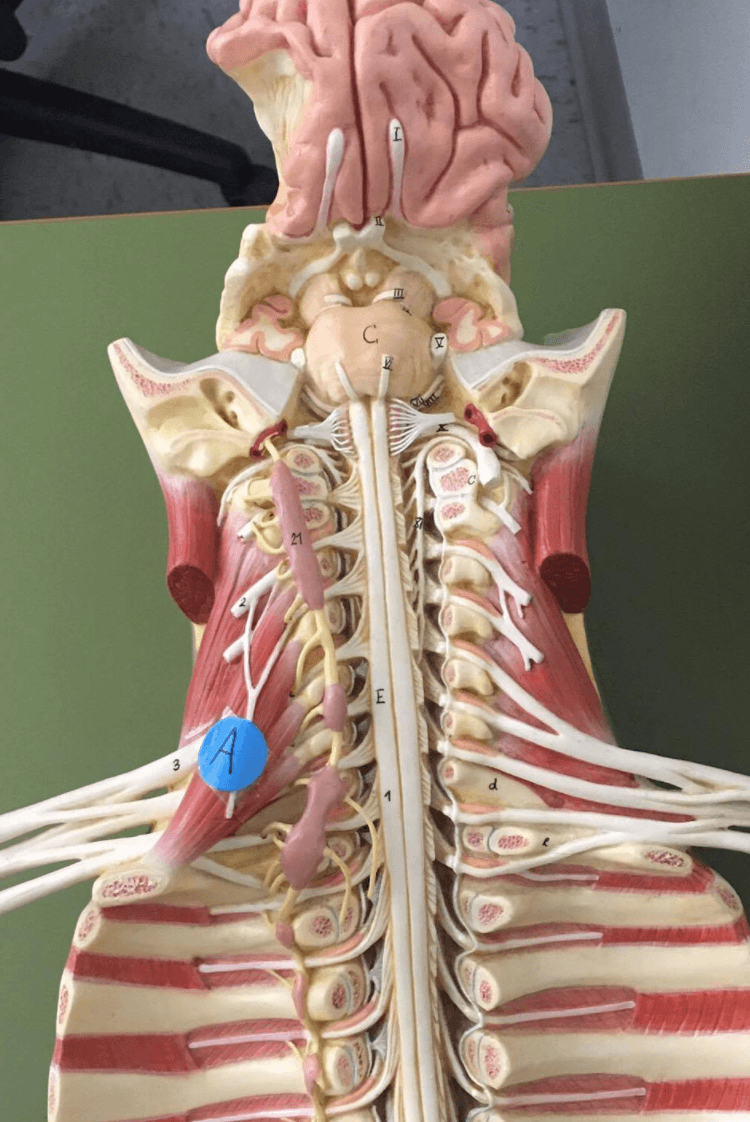
Label A please.
a)
Splenius Capitis
b)
Middle Scalene
c)
Levitator Scapulae
d)
Anterior Scalene
19.
Which one serves to extend the head and neck and is innervated by the cervical roots?
a)
A, Splenius Capitis
b)
B, Middle Scalene
c)
A, Levitator Scapulae
d)
B, Posterior Scalene
20.
True or False?
The Splenius Capitis originates from the mastoid process and inserts on the transverse processes of the cervical vertebrae.
The Splenius Capitis originates from the mastoid process and inserts on the transverse processes of the cervical vertebrae.
a)
True
b)
False
21.
Which of the following extrinsic muscles of the eye are NOT innervated via the oculomotor nerve (aka optic nerve)?
1. Superior Rectus
2. Superior Oblique
3. Medial Rectus
4. Lateral Rectus
5. Inferior Oblique
6. Inferior Rectus
1. Superior Rectus
2. Superior Oblique
3. Medial Rectus
4. Lateral Rectus
5. Inferior Oblique
6. Inferior Rectus
a)
1, 2, 3, & 4
b)
2 & 4 only
c)
4, 5, & 6
d)
4 & 6 only
22.
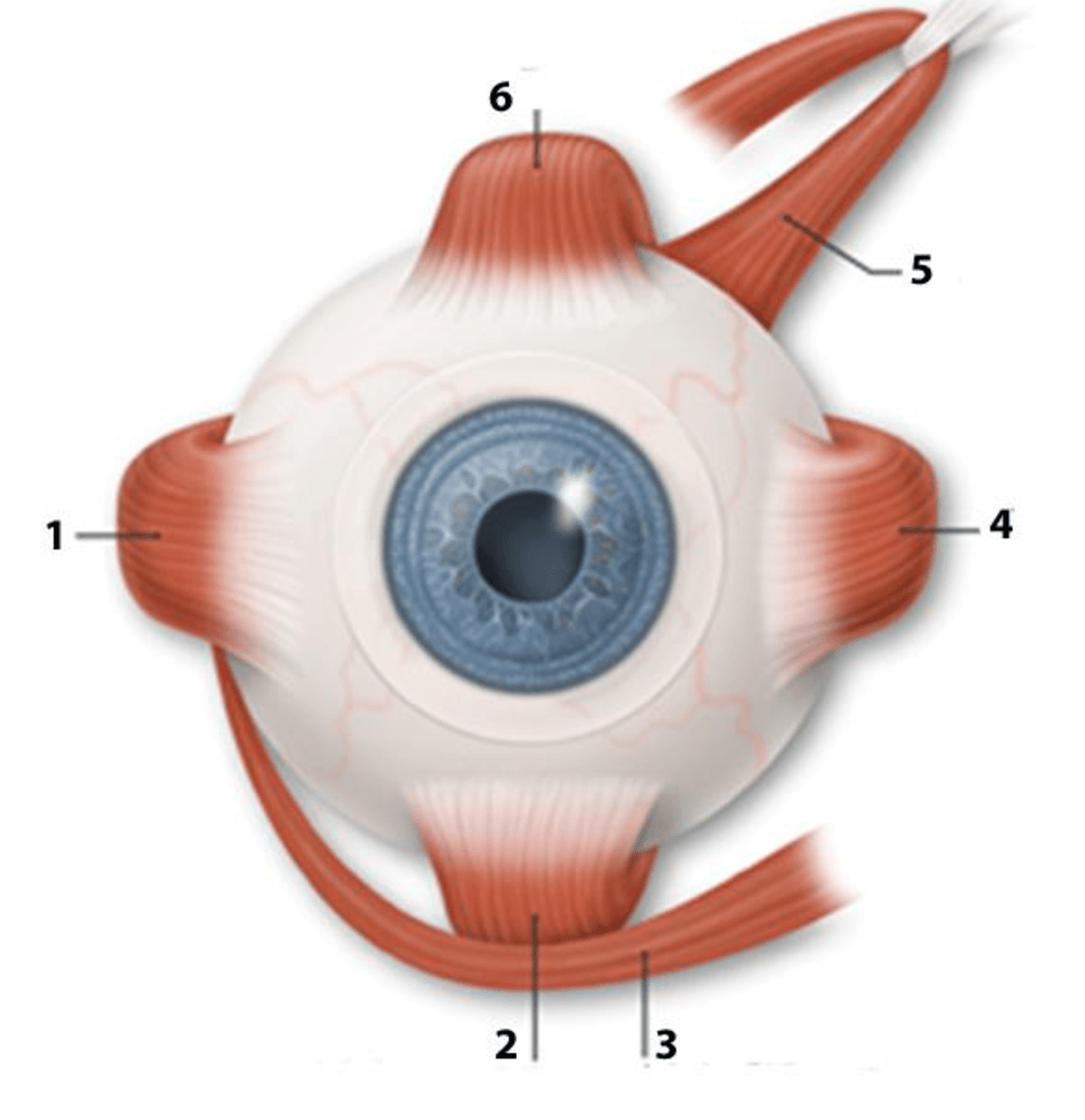
Which of the following extrinsic muscles of the eye has a primary function of abducting the and is innervated by the abducens nerve?
a)
5
b)
4
c)
1
d)
3
23.
Which of the following extrinsic muscles of the eye does NOT come off the common tendinous ring?
a)
5
b)
4
c)
1
d)
3
24.
Which of the following extrinsic eye muscles allows intorsion (aka medial rotation) and is innervated via the trochlear nerve?
a)
5
b)
4
c)
1
d)
3
Reset

