
 Worksheets
Text Structures/Text Features
Total questions: 57
Worksheet time: 39mins
Name
Class
Date
1.
This feature explains what the illustration/photograph is.
a)
Glossary
b)
Index
c)
Table of contents
d)
Caption
2.
This feature informs the reader of important words/vocabulary found within the paragraph.
a)
Glossary
b)
Bold words
c)
Captions
d)
Table of contents
3.
What text feature gives the
definitions of important vocabulary words?
a)
Captions
b)
Index
c)
Glossary
d)
None of the above
4.
This feature is usually found at the top of a page and explains what the paragraph is about?
a)
Table of contents
b)
Diagram
c)
Index
d)
subheading
5.
Important words are usually?
a)
Circled
b)
Bold print
c)
in the table of contents
d)
lowercase words
6.

This is an example of ____________ text feature?
a)
Index
b)
Table of contents
c)
Glossary
d)
Diagram
7.
This feature is used to show
one or more locations/ geographical regions.
a)
Glossary
b)
Maps
c)
Captions
d)
None of the above
8.
What text feature gives the definitions of important vocabulary words?
a)
Captions
b)
Index
c)
Glossary
d)
None of the above
9.

What is the arrow pointing to?
a)
Caption
b)
Picture
c)
Index
d)
Heading
10.

What is this text feature?
a)
Map
b)
The United States
c)
Picture
d)
Caption
11.
True/False: We should ALWAYS look at the text features.
a)
True
b)
False
12.
What helps us know exactly what something looks like?
a)
Map
b)
Caption
c)
Picture
d)
Heading
13.

What is the arrow pointing to?
a)
Heading
b)
Picture
c)
Caption
d)
Bold Word
14.
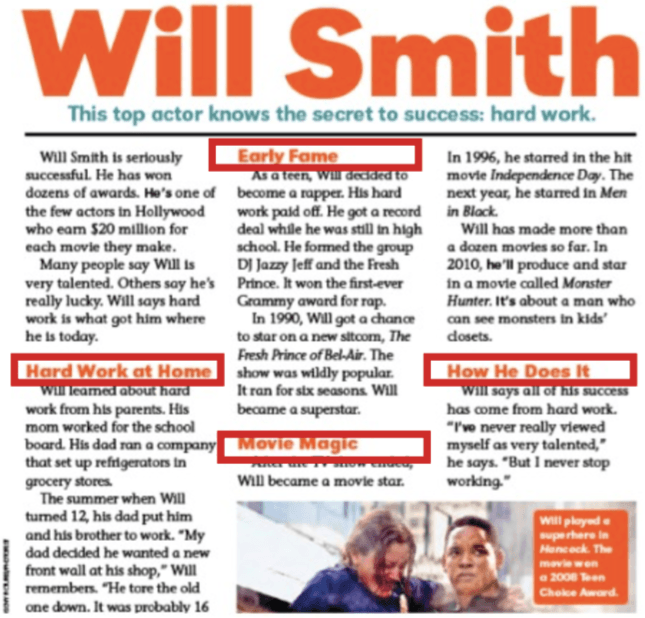
What is the purpose of these subheadings?
a)
To help the
reader understand
the author’s opinion
b)
To help the
reader visualize the
information
c)
To help the
reader find the main
ideas in each
section
d)
To help the
reader place events
in order
15.

The text feature in the yellow box is called a(an)
a)
caption
b)
diagram
c)
timeline
d)
sidebar
16.

What text feature is used on the list to the left?
a)
numbered list
b)
white space
c)
captions
d)
bulleted list
17.

What does this bulleted list tell you about the items on the list?
a)
They are in a
specific order that must
be followed.
b)
They are items that
are not very important.
c)
They are not in any
particular order
d)
They are items that
can only be bought at
one specific store
18.
The text feature in the yellow box is called a(an)
a)
caption
b)
diagram
c)
timeline
d)
sidebar
19.

The author uses this text feature to show
a)
How a cell phone
can get wet.
b)
How to remove a
SIM card from
your phone
c)
The dangers of
swimming with
your phone
d)
The proper steps
in saving your cell
phone when wet.
20.
Why are organizational patterns important to know?
a)
They help readers read a text quicker.
b)
They help readers determine the rising action in a story.
c)
They help readers understand the turning point in a story.
d)
They help readers understand the main idea and author's viewpoint.
21.
What kind of organizational pattern is sequence of events?
a)
a text written in chronological order
b)
a text comparing two different things
c)
a text providing a solution to an issue
d)
a text that is strictly eventful
22.
What kind of text structure is description?
a)
a text that gives details about, or explains, something
b)
a text that shows the similarities and differences between two things
c)
a persuasive text
d)
the language of poets
23.
What is problem and solution?
a)
a text that presents an issue and a way to fix it
b)
a text that compares and contrasts two different things
c)
a text that describes or explains something
d)
a text written in chronological order
24.
Which type of text structure answers the questions what happened and why?
a)
sequence of events
b)
cause & effect
c)
chronological order
d)
compare & contrast
25.
Which of the following of key words is written in the pattern of cause and effect?
a)
consequently
b)
in addition
c)
characteristics include
d)
on the other hand
26.
Choose the clue words that indicate chronological order, or sequence of events.
a)
first, next, finally, 8:30, after
b)
cause, effect, as a result of, because
c)
problem, solution, promise, struggle
d)
compare, contrast, similar, different
27.
Choose the clue words that indicate cause and effect.
a)
next, after, then, first, last
b)
struggle, promise, problem, solution
c)
consequently, as a result of, so, therefore
d)
similar, common, compare, contrast
28.
Which type of text structure describes an issue and at least one way to solve it?
a)
chronological order
b)
cause & effect
c)
problem & solution
d)
compare & contrast
29.
Which type of text structure describes events in sequential order?
a)
chronological order
b)
cause & effect
c)
problem & solution
d)
compare & contrast
30.
Which type of text structure shows how two or more things are alike and different?
a)
sequence of events
b)
cause & effect
c)
problem & solution
d)
compare & contrast
31.
The pattern that arranges information in a step-by-step order is called:
a)
cause & effect.
b)
organizational pattern.
c)
sequence of events.
d)
compare & contrast.
32.
The way the writer organizes information is called:
a)
mood.
b)
setting.
c)
cause & effect.
d)
organizational pattern.
33.
The organizational pattern is CAUSE & EFFECT. Which signal word doesn't belong?
a)
because
b)
as a result
c)
first
d)
the reasons why
34.
The organizational pattern is CAUSE & EFFECT. Which signal word doesn't belong?
a)
because
b)
as a result
c)
first
d)
the reasons why
35.
The organizational pattern is PROBLEM & SOLUTION. Which signal word doesn't belong?
a)
problem
b)
challenge
c)
solution
d)
April 27, 2016
36.
Why do you use a Venn diagram?
a)
to list causes and effects
b)
to describe a topic
c)
to discuss a problem and a solution
d)
to compare and contrast two items
37.
In which organizational pattern would a recipe be written?
a)
cause & effect
b)
sequence of events
c)
compare & contrast
d)
problem & solution
38.
You are reading an article about what started the Civil War and the results of the war. Which organizational pattern best represents this type of article?
a)
descrition
b)
compare & contrast
c)
cause & effect
d)
sequence of events
39.
The organizational pattern is SEQUENCE OF EVENTS. Which signal word doesn't belong?
a)
after that
b)
next
c)
in the beginning
d)
If, then
40.
You are reading a fiction story. Which organizational pattern represents how fiction stories are written?
a)
cause & effect
b)
problem & solution
c)
generalization
d)
chronological order
41.

What organizational pattern uses this graphic organizer?
a)
description
b)
order of importance
c)
cause & effect
d)
compare & contrast
42.
On June 28, 1914, Archduke Ferdinand was shot and killed. As a result, tensions between Serbia and Austria-Hungary rose. Consequently, the First World War began.
What is this paragraph an example of?
What is this paragraph an example of?
a)
cause & effect
b)
problem & solution
c)
sequence of events
d)
chronological order
43.
Which pattern uses the below signal words:
because, since, as a result, consequently, due to?
because, since, as a result, consequently, due to?
a)
description
b)
sequence of events
c)
problem & solution
d)
compare and contrast
44.
What are organizational patterns?
a)
the way an author organizes a text to get their message across to the reader
b)
plot development
c)
sequence of events
d)
the point of view from which a text is written
45.
What is another name for "organizational pattern"?
a)
sequence of events
b)
text structure
c)
rising action
d)
denouement
46.
You write a letter to the newspaper about how there aren't enough fun things to do in Winchester. In your letter, you suggest building an indoor trampoline park. Which pattern would best represent your letter?
a)
problem & solution
b)
sequence of events
c)
compare & contrast
d)
description
47.
You write a letter to the newspaper about how there aren't enough fun things to do in Winchester. In your letter, you suggest building an indoor trampoline park. Which pattern would best represent your letter?
a)
problem & solution
b)
sequence of events
c)
compare & contrast
d)
description
48.
The rain barrel was about 40” tall and could hold more than fifty gallons of water. It was reddish-brown in color, similar to the color of adobe. The top was sloped into a narrow opening and a spigot protruded near the bottom where a hose could be attached.
a)
inform
b)
describe
c)
entertain
d)
explain
49.
Nothing to do tonight? Why not see a play? The theater is alive and well, and tickets are available. Call the ticket hotline now and reserve your seats.
a)
persuade
b)
inform
c)
describe
d)
explain
50.
Many people dream of an acting career, but few have the followthrough to take the steps that will make that dream a reality. The first step to becoming an actor is to train. Actors are not born with acting skills; they study and practice. Next, have professional photos taken of yourself. Whenever you audition for a part, leave behind a photo.
a)
describe
b)
persuade
c)
explain
d)
inform
51.
In a recent survey of parents of children in grades 1-8, more than half of the parents agreed that students are overburdened with homework. These parents favored mandating less homework in local schools.
a)
persuade
b)
describe
c)
explain
d)
inform
52.
Lewis stared at the blank screen. Dead. His computer was dead. “I have to finish my paper tonight,” he thought, as panic slowly sunk in. “How am I going to do that?” Lewis’s mind raced. He tried to think of how he could get his work done. His little sister wandered by. “How long will it be?” she asked. Lewis looked at her blankly. “Until the power comes back?” she said. Lewis sighed with relief.
a)
Persuade
b)
Inform
c)
entertain
d)
describe
53.
Janet sighed as she tossed her heavy backpack onto her bed. “Another long night of homework,” she thought. “And I wanted to watch TV tonight!”
a)
persuade
b)
entertain
c)
inform
d)
describe
54.
Christopher and Lena splashed through the puddles, laughing at the fat raindrops that fell from the sky. Lena remember a song she’d learned in preschool and began to sing, “It’s raining, it’s pouring, the old man is snoring…”
a)
persuade
b)
inform
c)
explain
d)
entertain
55.
Destructive Cat Scratching and Animaland are both examples of _________________.
a)
Essays
b)
Web pages
c)
Websites
d)
None of the above
56.
The author's purpose in both articles is to_________
a)
Persuade
b)
Inform
c)
Entertain
d)
Explain
57.
The author's viewpoint in Animaland is _________.
a)
The author cares a lot about animals.
b)
The author feels passionately about pet care.
c)
The author feels passionately about cats and dogs.
d)
The author feels passionately abut animals.
100 %

