
 Worksheets
Solids and Liquids
Total questions: 43
Worksheet time: 32mins
Name
Class
Date
1.
Which equation should be used to calculate the heat needed to melt a sample of a substance?
a)
q = m • SH • ∆T
b)
q = m • Hf
c)
q = m • Hv
d)
PV = nRT
2.

Water exists as a _____________ at 700 mmHg and 50 °C.
a)
solid
b)
liquid
c)
gas
d)
supercritical fluid
3.
What phase change(s) may occur at pressures below 4.58 mmHg?
a)
sublimation/deposition
b)
melting/freezing
c)
all phase changes are possible at these pressures
d)
vaporization/condensation
4.

What is the normal boiling point of CO2?
a)
-78.5 °C
b)
-56.7 °C
c)
31 °C
d)
It doesn't have a normal boiling point.
5.

What state of matter is X?
a)
solid
b)
liquid
c)
gas
d)
supercritical fluid
6.
What state of matter is Y?
a)
solid
b)
liquid
c)
gas
d)
supercritical fluid
7.
What state of matter is Z?
a)
solid
b)
liquid
c)
gas
d)
supercritical fluid
8.
What change occurs from F to E?
a)
sublimation
b)
deposition
c)
melting
d)
condensation
9.
What change occurs from E to C?
a)
sublimation
b)
freezing
c)
melting
d)
boiling
10.
What change occurs from C to D?
a)
condensation
b)
vaporization
c)
melting
d)
sublimation
11.
What is the normal boiling point of this substance?
a)
150 °C
b)
100 °C
c)
-50 °C
d)
0 °C
12.
What is the normal melting point of this substance?
a)
150 °C
b)
100 °C
c)
-50 °C
d)
0 °C
13.
What is point A?
a)
triple point
b)
critical point
c)
equilibrium point
d)
normal melting point
14.
Below the temperature of point B, this substance can exist as a ____________.
a)
solid only
b)
liquid only
c)
gas only
d)
either a solid, liquid or gas
15.
The molecules in a glass of water at room temperature move around at
a)
a wide variety of speeds
b)
much the same rates of speeds
16.

What phase of matter is illustrated in "C"
a)
solid
b)
liquid
c)
gas
d)
melting
17.

What is labelled "B" on the graph?
a)
solids
b)
liquids
c)
gases
d)
a phase change
18.

What is happening at "D" on the graph?
a)
Water is boiling
b)
water is evaporating
c)
water is melting
d)
the sublimation of water
19.

Why does the graph have two flat lines at "b" and "d"?
a)
Those are times when we took the water off the hot plate
b)
Those are phase changes where temperature doesn't change while adding heat
c)
The line is flat because the water is all in the solid or gas phase
d)
The line is flat because temperature increases the most at those locations
20.
A change of state from a liquid to a solid is called....
a)
Melting
b)
Freezing
c)
Evaporation
21.
What is it called when a solid turns directly into a gas?
a)
Sublimation
b)
Condensation
c)
Liquid
22.
What happens to particles when they are heated?
a)
They speed up and spread out
b)
They slow down and compress
c)
They stop moving
d)
They move closer together and speed up
23.
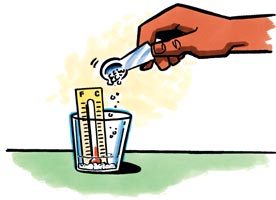
In an endothermic phase change, heat is ...
a)
taken in or absorbed
b)
given out or released
24.
Which of the following phase changes is an example of an endothermic phase change?
a)
Condensation
b)
Freezing
c)
Deposition
d)
Evaporation
25.

What is the triple point?
a)
Where the solid, liquid and gas connect.
b)
Solid, liquid and gas are equal.
c)
Between solid and gas
d)
Between solid and liquid
26.
What is the freezing point of ice?
a)
0° Celcius
b)
50° Celcius
c)
75° Celcius
d)
100° Celcius
27.
During a phase change, kinetic energy is causing which of the following to happen?
a)
the temperature goes up
b)
the particles change speed as it works against the intermolecular forces
c)
the temperature goes down
d)
intermolecular forces are absorbed
28.
Specific heat of water is 4.18 J/g°C. Specific heat of wood is 1.760 J/g°C What material needs more heat energy to raise the temperature?
a)
Water
b)
Wood
c)
Both are same
29.
Why does water NOT change temperature during phase changes?
a)
Because the molecules of water take in all the heat to their nucleus
b)
Because heat is not the same thing as temperature
c)
Because adding heat doesn't ever change the temperature of water
d)
Because all of the energy is used to overcome the attraction of molecules
30.
Find the specific heat of milk given these data:
Mass of dry cup: 3.2 g
Mass of milk and cup: 80.2 g
Tinitial = 20.5 °C
Tfinal = 2.8 °C
Final mass of milk, cup, and added water: 93.9 g
Mass of dry cup: 3.2 g
Mass of milk and cup: 80.2 g
Tinitial = 20.5 °C
Tfinal = 2.8 °C
Final mass of milk, cup, and added water: 93.9 g
a)
22.7 J/g•°C
b)
0.298 J/g•°C
c)
3.36 J/g•°C
d)
0.044 J/g•°C
31.
72.1 g of benzene is heated from 10.2 °C to 55.9 °C. How many joules was gained?
a)
9040 J
b)
550 J
c)
4290 J
d)
5500 J
32.
The force of attraction between nonpolar molecules:
a)
Hydrogen Bonding
b)
Dipole - Dipole Forces
c)
LDF
d)
Ionic Forces
33.

From 30 degrees to 55 degrees, what state of matter is the substance?
a)
Solid
b)
Liquid
c)
Gas
d)
Plasma
34.
Which of these is not an intermolecular force?
a)
covalent bonding
b)
hydrogen bonding
c)
London dispersion forces
d)
dipole-dipole forces
35.
Which IMF contains a temporary dipole?
a)
London Dispersion Forces
b)
Dipole Dipole
c)
Hydrogen Bonding
d)
Both London Dispersion Forces and Dipole Dipole
36.
What is the predominant IMF for NH3?
a)
London dispersion forces
b)
Dipole dipole
c)
Hydrogen bonding
d)
What is an IMFA?
37.
Which of the following has the highest boiling point?
a)
H2
b)
NH3
c)
N2
d)
O2
38.
Which IMF is the predominant IMF for non-polar molecules?
a)
London Dispersion Forces
b)
Dipole Dipole
c)
Hydrogen Bonding
d)
Both Dipole Dipole and Hydrogen Bonding
39.
What is the strongest IM attraction in CCl4 (non polar)?
a)
LDF
b)
dipole
c)
hydrogen bonding
40.
What is the strongest IM attraction in H2S (polar)?
a)
dispersion/Van der Waal
b)
dipole
c)
hydrogen bonding
41.
Rank the IM forces from strongest to weakest.
a)
dipole, hydrogen bonding, dispersion
b)
dispersion, dipole, hydrogen bonding
c)
hydrogen bonding, dipole, dispersion
d)
hydrogen bonding, dispersion, dipole
42.
What makes metallic bonds different from the other types of particle interactions?
a)
They are always solids at room temperature
b)
They are held together by a large pool of delocalized electrons.
c)
They are held together by covalent bonds
d)
They are held together by delocalized cations
43.
How many joules of energy does it take to boil 123 g of bromine at 63°C?
a)
23000 J
b)
3600 J
c)
8200 J
d)
2600 J
100 %

