
 Worksheets
6.E.2.3 and 6.E.2.4 - Soil Unit
Total questions: 66
Worksheet time: 38mins
Name
Class
Date
1.
Soil formation begins with the weathering of_______.
a)
Humas
b)
Subsoil
c)
Litter
d)
Rock
2.
What effect did over plowing and cutting down trees in the Great Plains during the 1930’s?
a)
It had little effect
b)
It increased soil fertility
c)
It was a primary cause of the Dust Bowl
d)
Farmers had a great harvest
3.
Decayed organic material in soil is called______.
a)
Litter
b)
Silt
c)
Humus
d)
Clay
4.
The two main factors that determine the rate of weathering are the TYPE of rock and_____.
a)
Music
b)
Climate
c)
Size of rock
d)
Weight of rock
5.
The movement of rocks and weathered materials is called_________.
a)
Chemistry
b)
Physical
c)
Weathering
d)
Erosion
6.
Soil conservation includes all of the following EXCEPT_______.
a)
Desertification
b)
Contour plowing
c)
Terracing
d)
Crop rotation
7.
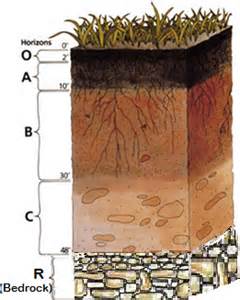
Which horizon is made up of partially weathered rocks?
a)
Horizon A
b)
Horizon B
c)
Horizon C
d)
Horizon D or R
8.
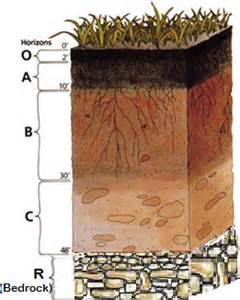
In which horizon is most of the HUMUS?
a)
Horizon A
b)
Horizon B
c)
Horizon C
d)
Horizon D or R
9.
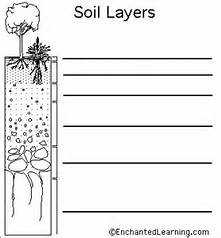
Which horizon contains clay, silt, minerals, and a little humus?
a)
Horizon A
b)
Horizon B
c)
Horizon C
d)
Horizon D or R
10.
There is an unlimited supply of fertile soil.
a)
True
b)
False
11.
Soil's one of the Earth’s most valuable resources. Everything on Earth depends on soil somehow.
a)
True
b)
False
12.

Humus is.....
a)
the dead parts of plants and animals in soil.
b)
A food we eat with pretzels.
c)
The tiny particles inside of soil
d)
The roots that come off of a plant and live in soil.
13.
Ellen grabs a topsoil sample in her hand. She rolls it into a ball. The soil feels gritty and the ball falls apart. What part of the topsoil most likely made the topsoil feel gritty?
a)
clay
b)
sand
c)
silt
d)
humus
14.
When there are not enough plants to hold topsoil in place, water and _______ carry the topsoil away, leaving the subsoil exposed
a)
sunlight
b)
birds
c)
magnetic fields
d)
wind
15.
When plants, animals, and other organisms die, they break down and become part of the soil. What is this part of the soil called?
a)
sand
b)
silt
c)
clay
d)
humus
16.
Which of the following is the largest particle in soil?
a)
sand
b)
silt
c)
humus
d)
clay
17.
Many plants cannot grow in clay soil. Why is this true?
a)
Clay soil does not have many nutrients.
b)
Roots cannot easily push through clay soil.
c)
Water doesn't drain well through clay.
d)
All of these choices.
18.
You dig a small hole in the soil and the next day it rains. The hole fills with water, but does not empty even after several days of dry weather. What is the soil mostly made of?
a)
clay
b)
sand
c)
humus
d)
silt
19.
Many plants cannot grow in sandy soil. Why is this true?
a)
Sandy soil does not hold enough water.
b)
Oxygen cannot pass through sandy soil.
c)
Roots cannot easily push through clay soil.
d)
Sandy soil has too many nutrients.
20.

Which layer of soil are these roots growing in?
a)
subsoil
b)
topsoil
21.

What is a soil problem all farmers face?
a)
soil hardening
b)
soil erosion
c)
soil spoiling
d)
soil pollution
22.
How would you describe the texture of "sandy" soil?
a)
sticky
b)
gritty
c)
smooth
d)
slimy
23.
What are some things that you can add to a compost pile?
a)
leaves, apple core, and tin foil
b)
grass clippings, banana peel, and newspaper
c)
egg shells, plastic spoon, and ziploc bags
d)
metal fork, rubber spatula, and shoelaces
24.
Where does most of the water go when it rains?
a)
in the ocean
b)
in the rivers
c)
in the gutters
d)
it absorbs into the soil
25.
Which soil horizon is the youngest?
a)
Topsoil
b)
Subsoil
c)
Parent material
d)
Bedrock
26.
What processes contribute to soil formation?
a)
Temperature and pressure
b)
Compaction and cementation
c)
Heating and cooling
d)
Weathering and erosion
27.
Which of the following is NOT considered to be soil?
a)
Gravel
b)
Sand
c)
Silt
d)
Clay
28.
A layer in the profile that has different physical properties from the other layers is called a:
a)
Soil horizon
b)
Soil profile
29.
Which soil horizon is best for supporting plant life?
a)
Horizon A - Topsoil
b)
Horizon B - Subsoil
c)
Horizon C - Weathered parent material
d)
Bedrock
30.
Which soil horizon contains lots of clay?
a)
Horizon A - Topsoil
b)
Horizon B - Subsoil
c)
Horizon C - Weathered parent material
d)
Bedrock
31.
Which soil horizon contains large rock fragments?
a)
Horizon A - Topsoil
b)
Horizon B - Subsoil
c)
Horizon C - Weathered parent material
d)
Bedrock
32.
Which soil particles have the largest pore spaces between sediments?
a)
Clay
b)
Silt
c)
Sand
33.
Which soil particles have the smallest pore spaces between sediments?
a)
Clay
b)
Silt
c)
Sand
34.
In which soil type would water drain easily?
a)
Sand
b)
Silt
c)
Clay
35.
In which soil type would water have difficulty draining?
a)
Sand
b)
Silt
c)
Clay
36.
What type of soil is a mixture of mineral matter?
a)
Sand soil
b)
Silt soil
c)
Clay soil
d)
Loam soil
37.
How is humus formed?
a)
Weathering and erosion
b)
Decomposition of organsims
c)
Chickpeas, seasoning, and water. Serve with pita or crackers.
38.
What type of soil is best for gardening?
a)
Sandy soil
b)
Silt soil
c)
Clay soil
d)
Loam soil
39.

Layers of soil are also known as:
a)
Soil Profiles
b)
Soil Horizons
c)
Soil sheets
d)
Soil cores
40.
Movement of soil and rocks from one place to another is called...
a)
weathering
b)
humus
c)
erosion
41.
The texture of soil depends mainly on
a)
the types of plants that grow in the soil.
b)
the size of the particles in the soil.
c)
the color of the soil.
d)
the number of worms in the soil.
42.
The rate at which water and air move through the soil
a)
soil horizon
b)
soil porosity
c)
soil permeability
43.
the spaces that allow air and water to move through the soil
a)
soil horizon
b)
soil porosity
c)
soil permeability
44.
Which of the following would have more porosity?
a)
sand
b)
gravel
c)
silt
d)
dust
45.

Soil sample that is 60% clay, 30% silt, and 10% sand has which texture?
a)
clay
b)
clay loam
c)
sandy loam
d)
silt
46.
What conservation method refers to forming steps in a hill to prevent water erosion?
a)
windbreaks
b)
contour plowing
c)
terrace farming
d)
strip cropping
47.
What conservation method refers to growing crops perpendicular to the slope of a hill?
a)
windbreaks
b)
contour plowing
c)
terrace farming
d)
strip cropping
48.
No-till farming is...
a)
not plowing the soil before planting new crops
b)
plowing the soil 8-12 inches deep to allow air and water to penetrate
c)
when strips of legumes and strips of row crops are planted
49.

The diagram shows two soil samples after a heavy rainstorm. Which property of soil is illustrated in the diagram?
a)
geographic origin
b)
relative porosity
c)
chemical composition
d)
nutrient content
50.

What soil conservation is this?
a)
Cover Crops
b)
Soil Conservation
c)
Crop Rotation
51.

What soil conservation technique is this?
a)
Crop Rotation
b)
Wind Breaks
c)
Contour Plowing
d)
No-Till Farming
52.
Which type of rock results from melting and cooling of magma?
a)
Igneous
b)
Metamorphic
c)
Sedimentary
d)
Extrusive
53.
Which type of rock forms from extreme heat and pressure?
a)
Igneous
b)
Sedimentary
c)
Organic
d)
Metamorphic
54.
A metamorphic rock changes into an igneous rock by what two processes?
a)
Melting and cooling
b)
Extreme heat and pressure
c)
Compaction and cementation
d)
Weathering and erosion
55.
True/False: Igneous rocks can only turn into metamorphic rocks.
a)
True
b)
False
56.
Sediment being dropped off and laid to rest
a)
Deposition
b)
Erosion
c)
Weathering
d)
Lithification
57.
Extreme Heat and Pressure creates a _________ rock.
a)
Igneous
b)
Metamorphic
c)
Sedimentary
d)
Mineral
58.
True or False: Once a rock is sedimentary, it cannot become an igneous rock.
a)
True
b)
False
59.
Fossils are only found in
a)
Sedimentary rocks
b)
Foliated Metamorphic rocks
c)
Igneous Rocks
d)
Nonfoliated Metamorphic rocks
60.

This rock formed when bits of other rocks became pressed into a solid. What type of rock is it?
a)
Sedimentary Rock
b)
Metamorphic Rock
c)
Igneous Rock
61.
How does freezing water cause the weathering of rocks? The freezing water—
a)
keeps the rocks in place
b)
makes the rocks last longer
c)
expands cracks and breaks rocks
d)
causes rocks to fall in landslides
62.
How does wind abrasion work?
a)
Sediment is blown off a surface from wind.
b)
Wind-blown sediment strikes a surface.
c)
Wind blows large chunks of rock off a surface.
d)
Sediment falls off of a surface on its own.
63.

What is mechanical weathering?
a)
Process through which rocks are physically broken into smaller pieces.
b)
Rocks are broken down through chemical changes.
c)
Rocks are worn away from acid in plant roots.
d)
Rocks broken down by machinery.
64.
Which type of climate will have faster chemical weathering?
a)
Hot and Wet
b)
Cold and Dry
c)
Hot and Cold
d)
Cold and Wet
65.

During chemical weathering, what can happen to the type of rock that has undergone chemical weathering?
a)
a new rock is produced that is larger than the original rock
b)
a new rock is produced that is the same as the original rock
c)
a new rock is produced that is different from the original rock
d)
no new rock is created - it is just smaller in size
66.
A marble statue is left exposed to the weather. Within a few years, the details on the statue have begun to weather away. This weathering probably is caused by...
a)
oxygen in the air
b)
carbonic acid in rainwater
c)
lichens
d)
abrasion
100 %

