
 Worksheets
Saltwater/Oceans
Total questions: 37
Worksheet time: 27mins
Name
Class
Date
1.
The majority of the ocean is owned by
a)
No One
b)
The US
c)
The UK
2.
What causes ocean currents in the Northern Hemisphere to curve to the right?
a)
Earth's orbit around the Sun
b)
Earth's spinning on its axis
c)
Earth's magnetic field
d)
Earth's force of gravity
3.
The highest point on a wave is:
a)
the crest
b)
the trough
c)
the top
d)
the coast
4.
The lowest point on a wave is the:
a)
Amplitude
b)
Crest
c)
Trough
d)
Wavelength
5.
The number of wavelengths that pass a point each per second is:
a)
frequency
b)
period
c)
longitudinal
d)
transverse wave
6.
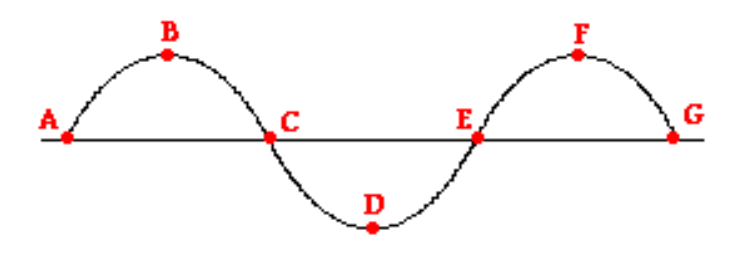
Which letter(s) represent the crest of the wave?
a)
A
b)
B & D
c)
B & F
d)
F
7.
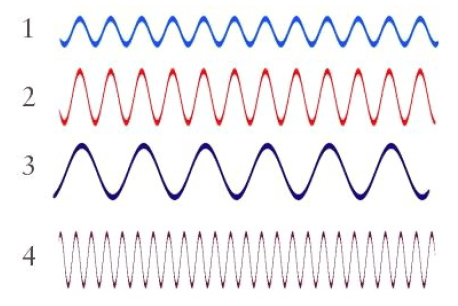
Which wave in the diagram has the greatest frequency?
a)
1
b)
2
c)
3
d)
4
8.
crest to crest or trough to trough
a)
crest
b)
trough
c)
amplitude
d)
wavelength
9.
A[n] ______________ tide occurs when the sun is at right angles to the line between Earth and the moon.
a)
high
b)
neap
c)
low
d)
spring
10.
Differences in the moon's and sun's pull on different sides of the Earth cause _________.
a)
gravity
b)
lunar phases
c)
tides
d)
dabbing
11.
A[n] ___________ tide occurs when the sun, Earth, and the moon are nearly in a line.
a)
spring
b)
high
c)
low
d)
neap
12.
Water flows toward the high tides, so halfway between the high tides are...
a)
neap tide
b)
high tide
c)
spring tide
d)
low tides
13.
A neap tide is a tide with the greatest difference between low and high tides
a)
true
b)
false
14.
Neap tides occur once a month.
a)
True
b)
False
15.
You’re on the beach at midnight. The moon is right overhead. Is the tide low or high? Why?
a)
Low tide, because the moon is so very far away.
b)
High tide because the moon is closest as it can be
16.
Why does the moon's gravitational pull have more of effect on tides than the sun's gravitational pull?
a)
they are the same
b)
the moon is larger than the sun
c)
tides are not caused by the moon
d)
the moon is closer to the Earth than the sun
17.

What type of tides would this arrangement of earth-moon-sun create?
a)
neap tide
b)
spring tide
c)
new moon tide
d)
full moon tide
18.

What type of tide would this arrangement of earth-moon-sun create?
a)
full moon tide
b)
new moon tide
c)
neap tide
d)
spring tide
19.
What causes tides?
a)
gravity
b)
wind
c)
spring
d)
neap
20.

Which body has the greater effect on Earth's tides?
a)
Sun
b)
Saturn
c)
Moon
d)
Venus
21.
At the same time the sea is drawn to the moon, another tidal bulge takes place on other side of Earth. True or False?
a)
True
b)
False
c)
Maybe
d)
I don't know!
22.
If tides alternate from high to low and there are two of each type of tide a day, about how many hours will generally be between each different tide?
a)
2 hours
b)
6 hours
c)
12 hours
d)
24 hours
23.
The Coriolis Effect is caused by
a)
Earth rotating around the sun
b)
Earth rotating on its axis
c)
The tides
d)
Gravity
24.
The Gulf stream carries _____________ water from the east coast of The United States to the West coast of Europe.
a)
Cold
b)
Warm
c)
Freezing
d)
Fresh
25.
Two types of water currents are
a)
local and global
b)
sea and land
c)
surface and deep
d)
warm and cold
26.
A strong surface current that runs along the east coast of the United States and carries warm water to Europe.
a)
California Current
b)
Global Conveyor Belt
c)
Gulf Stream
d)
Surface Current
27.
What process brings the deep cold ocean currents up to the surface?
a)
Conduction
b)
Global Wind Patterns
c)
Upwelling
d)
Temperature and salinity
28.
Deep-ocean currents are driven by
a)
differences in soil
b)
differences in the water’s density,
c)
differences in nutrients
d)
None of the Above
29.
The apparent curving of moving objects from a straight path due to Earth's rotation is called the _____________ effect.
a)
Coriolis
b)
Jupiter
c)
sun
d)
continental
30.
A dangerous current that results from a break in a sandbar is known as a
a)
longshore current
b)
global current
c)
tidal current
d)
rip current
31.
Dunes reduce beach erosion because
a)
They interrupt the movement of sand due to long shore drift
b)
The roots of dune plants hold sand in place
c)
They cause waves to break offshore
d)
They prevent people from walking on the beach
32.
In which ocean are tsunamis most common?
a)
Atlantic
b)
Indian
c)
Pacific
d)
Antarctic
33.
About how often do high tides occur in most places?
a)
Every 12 hours
b)
Every 24 hours
c)
Every other day
d)
Twice a month
34.
What is desalination?
a)
Getting the salt out of water
b)
Deposits of fine solids from waste water
c)
Cracks and spaces underground soil and rock
d)
Huge masses of ice near the North and South poles
35.
How do water particles move within a wave?
a)
Towards the top of the wave
b)
In a circular path
c)
They do not move at all
d)
Ocean organisms move the water particles
36.
There are huge changes of the amount of water between high and low tides waiting to be used as tidal power. What type of energy is this?
a)
Potential energy
b)
Kinetic energy
c)
Electrical energy
d)
Solar energy
37.
To reduce erosion along a strip of beach, you might build a short wall called a
a)
Dune
b)
Barrier beach
c)
Sandbar
d)
Groin
100 %

