
 Worksheets
Ch6/Ch10 Review
Total questions: 30
Worksheet time: 17mins
Name
Class
Date
1.
What type of energy does a washing machine have?
a)
nuclear
b)
electrical
c)
chemical
d)
potential
2.
Kinetic energy deals with ___________.
a)
position
b)
substances
c)
motion
d)
height
3.
______________ energy is potential energy.
a)
moved
b)
placed
c)
positive
d)
stored
4.
Nuclear _____________ is the combining of atoms and how the sun gets energy.
a)
fission
b)
fusion
c)
faction
d)
famine
5.
Gravitational potential energy depends on _________ and _________.
a)
mass and weight
b)
mass and gravity
c)
mass and height
d)
weight and position
6.
A solar calculator transforms radiant energy to ____________ energy.
a)
electrical
b)
chemical
c)
thermal
d)
nuclear
7.
Playing a flute transforms ________________ energy to sound energy.
a)
radiant
b)
chemical
c)
mechanical
d)
kinetic
8.
Kinetic energy depends on mass and __________.
a)
energy
b)
speed
c)
acceleration
d)
gravity
9.
Sound waves, water waves, and seismic waves are examples of __________________ waves
a)
electromagnetic
b)
electric
c)
mechanical
d)
momentum
10.
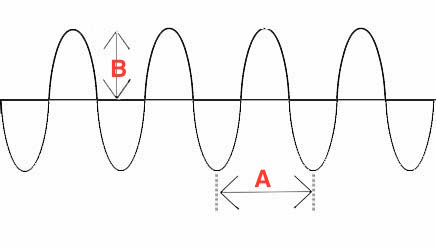
What property of this wave is represented by the letter "A"
a)
amplitude
b)
crest
c)
trough
d)
wavelength
11.
The highest point on a wave is:
a)
the crest
b)
the trough
c)
the top
d)
the amplitude
12.
The lowest point on a wave is the:
a)
Amplitude
b)
Crest
c)
Trough
d)
Wavelength
13.
The number of wavelengths that pass a point each per second is:
a)
frequency
b)
period
c)
longitudinal
d)
transverse
14.
The type of waves that require medium to pass:
a)
Mechanical Waves
b)
Electromagnetic Waves
c)
Gamma Ray Waves
d)
Infrared Waves
15.
A mechanical wave cannot travel through...
a)
a vacuum(empty space).
b)
water.
c)
air.
d)
glass.
16.
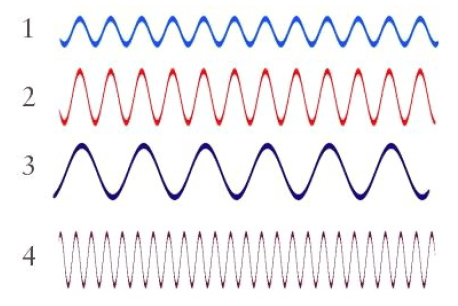
Which wave in the diagram has the greatest frequency?
a)
1
b)
2
c)
3
d)
4
17.
Regular disturbances that carry energy through matter or space
a)
crest
b)
energy
c)
wave
d)
trough
18.
When a wave strikes an object and bounces off. (example echo)
a)
medium
b)
refraction
c)
reflection
d)
interference
19.
When a wave bends as it passes through at an angle from one medium to another.(example: pencil in a glass of water-)
a)
medium
b)
refraction
c)
reflection
d)
interference
20.
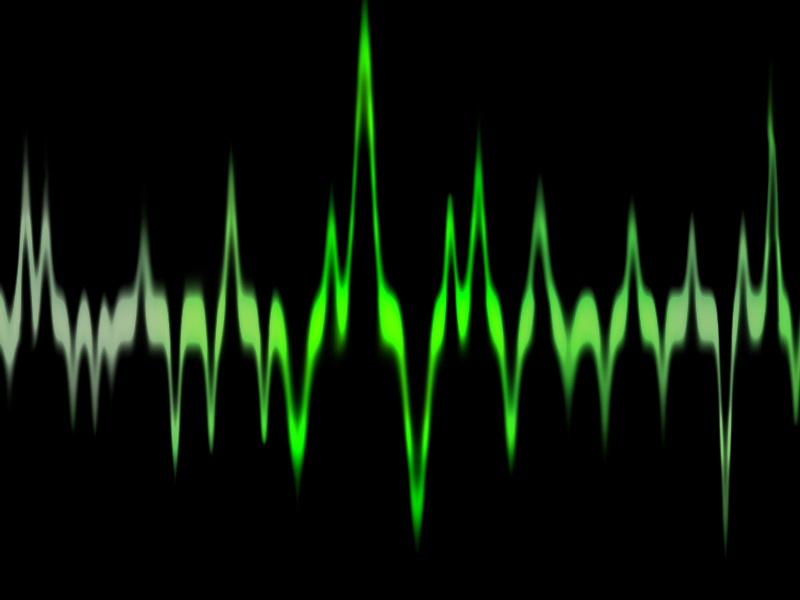
The units for frequency are measured in _____________.
a)
hertz
b)
seconds
c)
m/s
d)
m
21.
In a transverse wave, particles move...?
a)
perpendicular
b)
parallel
c)
diagonal
d)
wherever the matter's going
22.
In a longitudinal wave, the particles move...?
a)
perpendicular
b)
parallel
c)
diagonal
d)
in the direction of the hertz
23.

Which wave is pictured?
a)
Transverse
b)
Longitudinal
c)
Both
d)
Neither
24.

Letter G identifies which part of the wave?
a)
Wave Length
b)
Amplitude
c)
Trough
d)
Crest
25.
Nuclear _____________ involves the splitting of an atom to release energy.
a)
fission
b)
fusion
c)
feline
d)
faction
26.

How do you measure wavelength?
a)
From trough to crest
b)
From the crest to trough
c)
From any part of the wave
d)
From crest to crest
27.
What do waves carry from place to place?
a)
Energy, but not matter or particles
b)
Energy and matter or particles
c)
Matter or particles but not energy
d)
Neither energy nor matter or particles
28.
How are electromagnetic waves different from mechanical waves?
a)
Electromagnetic waves need a medium to travel through; mechanical waves don't
b)
Electromagnetic waves can travel through water; mechanical waves can only travel through solid matter
c)
Electromagnetic waves can travel through empty space; mechanical waves can't
d)
Electromagnetic waves are long chains of vibrating molecules; mechanical waves aren't
29.

What type of wave is shown?
a)
Longitudinal waves
b)
Transverse waves
c)
Sound waves
d)
P-waves
30.
What does it mean when a wave's amplitude increases?
a)
It is moving through a denser medium
b)
Its energy also increases
c)
Its wavelength gets longer
d)
It is carrying more particles
100 %

