
 Worksheets
Causes of the Cold War
Total questions: 93
Worksheet time: 3hrs 50mins
Name
Class
Date
1.
NATO, or the North Atlantic Treaty Organisation, is a treaty between the U.S. and other nations ...
a)
to protect one another against Communist aggression.
b)
to protect one another against slavery.
c)
to protect one another against Hitler's Fascist aggression.
d)
to protect one another against the affects of global warming.
2.
This President made the final decision to drop the atomic bomb on Japan
a)
Franklin Roosevelt
b)
Teddy Roosevelt
c)
Harry Truman
d)
Dwight Eisenhower
3.
One given justification for the use of the bomb was it would...
a)
Scare the Germans into surrender
b)
Stop the spread of Chinese Communism
c)
Save American lives lost in an Invasion of Japan
d)
Eliminate people of the lower end of the social darwinistic line
4.

The Truman Doctrine's main goal was to:
a)
Contain communism
b)
Provide weapons to democratic countries
c)
Help north Korea
d)
Provide collective security
5.

Why is the Cold War called a "cold" war?
a)
The areas affected were in the polar regions of the world
b)
The war was fought during winter months only
c)
Leaders of the superpowers were sick with coughs and fevers
d)
There was never direct fighting between the two superpowers
6.

What does NATO stand for?
a)
North Atlantic Treaty Organization
b)
North American Trade Organization
c)
Northern Alliance Trade Origins
d)
Native American Tribal Organization
7.
When was the Cold War?
a)
1950-1962
b)
1962-1991
c)
1929-1947
d)
1947-1991
8.
How did USA use the Marshall Plan to promote democracy?
a)
Containing Communism so
that it cannot spread any farther
b)
Giving money to countries
so they do not become Communist
c)
Finding ways other than
nuclear missiles to stop Communism
d)
Fighting wars by using
other countries to stop Communism
9.
What was the result of the Berlin Airlift?
a)
U.S. and Allied airplanes
delivered supplies to West Berlin for almost a year, but the Soviet Union NEVER
gave up. All of Berlin is now under
Communist rule.
b)
U.S. and Allied airplanes
delivered supplies to West Berlin for almost a year, and the Soviet Union
finally gave up and lifted the blockade.
c)
U.S. and Allied troops
crossed the border into West Berlin and defeated the Soviets.
d)
U.S. and Allied troops
crossed the border into West Berlin and were defeated by the Soviets.
10.
What was the "Iron Curtain"?
a)
The Berlin Wall
b)
Boundary to block off Soviet contact to other nations
c)
A military defense system
d)
The imaginary boundary dividing Europe into two separate areas
11.
What was the beginning of the arms race between the U.S. and Soviet Union?
a)
Soviets detonated an A-bomb in 1949
b)
Germany using an atomic weapon in WWII
c)
The United States destroying its nuclear arsenal
d)
Cuban Missile Crisis
12.
Which of the following is an example of the Marshall Plan at work?
a)
The Soviet Union blockaded the city of Berlin.
b)
The United Nations sent military forces to Korea.
c)
The United States helped France rebuild its economy.
d)
The United States set up the North Atlantic Treaty Organization.
13.
How did the United States respond to the Soviet Union’s Berlin blockade?
a)
airlifted supplies to the people of Berlin
b)
withdrew its troops from Germany
c)
sent troops into the Soviet zone of Germany
d)
built a wall between East Berlin and West Berlin
14.
The Cold War was a fight between _________________ & ____________________
a)
democracy/communism
b)
U.S./Soviet Union
c)
Allies/Soviet Union
d)
Germany/Allies
15.
How did the United States' economic system differ from the Soviet Union's economic system?
a)
The United States had a capitalist economy, and the Soviet Union had a centrally planned socialist economy
b)
The United States has a socialist economy, and the Soviet Union had a capitalist economy
c)
The United States had a barter economy, and the Soviet Union had a socialist economy
d)
The United States had a capitalist economy, and the Soviet Union had a barter economy
16.
The ideological difference between the United States and the Soviet Union resulted in which conflict?
a)
The Cold War
b)
WWII
c)
The Great War
d)
The Seven Years War
17.
What is capitalism?
a)
an economic and political system in which the
government owns all the land and most industries in
the name of the people
government owns all the land and most industries in
the name of the people
b)
an economic system that encourages citizens to own
businesses and property
businesses and property
c)
a 40-year struggle between two worldviews
d)
a contest to build more and better weapons than those
of your enemy
of your enemy
18.
What is the Cold War?
a)
a 40-year struggle between two worldviews
b)
a 1968 attack on South Vietnam
c)
limiting the production of weapons
d)
political bullying of innocent people
19.
What is the arms race?
a)
political bullying of innocent people
b)
someone who leaves his or her country to escape war
or famine
or famine
c)
a contest to build more and better weapons than those
of your enemy
of your enemy
d)
a 1968 attack on South Vietnam
20.
Why did the United States fight in Korea and Vietnam?
a)
to re-conquer land that had been theirs before
b)
to support the Allies in their struggle against Japan
c)
to stop the spread of communism
d)
to build an alliance with China
21.
What country provided the most help to North Korea in the Korean War?
a)
China
b)
the United States
c)
Japan
d)
Vietnam
22.
After World War II, the opposing political and economic systems of the United States and Soviet Union led to what outcome?
a)
the end of totalitarian dictatorships in Europe
b)
the spread of democracy in Eastern European nations
c)
the division of Europe along communist and non-communist lines
d)
the end of political alliances of European nations
23.

This chart compares two governments in the 1950s and 1960s. The differences between these two governments led to what
a)
The Cold War
b)
The Gulf War
c)
WWI
d)
WWII
24.

According to this political cartoon, why did the Soviet Union prevent access to their nations?
a)
The Soviet Union did not need the aid of Western Europe.
b)
The Soviet Union was weaker than Western Europe.
c)
They believed they needed to defend themselves from the invasion of Western Europe.
d)
They believed that the Soviet Union was less prosperous than the Western democracies.
25.
Which statement summarizes the United States' policy of containment during the Cold War?
a)
The United States refused to go to war after World War II.
b)
The United States became isolationist and avoided conflict in other parts of the world
c)
The United States focused only on the economic issues within its borders.
d)
The United States promised to defend democracy by stopping communist expansion
26.
How did the Soviet Union implement communism into countries like Poland, Romania, and Hungary?
a)
They only allowed members of the communist party to run for office.
b)
They denied free elections and installed communist governments.
c)
These countries freely elected communist leaders and governments.
d)
They assassinated any leader elected to office that was not a member of the communist party.
27.
Which country was divided at the 38th Parallel after World War II?
a)
Germany
b)
Japan
c)
Korea
d)
Italy
28.
What was the main cause of the United States' involvement in the Korean War?
a)
the fear that allowing Korea to fall to communism would cause other countries to become communist as well
b)
the desire to acquire resources and fishing markets that were lacking in the United States
c)
the desire to prevent Japan from forcing democratic rule upon Korea, a communist nation
d)
the fear that Korea was attempting to build a nuclear bomb
29.
What situation led to the start of the Vietnam War?
a)
The Vietnamese rebelled against their French rulers and asked the United States for aid.
b)
After earning independence from France, communist leaders influenced Vietnam to abandon democracy.
c)
The Soviets forced China to invade Vietnam to eliminate a democratic nation in the region.
d)
The Vietnam War began as a civil war between communist Vietnam and Nationalist Vietnam.
30.
Why was the Berlin Wall a major symbol of the Cold War?
a)
The wall became covered with poetry and art that described the conditions of the time.
b)
Despite the fact that a wall divided the city of Berlin, people still moved freely within the city
c)
The wall symbolized an "iron curtain" between the democratic west and the communist east.
d)
The wall proved that communist countries and democracies could easily work together after World War II.
31.
This is a political cartoon from the 1950s. What political idea is this cartoon referencing?
a)
anti-Semitism
b)
the communist utopia
c)
the domino theory
d)
Social Darwinism
32.
What was one result of the Chinese Civil War?
a)
Japan conquered China.
b)
China signed a trade agreement with the United States.
c)
China became a communist nation.
d)
The Soviet Union lost China as a political ally.
33.
What leader greatly influenced the spread of communism in Latin America?
a)
Santiago Cazorla
b)
Simón BolÃvar
c)
Manuel Noriega
d)
Fidel Castro
34.

These quotes are from two leaders during the Cold War. What debate is illustrated by their opposing viewpoints?
a)
the need for atomic weapons during a war
b)
democratic vs. communist governments in Eastern Europe
c)
the benefits of global alliances
d)
the establishment of the United Nations
35.
Despite being in the heart of East Germany, which statement is true about the city of Berlin have during the Cold War?
a)
Berlin was entirely democratic.
b)
Berlin was split into a communist section and a democratic section.
c)
Berlin was entirely communist.
d)
Berlin became a separate country independent of East and West Germany.
36.

Which time period is best represented by this map of Europe?
a)
During the Cold War
b)
Between World War I and World War II
c)
During the Russian Revolution
d)
Between the Renaissance and the Enlightenment
37.
How did the Truman Doctrine impact the United States' interactions with the Soviet Union?
a)
It urged the United States to stop the Soviet Union from spreading communism.
b)
It encouraged the United States to share scientific information with the Soviet Union.
c)
It led to peace negotiations between the United States and the Soviet Union.
d)
It established open trade between the United States and the Soviet Union.
38.
He was the U.S. backed leader of South Vietnam
a)
Diem
b)
Johnson
c)
Ho Chi Minh
d)
Castro
39.
He was the communist leader of North Vietnam
a)
Diem
b)
Johnson
c)
Ho Chi Minh
d)
Castro
40.
These were South Vietnamese who supported the communist north
a)
North Vietnamese Army
b)
Deferment
c)
Tet
d)
Viet Cong
41.
To avoid U.S. soldiers North Vietnam simply used which trail that went through Laos/Cambodia?
a)
Ho Chi Minh Trail
b)
Hmong Trail
c)
Laos Trail
d)
Cambodian Trail
42.
This herbicide that was used to destroy Vietnam's jungle
a)
Agent Red
b)
Agent Orange
c)
Napalm
d)
Saturation Bombing
43.
This jelly-like substance burns uncontrollably.
a)
Agent Orange
b)
Deferment
c)
Kent
d)
Napalm
44.
The U.S. got involved in Vietnam because of what foreign policy?
a)
containment
b)
Good Neighbor policy
c)
isolationism
d)
Roosevelt Corollary
45.
What was the domino theory?
a)
A Game played by soldiers
b)
A strategy for the communists to advance against US forces
c)
A reason to stop the spread of communism
d)
An app on a smart phone
46.
Who led the rebellion against France for Vietnam?
a)
Ngo Dihn Diem
b)
Ho Chi Minh
c)
President Kennedy
d)
Sui Chin
47.
Which countries were part of Indochina?
a)
Vietnam
b)
Laos
c)
Cambodia
d)
All of these
48.
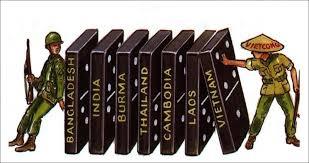
The idea that if South Vietnam fell to communism, other nations would soon follow...
a)
Vietnamization
b)
Communism
c)
Domino Theory
d)
Imperialism
49.

Allowed the public to be negatively influenced concerning the Vietnam war?
a)
Television and media bias
b)
Radio
c)
Telegraph
d)
Internet
50.
What were the first soldiers sent to Vietnam used as?
a)
spies
b)
bomb makers
c)
Advisors
d)
Snipers and assassins
51.

In Vietnam the fighters used an irregular warfare tactic that made it difficult for our soldiers to be successful...it was called?
a)
Vietnamese Warfare tactics
b)
Cheetah Warfare
c)
Hidden Warfare
d)
Guerrilla warfare
52.

The U.S. military used ______ to wipe out jungles so the North Vietnamese would have no place to hide:
a)
Agent Orange
b)
Mustard Gas
c)
Napalm
d)
All of the above
53.
What were the problems of fighting in Vietnam?
a)
Identifying the enemy
b)
Jungle/Location provided cover and a place to transport enemy supplies
c)
Weather and climate
d)
all of these
54.
What caused birth defects in babies in Vietnam and caused cancer and continues to cause ailments killing U. S. soldiers years after the war?
a)
Nuke Radiation
b)
Agent Orange
c)
Agent Blue
d)
Food poisoning
55.
Which side ended up winning the war, if not militarily, politically due to the lack of support of the civilian population?
a)
United states
b)
South Vietnam
c)
North Vietnam
d)
North korea
56.
What rule was Vietnam unified under
a)
Democratic
b)
Communist
c)
Socialist
d)
Monarchy
57.
Who helped North Vietnam during the war?
a)
US and Russia
b)
Canada and the Soviet union
c)
China and Spain
d)
Chinese and the Soviet Union
58.

According to those who supported the war, what would happen if the U.S. didn't get involved?
a)
Communism would spread to other countries
b)
Russia would invade Vietnam
c)
Vietnam would attack the U.S.
d)
China would invade Vietnam
59.

What earlier event led to the Cuban Missile Crisis?
a)
World War II
b)
The Bay of Pigs Invasion
c)
The Space Race
d)
The Spanish-American War
60.

This 1969 Arts and Music Festival was a celebration of Peace during the Vietnam War...
a)
Mile of Music
b)
National Folk Festival
c)
Woodstock
d)
Essence Music Festival
61.

After the Gulf of Tonkin incident, the U.S. responded to Vietnamese aggression with...
a)
Operation Rolling Thunder
b)
Operation Desert Shield
c)
Operation Restore Hope
d)
Operation Just Cause
62.

Where was the Ho Chi Minh Trail located?
a)
In North Vietnam
b)
In South Vietnam
c)
In Laos and Cambodia
d)
In the Mekong Delta
63.

Who was President during the Cuban Missile Crisis?
a)
Kennedy
b)
Nixon
c)
Johnson
d)
Eisenhower
64.

What helped make the Vietnam War even more unpopular with the American public?
a)
Press coverage of the war
b)
The U.S. was winning the war
c)
The U.S. planned to make Vietnam a colony
d)
The U.S. planned to split Vietnam with Russia
65.
After China pushed the US/S Koreans back to 100 miles south of the 38th parallel, MacArthur wanted Truman to order a _____________________ against China
a)
nuclear strike
b)
total war
c)
trade embargo
66.
What best describes the outcome of the Korean War?
a)
South Korea and the U.S. won, unifying a Democratic Korea
b)
North Korea and China won, unifying a Communist Korea
c)
Stalemate, with the boarder remaining at the 38th parallell
d)
The U.S. and China split Korea, each controlling a part
67.
Which country controlled the Koreas during WWII
a)
Germany
b)
Japan
c)
USSR
68.
Who was the non communist leader of South Korea?
a)
Dr. Syngman Rhee
b)
Kim Il Sung
c)
Ho Chi Minh
69.
Which one of the following is true?
a)
The was was a U.S.run mission
b)
The was a U.N. led mission
c)
The war was solely between the Koreas
70.
What year did the Korean War begin?
a)
1940
b)
1950
c)
1970
d)
1960
71.
How did the Korean War end?
a)
Peace Treaty
b)
South Korea Victory
c)
North Korea Victory
d)
Armistice
72.

Who was put in charge of the American forces in Korea and even wanted to use the atomic bomb against China?
a)
John Bassilone
b)
Douglas MacArthur
c)
Harry Truman
d)
Richard Nixon
73.

Who overthrew China during the Cold War and created a Communist government there?
a)
Miguel Gorbachev
b)
Fidel Castro
c)
Mao Zedong
d)
Ho Chi Minh
74.
____________ started the Korean War by invading ________________.
a)
N Korea/S Korea
b)
USA/N Korea
c)
China/USA
d)
China/S Korea
75.
The explosion of the 1st Soviet atomic bomb, made USSR _________. This made them want to __________.
a)
inferior/ fight back
b)
confident/ support North Korea in the Korean War
c)
stronger/ invade other countries
d)
poor/ look for more money
76.
General MacArthur defied the directives of ____________________ and the __________________, and continued to push the North Korean troops towards the Yalu River.
The Chinese forces responded and caught the UN forces by surprise.
The Chinese forces responded and caught the UN forces by surprise.
a)
US President, Truman/ UN
b)
Korean President/ UN
c)
USSR leader, Stalin / NATO
d)
USSR leader, Truman/ NATO
77.
The agreement between the US and the Soviet Union was that they would remove the missiles from Cuba if the US did what?
a)
Take missiles out of Poland
b)
Promised not to attack Cuba
c)
Promised to not attack the Soviet Union
d)
Take missiles out of the Soviet Union
78.
The ____________ were badly outnumbered during the Bay of Pigs by ___________ troops.
a)
Islanders, US
b)
Crew members, Castro's
c)
Cuba exiles, Castro's
d)
Invaders, US
79.
Who sided with Castro during the Cuban Missile Crisis?
a)
Raul Castro
b)
Dwight D. Eisenhower
c)
John F. Kennedy
d)
Nikita Khrushchev
80.
The Cuban missiles were being installed _____ miles from the shore of Florida.
a)
90
b)
100
c)
110
d)
80
81.
What did the US Navy established around Cuba?
a)
A naval blockade
b)
Bases
c)
Missiles
d)
Ship Ports
82.
What did Khrushchev want when sending the missiles to Cuba?
a)
To increase the Soviet Union's nuclear capability
b)
Aid the Cuba
c)
Aid the US
d)
To increase the US nuclear capability
83.
What was the purpose of the US blockade of Cuba?
a)
Prevent missiles and military equipment from going in
b)
Prevent missiles and military equipment from going out
c)
Torture the Cubans into submission
d)
Torture the Cubans so that they will fight the Russians
84.
How long was the conflict?
a)
12 days
b)
13 days
c)
1 week
d)
1 month
85.
Who was the leader who took power in Cuba?
a)
Joseph Stalin
b)
John Fitzgerald Kennedy
c)
Fidel Castro
d)
FDR
86.
What conflict did the Cuban Missile Crisis occur in?
a)
WW2
b)
Cold War
c)
WW1
d)
Vietnam War
87.
Where did the US have nuclear missiles?
a)
Italy and China
b)
Western Europe and Turkey
c)
Turkey and Italy
d)
Western Europe and China
88.
What is M.A.D?
a)
Missiles Are Dangerous
b)
More Action Destroyed
c)
Mutual Assured Destruction
d)
Mega Announced Disaster
89.
Why did the U.S. place missiles in Turkey?
a)
They wanted to keep the Soviet Union in check during the period of Cold War
b)
The US had too many missiles, that they didn't have enough storage
c)
The US wanted a place close to Cuba so they could easily destroy Cuba
d)
They wanted to test the missiles in Turkey
90.
Why did the US blockade Cuba?
a)
Cuba betrayed the US by suprise attacking the US
b)
They sent a bomb to the US and bombed the US
c)
The US hated Cuba
d)
The US discovered Soviet missiles in Cuba
91.
What ended the Cuban Missile Crisis?
a)
The USSR removes missiles and the US leaves Cuba alone.
b)
The US uses all of their missiles and destroys Cuba
c)
Cuba forfiets
d)
JFK got tired of fighting and just made a treaty
92.
What is an embargo?
a)
A tax on imports
b)
A limit on the number of goods that can be imported into a country.
c)
When one country stops trading with another country in order to put pressure on their government.
d)
When the government tells businesses what and how much to produce.
93.
The Bay of Pigs happened on _____________.
a)
January, 1961
b)
April, 1961
c)
February, 1961
d)
March, 1961
100 %

