
 Worksheets
Probability and Simulations
Total questions: 27
Worksheet time: 1hrs 1mins
Name
Class
Date
1.
Which is the best way to simulate choosing one student out of 12 to be the class president?
a)
roll a die and flip a coin
b)
roll a die
c)
spin a spinner with 4 sections
d)
flip a coin
2.
The questions on a multiple choice test each have 6 answer choices. Which model can be used to simulate randomly selecting the correct answer on a 20 question multiple choice test?
a)
rolling a six-sided number cube 6 times
b)
rolling a six-sided number cube 20 times
c)
spinning a spinner with 4 equal sized sections 4 times
d)
choosing 1 marble in a bag of 20 different colored marbles
3.
The probability of it raining today is 30%. What is the probability that it will NOT rain?
a)
30%
b)
70%
c)
100%
d)
0%
4.
Probability can be written as ...
a)
a fraction
b)
a decimal
c)
a percent
d)
all of the above
5.

P(not A) =
*Remember to simplify.*
*Remember to simplify.*
a)
6/8
b)
3/4
c)
2/8
d)
1/4
6.
A jar contains 2 green marbles, 4 blue marbles, 3 yellow marbles, and 2 black marbles. A marble is chosen at random from the jar and replaced. Then a second marble is chosen at random. Find the probability of the first marble being green and the second marble being yellow.
a)
4/121
b)
8/121
c)
3/121
d)
6/121
7.
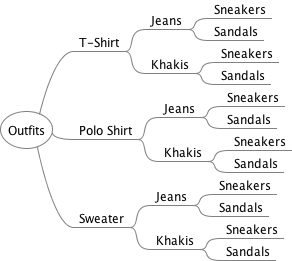
How many total outfit options are represented?
a)
12
b)
22
c)
3
8.

You roll a six sided die. What is the probability of rolling an even number three times in a row?
a)
3/100
b)
1/2
c)
1/6
d)
1/8
9.

P(2 then 5) =
a)
1/6
b)
1/12
c)
1/36
10.
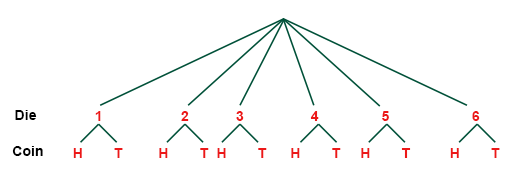
The tree diagram shows the outcomes of rolling a die and flipping a coin.
What is the probability of rolling an even number and flipping a head?
What is the probability of rolling an even number and flipping a head?
a)
3/12
b)
1/2
c)
4/12
d)
0/12
11.

a)
1/4
b)
1/8
c)
1/2
d)
1/6
12.

a)
1/2
b)
1/8
c)
1/3
d)
1/12
13.
Max rolls a number cube 5 times. Below is the data from his experiment. Find the experimental probability that the next roll Max makes will be a 1?
Outcomes: 1, 3, 3, 4, 4
Outcomes: 1, 3, 3, 4, 4
a)
3/5
b)
1/6
c)
2/5
d)
1/5
14.

What is the relative frequency of getting TT?
a)
1/5
b)
2
c)
7/10
d)
1/2
15.

Find the probability that a point chosen at random inside the figure shown is in the shaded area. (11-2)
a)
2/15
b)
11/15
c)
4/15
d)
1/15
16.
What is the probability of getting a factor of six or a five when rolling a fair number cube one time?
a)
1/6
b)
1/2
c)
5/6
d)
1/3
17.
What is an outcome?
a)
The result of an experiment
b)
The chance or likelihood of an event
c)
A fraction, decimal, or a percent
d)
An activity that gives various results
18.
A set of all possible outcomes is known as -
a)
a list
b)
a complement
c)
a sample space
d)
an event
19.

You pick a marble from this bag.
What is the probability you will choose either a black or white marble?
What is the probability you will choose either a black or white marble?
a)
3/5
b)
9/100
c)
1/10
d)
2/5
20.
A bag contains:
• 5 red marbles
• 6 blue marbles
• 3 green marbles
• 4 black marbles
• 2 yellow marbles
A marble will be drawn from the bag and replaced 100 times. What is a reasonable prediction for the number of times a green or black marble will be drawn? (Hint: Use a Proportion)
a)
14
b)
65
c)
7
d)
35
21.
The tree diagram shows the outcomes of rolling a die and flipping a coin.
What is the probability of rolling a number higher than 3 and flipping a tails?
What is the probability of rolling a number higher than 3 and flipping a tails?
a)
1/12
b)
2/12
c)
3/12
d)
4/12
22.
A sportswriter wants to know how strongly Toledo residents support the Toledo MudHens baseball team. She stands outside the stadium one summer day to interview the first 20 people that enter the stadium. The population for this survey is...
a)
all people at the game
b)
all MudHens fans
c)
all Toledo residents
d)
everyone in the world
23.
_________ is a sample in which each individual or object in the entire population has an equal chance of being selected.
a)
Sample
b)
Population
c)
Random Sample
d)
Quartile
24.
At a middle school, the 7th graders will conduct a survey for where to go on a field trip. Which method will result in the least biased decision?
a)
to randomly ask 8th grade students who went on a field trip last year
b)
to randomly choose some 7th grade students to select a location
c)
to ask all 7th grade teachers and administrators for a location
d)
to ask the student council to choose a location
25.
The entire group studied is called the
a)
sample
b)
population
26.
Zoie completes a report by asking 70 students across campus. She wants to know how many Middle school students do not wash their hands after using the bathroom. What is the sample size?
a)
washing their hands
b)
Zoie
c)
70 randomly selected students
d)
Middle school students
27.
Increasing the sample size of an experiment will reduce the
a)
bias of the estimates made from the data collected.
b)
variability of the estimates made from the data collected.
c)
probability of the event occurring.
d)
relative frequency of the event occurring.
100 %

