
 Worksheets
Clouds and Wind
Total questions: 25
Worksheet time: 13mins
Name
Class
Date
1.

Which cloud is this?
a)
cumulus
b)
cumulonimbus
c)
cirrus
d)
stratus
2.
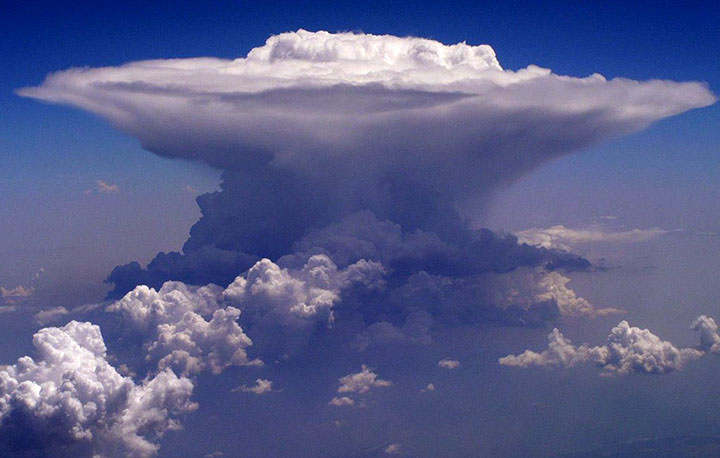
Which cloud is this?
a)
cumulus
b)
cumulonimbus
c)
cirrus
d)
stratus
3.

Which cloud is this?
a)
cumulus
b)
cumulonimbus
c)
cirrus
d)
stratus
4.

What type of cloud is this? Middle altitude, not much rain
a)
Altostratus
b)
Cumulonimbus
c)
Altocumulus
d)
Stratocumulus
5.

What type of cloud is this? A combination of two types
a)
Altocumulus
b)
Fog
c)
Nimbostratus
d)
Stratocumulus
6.
Which statement best explains how wind is formed?
a)
Air is warmed by radiation and airflow increases as a result of the warming.
b)
Pressure decreases as a result of frictional contact with earth causing air to flow more freely.
c)
Unequal heating of the land causes air to flow from areas ofhigher pressure to areas of lowerpressure.
7.
Which best describes why winds at the beach change direction between day and night?
a)
because the temperatures over land and over water change
b)
because warm air over land sinksand stays in place over land
c)
because cool air rises and isreplaced by warm air from the ocean
d)
because cool air sinks and staysin place over land
8.
Which best describes why wind movement is predictable?
a)
Air moves from areas of low altitude to areas of high altitude.
b)
B. Air moves from areas of high pressure to low pressure.
c)
C. Air moves from areas of low pressure to high pressure.
9.
Which term best describes the type of wind which would most likely be present while playing on a sunny beach during the day?
a)
hurricane
b)
land breeze
c)
sea breeze
10.
Which conditions will result in high winds?
a)
large differences in air pressure
b)
heavy rains over several days
c)
increase in evaporation rates
d)
presence of cirrus clouds
11.
How does the jet stream affect weather conditions around the world?
a)
The strong wind current of the jetstream pushes weather systems around the world.
b)
The weak wind current of the jetstream redirects weather systems around the world.
c)
The strong wind current of the jet stream prevents weather systemsfrom moving around the world.
12.
Which describes a wind that moves from the land to the sea overnight?
a)
land breeze
b)
sea breeze
c)
trade winds
13.
If you wanted to visit an area with very little wind, where might you go?
a)
The doldrums around the equator
b)
the jet streams in the northern and southern hemisphere
c)
the North or South Pole
d)
the area around the Mediterranean Sea
14.
When Earth's rotation causes the wind to curve
a)
cloudy
b)
Coriolis effect
c)
high pressure
d)
low pressure
15.
The Jet Stream is a wind in the upper troposphere that moves from ____.
a)
North to South
b)
East to West
c)
West to South
d)
West to East
16.
Low pressure zones near the equator are known as ____.
a)
Westerlies
b)
Easterlies
c)
Jet Streams
d)
Doldrums
17.
Winds that blow from the east are called ____.
a)
Polars
b)
Westerlies
c)
Easterlies
d)
Temperates
18.
What is the warming of Earth's atmosphere by gases like carbon dioxide and water vapor trapping the Sun's energy called?
a)
the Greenhouse effect
b)
the Coriolis effect
c)
prevailing westerlies
d)
Gulf Stream
19.

What kind of breeze is this and when would it form?
a)
Land breeze - daytime
b)
Land breeze - nighttime
c)
Sea breeze - daytime
d)
Sea breeze - nighttime
20.
What causes warm air to rise?
a)
the fact that it's less dense than cold air
b)
The fact that it weighs more than cold air
c)
The fact that it has higher pressure than cold
d)
the fact that its more dense than cold air
21.
Clouds are formed by _____________.
a)
evaporation
b)
precipitation
c)
condensation
d)
clouds don't form they are always there
22.
Meteorologists name wind based on the direction the wind is COMING FROM
a)
Yes
b)
No
c)
Sometimes
23.
Water is absorbed by the plant through the roots, and transpiration takes place as the water exits the ________.
a)
Leaves
b)
Roots
c)
Stem
24.
What cycle is transpiration a part of?
a)
The water cycle
b)
The life cycle
c)
The bicycle
25.
What is transpiration?
a)
Excess water being released from the leaves
b)
Excess sugar being released from the leaves
c)
The way a plant makes its food
d)
When the plant uses sugar for energy
100 %
![FINAL EXAMS | [HARD] Grammar Practice Quiz](https://cf.quizizz.com/image/image-loader.svg)
