
 Worksheets
LHS Evolution Theory
Total questions: 20
Worksheet time: 20mins
Name
Class
Date
1.

T1. Farmers breed cows to produce high amounts of milk. This is an example of...
a)
Natural Selection
b)
Variations in a species
c)
Selective Breeding
2.
T1. Lamarck’s ideas about evolution include the concept that differences among the traits of organisms arise as a result of
a)
continual increases in population size.
b)
the actions of organisms as they use or fail to use body structures.
c)
an unchanging local environment.
d)
the natural variations already present within the population of organisms.
3.
T1. Where the better adapted organisms survive to pass traits along to offspring.
a)
Evolution
b)
Natural Selection
c)
Extinction
d)
Artificial Selection
4.

T1. This salamander did not use its eyes so it lost its vision, Who said if you don't use it you lose it?
a)
Darwin
b)
Lamarck
c)
Malthus
5.

T2. Which process produced the two different types of beaks in the ground finch and the tree finch?
a)
artificial selection
b)
geographical distribution
c)
natural selection
6.
T2. What is natural selection?
a)
Your natural fate is decided from birth
b)
Nature actively chooses who surivives
c)
Those best suited to demands of environment survive
d)
The weakest of a species survive
7.
T2. In natural selection, the selective agent is the
a)
humans
b)
mutations
c)
breeders
d)
environment
8.

T3. Which best defines homologous structures
a)
structures with same function different ancestors
b)
reduced form of a structure indicating shared ancestry
c)
adapting to surrounding
d)
similar structures inherited from a common ancestor
9.

T.3 This image shows that
a)
These animals have no simliarities in their structures.
b)
two different species may have evolved from a common ancestor.
c)
These animals are from the same species.
d)
These animals likely evolved from different ancestors due to their differences.
10.
T3. This kind of structure is when the structures have the same function but have a different structure. (bird wings and bat wings)
a)
analogous structure
b)
homologous structure
c)
vestigial structure
11.
T3. This kind of structure are body parts that have no function now and are now the remains from an ancestor.
a)
analogous structure
b)
homologous structure
c)
vestigial structure
12.
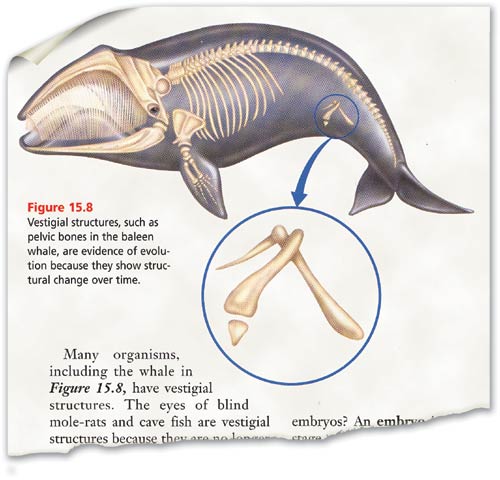
T3. Which of the following is an example of a vestigial structure?
a)
the wings of a red-tailed hawk
b)
the hind limbs of a house cat
c)
the fins of sharks
d)
the tailbone of a human
13.
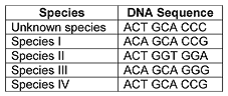
T4. According to this data, the unknown bacterial species is most closely related to:
a)
Species I
b)
Species II
c)
Species III
d)
Species IV
14.
T4. When you compare DNA or proteins to support evolution, you are using what kind of evidence?
a)
anatomical evidence
b)
molecular evidence
c)
fossil evidence
15.
T4. There are three species of birds on an island. Bird A has a heavy bill for eating seeds. Bird B has a pointed bill for eating insects. Bird C has a sharp bill for eating both insects and seeds. If all insects on the island suddenly disappeared, which bird or birds would be the LEAST affected?
a)
Bird A
b)
Bird B
c)
Bird C
d)
Bird A and Bird B
16.

T4. Two organisms that are closely related would have
a)
very similar DNA sequence
b)
exactly the same DNA sequences
c)
no proteins in common
d)
completely different DNA sequence
17.
T4. If two organisms have similar traits of DNA they are probably
a)
share a common ancestor
b)
share a common environment
c)
share a common population
d)
speciation
18.
T4. If species A and B have very similar genes and proteins, what is probably TRUE?
a)
species A and B share a relatively recent common ancestor
b)
species A evolved independently of species B for a long period
c)
species A is younger than species B
d)
species A is older than species B
19.

T4. The image shows an example of..
a)
vestigial structure
b)
analogous structure
c)
homologous structure
20.

T5. Which type of evidence is illustrated in this picture
a)
fossil evidence
b)
molecular
c)
anatomical
d)
embryological
100 %

