
 Worksheets
Study Guide
Total questions: 53
Worksheet time: 39mins
Name
Class
Date
1.
Constantinople led to Byzantine success because...
a)
Had invulnerable defenses and was militarily importnat
b)
Was at a crossroads between Asia and Europe
c)
Economically important through trade
d)
fr4099999999999999999999999999999999999999999999999999999999999999999999999999990\0000000000000000000000000000000000000000000000000000000000000000-0000000000000000000000000------------------------------------------------------------------------------------------------------------------------------------------------------------------------------------------------------------------------------------------------------------4 444444444444444444444444444444444444444444444444444444444444444444444444444444444444444444444444444444444444444444444444444444444444444444444444444444444444444444444- 0-00000000000000000000000000000000000000000000000000000000000000000000000000000000000000000000000000000000000000000000000000000000000000000000000000000000000000000000000000000000000000000000--00000All of the above
2.
How did the emergence of medieval feudalism in Europe influence the Christian Church?
a)
The Church encouraged voyages
of exploration.
b)
The Church published the Bible in
the vernacular.
c)
The Church adopted Latin as the
official language.
d)
The Church served as the
unifying power in society.
3.
Which of the following changes occurred in western Europe during the Middle Ages?
a)
rise in rural population
b)
rise in urban population
c)
decrease in church power
d)
increase in international trade
4.
Which empire came to an end as a result of the capture of Constantinople by the Ottoman Turks?
a)
the Seljuk Empire
b)
the Safavid Empire
c)
the Byzantine Empire
d)
the Mongolian Empire
5.
Which empire came to an end as a result of the capture of Constantinople by the Ottoman Turks?
a)
the Seljuk Empire
b)
the Safavid Empire
c)
the Byzantine Empire
d)
the Mongolian Empire
6.
A major goal of the Catholic Church during the Crusades (1096-1291) was to –
a)
Unite Arab peoples
b)
Establish Christianity in Western Europe
c)
Capture the Holy Land from Islamic rulers
d)
Strengthen the power of European rulers
7.
Which is the most valid generalization about the impact of the Crusades?
a)
They strengthened the power of the serfs in Europe
b)
They increased trade between Europe and Asia
c)
They brought European influence to Asia
d)
They promoted the idea of religious freedom
8.
What title was given to Charlemagne by the Pope in 800 AD?
a)
King of England
b)
Holy Roman Emperor
c)
Head of the Eastern Orthodox Church
d)
None of the above
9.
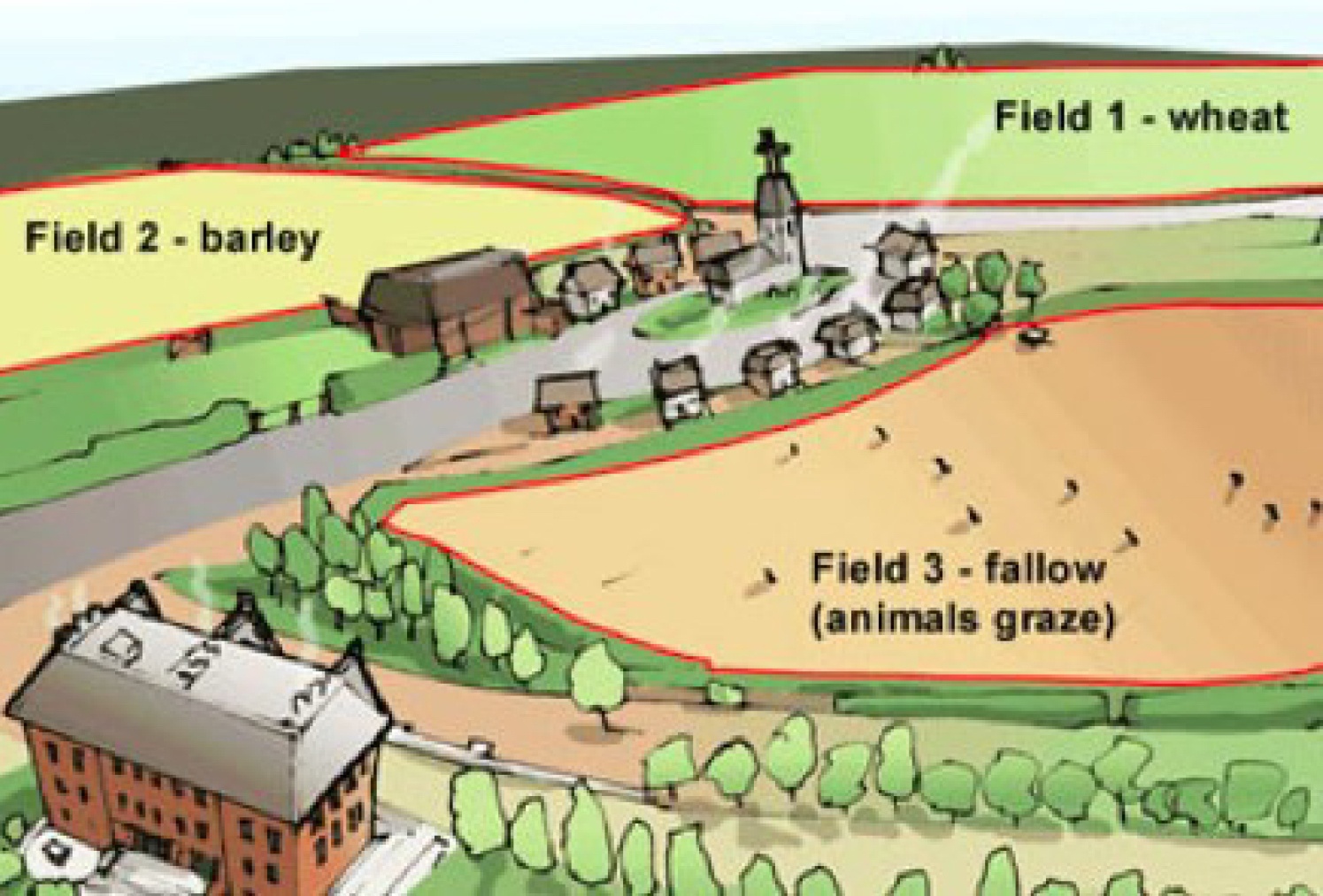
The picture above best describes which medieval farming technique?
a)
Three-field system
b)
Crop rotation
c)
Irrigation
d)
pig farming
10.
The barbarian group, the Goths, encouraged a new form of architecture called?
a)
Classic
b)
Roman
c)
Romanesqe
d)
Gothic
11.
The barbarian group, the Goths, encouraged a new form of architecture called?
a)
Classic
b)
Roman
c)
Romanesqe
d)
Gothic
12.
Which group of people can be classified as fierce warriors that are known for their ship building and navigation?
a)
the Moors
b)
the Vikings
c)
Muslims
d)
Anglo/Saxons
13.
Which is NOT an accomplishment Charlemagne can be associated with?
a)
reclaiming civilization after barbarian invasions
b)
the feudal system
c)
promoting Eastern Orthodox
d)
encouraging learning
14.
Catholics and the Eastern Orthodox were the two main factions of Christianity. How do the two differ?
a)
Orthodox is monotheistic while Catholic is polytheistic
b)
Catholic is headed by a Patriarch while Orthodox is controlled by the Pope
c)
Orthodox has priests while Catholic has shaman
d)
Orthodox is headed by a Patriarch while Catholic is controlled by the Pope
15.
Why was the time immediately following the fall of Rome called the Dark Ages?
a)
Emperors kept tight control of the people.
b)
There was little formal education for the masses.
c)
Artwork from Greece, not Rome, survived.
d)
There was no building being done.
16.
The medieval Church was a unifying force in Europe after the fall of Rome because it offered:
a)
indulgences for sinners
b)
stability and security
c)
redistribution of wealth
d)
multiple sets of beliefs
17.
Which of the following best completes the graphic? CAUSE----->EFFECT
a)
Feudalism develops in medieval Europe - Invaders overrun the Roman Empire
b)
Invaders overrun Roman Empire - Council of Nicaea sets tenets for church
c)
Roman army cannot defend the empire - Rome falls and feudalism develops
d)
Council of Nicaea sets Christian tenets - Catholic Church becomes powerful
18.
Which of the following is the MOST accurate comparison of the early medieval period in Europe compared to the preceding period?
a)
Early medieval Europe was characterized by less local autonomy and cultural diversity.
b)
Early medieval Europe was characterized by greater emphasis on the arts.
c)
Early medieval Europe was characterized by greater scientific achievement.
d)
Early medieval Europe was characterized by less stability and progress.
19.
All of the following are factors in the decline of the Roman Empire EXCEPT—
a)
loss of morals and values
b)
corrupt governments
c)
population growth
d)
hostile invasions
20.
Which of the following groups had the MOST political power?
a)
vassals
b)
serfs
c)
lords
d)
knights
21.
What is the historical significance of Justinian's Law Code?
a)
It served as the first written legal constitution.
b)
It promoted the idea of the king as the primary legal authority.
c)
It introduced the ideas of legalism and retribution for crimes.
d)
It preserved the Roman legal customs for later Western civilizations.
22.
-Begun during the Roman Empire -Started as an offshoot of Judaism -Spread throughout the Roman Empire -Promoted the idea of salvation for all -Became the most powerful influence in medieval Europe Which of the following is the best title for the above list?
a)
Origins, Ideas, and Spread of Christianity
b)
Reasons for the Spread of Christianity
c)
History and Development of Feudalism
d)
Origins and Spread of Islam
23.
_____________ is a political/social system and _____________ is an economic system.
a)
Middle Ages…feudalism
b)
manorialism…feudalism
c)
feudalism…manorialism
d)
Roman Empire…feudalism
24.
-Begun during the Roman Empire -Started as an offshoot of Judaism -Spread throughout the Roman Empire -Promoted the idea of salvation for all -Became the most powerful influence in medieval Europe Which of the following is the best title for the above list?
a)
Origins, Ideas, and Spread of Christianity
b)
Reasons for the Spread of Christianity
c)
History and Development of Feudalism
d)
Origins and Spread of Islam
25.
How did the Frankish king Clovis contribute to the spread of Christianity in the early Middle Ages?
a)
His conversion spread Christianity to the Germanic states.
b)
His crowning marked the beginning of the Holy Roman Empire.
c)
His missionary journeys brought Christianity to the British Isles
d)
His support of the Crusades gave the Roman Catholic Church more power.
26.
All things were under its domain as the most powerful institution during the Middle Ages...
a)
The Germanic Monarchs
b)
The Church
c)
The Medieval Lords
d)
The knights' authority
27.
Middle Age knights followed a code of conduct called...
a)
Bushido
b)
Honor
c)
Chivalry
d)
Code of Justinian
28.
How did Germanic people learn about Christianity?
a)
They read the bible
b)
The didn't
c)
By going to school
d)
From christian missionaries
29.
When a Pope crowned a king what form of unity was created?
a)
All churches were unified
b)
The church and government were unified
c)
The governments all worked together
d)
All Germanic Tribes were unified
30.
Castles provided what?
a)
Protection for lords and peasants
b)
Protection just for lords
c)
no protection at all
d)
A fancy place to have church service
31.
Who served both the social and religious needs of Medieval people?
a)
Kings
b)
Knights
c)
Lords
d)
Catholic Priests
32.
This institution gave Europeans unity and stability after the fall of Rome...
a)
The Roman Catholic Church
b)
Islam
c)
Frankish Monarchy
d)
Germanic Government
33.
The economy of the Middle Ages (work for protection) centered on what living arrangement?
a)
Capitalism
b)
Manors
c)
Personal farms
d)
Trade
34.
Medieval society was based on all of the following EXCEPT...
a)
Germanic Customs
b)
Roman Heritage
c)
Christian Beleifs
d)
Ending Feudalism
35.
Which Frankish king was crowned by the Pope, uniting their powers?
a)
Charlemagne
b)
King John
c)
King Henry
d)
St. Cyril
36.
Feudalism was necessary because central governments lost power. What resulted from this situation?
a)
People left feudal society
b)
Serfs revolted against powerful nobles
c)
People entered into agreements with landowning lords
d)
Lords freed their serfs
37.

What is going on in this picture?
a)
Serfs do work for lords who protect them
b)
Lords work for serfs
c)
Serfs owned their own land
d)
knights worked the land when they weren't fighting
38.
Christian monasteries did all of the following except...
a)
Provide shelter for travelers
b)
Care for the sick and needy
c)
copy books/
manuscripts
manuscripts
d)
enforce laws
39.
How did Charlemagne create a large empire?
a)
He tolerated all religions
b)
Fighting/
military/
conquest
military/
conquest
c)
He made treaties with all of his enemies
d)
He broke away from his alliance with the church
40.
After Rome, ______ invaders disrupted trade creating a need for Feudalism in Europe.
a)
Asian
b)
African
c)
Greek
d)
Germanic
41.
The economy of a medieval manor depended on...
a)
Trade
b)
Herding and weaving
c)
Farming and self-sufficiency
d)
arts and crafts
42.
Feudal agreements were between...
a)
Kings and the church
b)
Lords and their vassals(lower lords)
c)
traders and merchants
d)
serfs and their peasants
43.
Charlemagne was the king of which powerful Germanic tribe?
a)
Saxons
b)
Goths
c)
Franks
d)
Jutes
44.
Charlemagne did all of the following except...
a)
create a strong efficient governments
b)
create schools
c)
spread Christianity
d)
end slavery/ serfdom
45.
The Pope crowned Charlemagne in 800 AD. Who had more power?
a)
The Pope
b)
Charlemagne
c)
They had equal power
d)
Neither had much power
46.
The Pope crowned Charlemagne in 800 AD. Who had more power?
a)
The Pope
b)
Charlemagne
c)
They had equal power
d)
Neither had much power
47.
Like Byzantine emperors, Charlemagne gained power by unifying...
a)
All of the Germanic people
b)
All religions
c)
His government and the Church
d)
Eastern Europe
48.
If you disobeyed church rules you were kicked out and not allowed into heaven. What's this called?
a)
Slavation
b)
Ordination
c)
Excommunication
d)
Denunciation
49.

The area in yellow is called Scandinavia. Who came from there?
a)
Vikings
b)
Chinese
c)
Franks
d)
Eskimos
50.
These 2 Germanic groups settled in England...
a)
Angles and Saxons
b)
Franks and Visogoths
c)
Angles and Franks
d)
Magyars and Vikings
51.

Which group on the map (in green) settled in Eastern Europe/Hungary?
a)
Vikings
b)
Angles
c)
Saxons
d)
Magyars
52.

Which group of sailors migrated from Scandenavia to Russia?
a)
Magyars
b)
Saxons
c)
Vikings
d)
Slavs
53.
Which group of sailors migrated from Scandinavia to Russia?
a)
Slavs
b)
Angles
c)
Vikings
d)
Saxons
100 %

