
 Worksheets
Succession + Dich. Key + Adaptations + Natural Selection
Total questions: 32
Worksheet time: 26mins
Name
Class
Date
1.
Pioneer species are the first species to populate an area. How do they get to that area usually?
a)
Water only
b)
Magic
c)
Wind AND Water
d)
Sunshine AND Nitrogen Cycle
2.
This type of succession occurs after a volcano erupts or a glacier recedes...
a)
Apex succession
b)
Primary succession
c)
Secondary succession
d)
Tertiary succession
3.
The series of changes that occurs in an area where the ecosystem has been disturbed, but where soil and organisms still exist
a)
Primary succession
b)
Secondary succesion
c)
Tertiary succession
d)
Climax community
4.
Which type of succession occurs more rapidly?
a)
Primary succession
b)
Secondary succession
5.
This type of succession occurs after a fire, tornado, hurricane, or even logging...
a)
Climax community
b)
Primary Succession
c)
Secondary Succession
d)
Tertiary Succession
6.
This may take hundreds or thousands of years
a)
Pioneer species
b)
Ecosystem
c)
Primary community
d)
Climax community
7.
A climax community is
a)
when primary succession begins
b)
when herbivores first come into an ecosystem
c)
when secondary succession begins
d)
when an ecosystem has completed secondary succession and has become a mature community with large tree and predators
8.
The series of changes that occurs in an area where no soil or organisms exist is called this
a)
succession
b)
primary succession
c)
secondary succession
d)
climax community
9.
Typical pioneer species are
a)
Mosses and lichens
b)
Ferns and Roses
c)
Grasses and Shrubs
d)
Animals and humans
10.
Which of the following characteristics will most likely be helpful in identifying a butterfly using a dichotomous key?
a)
Migrates north every spring
b)
hangs on branches
c)
flutters wings fast on hot days
d)
Wings have long extensions
11.

An illustration and a dichotomous key are given. What is the correct classification for this organism?
a)
Class Insecta
b)
Order Amblygygi
c)
Order Araneae
d)
Order Scorpiones
12.
What step do we always start with when using dichotomous keys?
a)
1
b)
2
c)
3
d)
4
13.
When using a dichotomous key to identify organisms, what do we look at?
a)
physical features
b)
weather patterns
c)
environment
d)
diet
14.

A table of arachnid and insect characteristics is shown. Which characteristic could be used to distinguish between
arachnids and insects?
arachnids and insects?
a)
Jointed legs
b)
Body segments
c)
Presence of eyes
d)
Presence of antennae
15.

Why might some plants have thorns?
a)
to stay safe from animals that want to eat the plant
b)
to attract insects that spread pollen to other plants
c)
to take in nutrients from the air
d)
to provide shade for the plant
16.
Some grasses grow in hot dry areas. Why might they grow deep roots?
a)
to protect the plant from sun damage
b)
to take in as much light as possible
c)
to spread seeds to new places
d)
to reach water down below
17.

Coloring or another physical characteristic that help an organism blend in with its environment
a)
mimicry
b)
camouflage
c)
hibernation
d)
migration
18.
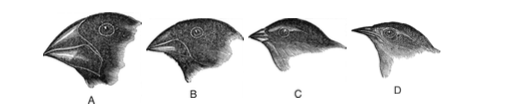
Base your answer(s) to question(s) on the diagram below and on your knowledge of biology. The diagram shows the heads of four different species of Galapagos Islands finches.
The four different types of beaks shown are most likely the result of
The four different types of beaks shown are most likely the result of
a)
gene manipulation
b)
natural selection
c)
unchanging environmental conditions
d)
patterns of behavior learned from parents
19.
"Survival of the Fittest" describes which theory
a)
a) natural selection
b)
b) gravity
c)
c) heredity
d)
d) string theory
20.
What is the advantage of having different shaped beaks?
a)
To look different from other species.
b)
To be able to eat the food readily available in the environment.
c)
To protect itself against predators.
d)
To protect itself against prey.
21.
Why are advantageous traits more likely to be passed onto offspring?
a)
Because they are more likely to survive and reproduce.
b)
Because they come from dominant alleles.
c)
Because they come from recessive alleles.
d)
Because the trait is an acquired phenotype.
22.
What do we call traits that increase an individual's chance to survive and reproduce?
a)
Maladaptations
b)
Adaption
c)
Variations
d)
Adaptations
23.
Why do some organisms hibernate?
a)
To get some rest
b)
To escape harsh winters and maintain homeostasis
c)
To be the bearer of bad news
d)
To strive for greatness with rest
24.
What is a reason why people want to engage in selective breeding?
a)
To generate desired traits in the organism's offspring
b)
To generate wealth and freedom
c)
To generate freedom only
d)
To generate more offspring for themselves
25.
What is the purpose of xylem in plants?
a)
to transport water through out the plant
b)
to remove water through out the plant
c)
to generate water through out the plant
d)
to give off more water through out the plant
26.
Why do birds need the adaptation of hollow bones?
a)
to fly
b)
to live
c)
to reproduce
d)
to run
27.

When there is higher biodiversity
a)
more organisms are likely to die because they can't adapt to environmental changes.
b)
there is less diversity.
c)
there is more diversity and higher sustainability of life.
d)
there is more diversity and lower sustainability of life
28.

How do biodiversity and sustainability work together?
a)
The lower the biodiversity the greater the sustainability.
b)
The higher the biodiversity, the less sustainable the ecosystem
c)
The higher the biodiversity, the greater the sustainability.
d)
Biodiversity has nothing to do with sustainability.
29.

Type of forest biome near the equator; receives a lot of rain; temperatures are warm all year.
a)
desert
b)
tropical rain forest
c)
arctic
d)
temperate rain forest
30.

Northern biome with many coniferous trees; very cold temperatures in the winter months.
a)
Taiga
b)
tundra
c)
desert
d)
temperate rain forest
31.

Cold, dry biome where the soil stays frozen the entire year. Very little precipitation.
a)
savannah
b)
taiga
c)
tundra
d)
desert
32.

Biome with many different species of cacti and reptiles and very little rainfall.
a)
Desert
b)
Temperate Rainforest
c)
Tropical Rainforest
d)
Tundra
100 %

