
 Worksheets
Reproduction in Human
Total questions: 13
Worksheet time: 12mins
Name
Class
Date
1.
When is ovulation most likely to occur?
a)
About halfway between the start of one menstruation and the next
b)
At the start of menstruation
c)
1-5 days before the start of menstruation
d)
5-10 days after the start of menstruation
2.
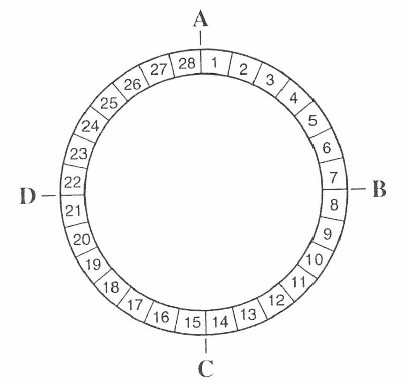
The diagram shows the 28 days of the menstrual cycle. When does the lining of the uterus break down?
a)
A
b)
B
c)
C
d)
D
3.

The diagram shows the female reproductive system. In which parts are the eggs and the zygote formed?
a)
A
b)
B
c)
C
d)
D
4.

The diagram shows the male reproductive system and part of the urinary system. Which is the prostate gland?
a)
A
b)
B
c)
C
d)
D
5.
Chimpanzees have 48 chromosomes in each normal body cell. How many chromosomes does a chimpanzee gamete contain?
a)
23
b)
24
c)
46
d)
48
6.
The skin cells of an animal contain 8 chromosomes. How many chromosomes will be present in each of the gametes produced by this animal?
a)
16
b)
8
c)
4
d)
2
7.

The diagram shows a fetus developing in a uterus. Which structures remove excretory products from the fetus?
a)
P and Q
b)
Q and R
c)
R and S
d)
S and P
8.
In human reproduction, which sequence of events if correct?
a)
menstruation > ovulation > fertilisation > implantation
b)
menstruation > ovulation > implantation > fertilisation
c)
ovulation > menstruation > fertilisation > implantation
d)
ovulation > menstruation > implantation > fertilisation
9.

The diagram shows a developing fetus. Where does gaseous exchange between mother and fetus occur?
a)
A
b)
B
c)
C
d)
D
10.

The diagram shows part of the female urogenital system. Where are sperms deposited during intercourse?
a)
A
b)
B
c)
C
d)
D
11.
What would be the result of cutting both the sperm ducts in a male animal?
a)
Male sex hormones would no longer circulate in the blood.
b)
The animal would be unable to pass urine.
c)
The animal would be unable to develop sperms.
d)
The animal would become sterile.
12.

The diagram shows a male reproductive system. What are the functions of the labelled parts?
a)
A
b)
B
c)
C
d)
D
13.
Which precautions should be taken to prevent the spread of HIV? 1) avoidance of direct skin contact 2) wearing gloves when treating patients 3) not sharing soap with another 4) prevent exchange of body fluids 5) treatment of blood to destroy virus
a)
1, 2 and 3
b)
1, 3 and 4
c)
2, 3 and 5
d)
2, 4 and 5
100 %

