
 Worksheets
Life Science, Unit B, Ch 1, History of Life, Post Assessment
Total questions: 25
Worksheet time: 49mins
Name
Class
Date
1.
Which of the following is a fossil?
a)
a plant that has recently died
b)
a group of organisms that can reproduce
c)
a structure or organ that no longer functions
d)
a trace of an organisms that existed in the past
2.
What were Earth's first living organisms?
a)
Photosynthetic eukaryotes
b)
Photosynthetic prokaryotes
c)
Anaerobic prokaryotes
d)
Anaerobic eukaryotes
3.
TRUE OR FALSE: Life started on Earth 3.5 billion years ago.
a)
True
b)
False
4.
The Earth is about this old...
a)
10 billion years
b)
4.6 billion years
c)
3.8 billion years
d)
4.4 million years
5.
Humans and dinosaurs lived together.
a)
True
b)
False
6.
We have found fossils of all of the species.
a)
true
b)
false
7.
In early Earth's history, there was one giant land mass called
a)
Pangaea
b)
Panera
c)
Pantera
d)
The Island on Silver Lake
8.
Paleontologists believe that hominid evolution began in
a)
Africa
b)
Europe
c)
Illinois
d)
Asia
9.
When scientists discovered the first fossil of australopithicus, they named it
a)
Boss
b)
Nancy
c)
Marsha
d)
Lucy
10.
A researcher who studies fossils to know about ancient life is a ____________.
a)
geneticist
b)
biochemist
c)
paleontologist
d)
physicist
11.
A _________ is evidence of an organism that lived long ago.
a)
strata
b)
fossil
c)
half-life
d)
radioactive isotope
12.
Today's atmosphere is composed of:
a)
mainly carbon dioxide & water vapor
b)
mainly nitrogen & oxygen
c)
mostly water vapor & methane
d)
none of the above
13.
What gas was necessary for complex (eukaryotic) life to evolve?
a)
Carbon dioxide
b)
Oxygen
c)
Dihydrogen monoxide
d)
Methane
14.
What allowed larger, more complex life to form during ancient Earth?
a)
oxygen in the oceans and atmosphere
b)
carbon dioxide increased in the atmosphere
c)
high energy, inorganic compounds
15.
Fossils form in which type of rock?
a)
sedimentary
b)
igneous
c)
metamorphic
16.
The most well-known of the five mass extinctions marked the end of what?
a)
Dinosaurs
b)
Mammals
c)
MTV
d)
Trilobites
17.
Survival of the Fittest and Evolution were proposed by what scientist?
a)
Charles Darwin
b)
Galen Schumacher
c)
Steven Hawking
d)
Isaac Newton
18.
Behavioral changes of individuals of a species that allow for better survival. (Acquired traits)
a)
Variation
b)
Adaptation
c)
Behavior
d)
Environment
19.
What is the advantage of having different shaped beaks?
a)
To look different from other species.
b)
To be able to eat the food readily available in the environment.
c)
To protect itself against predators.
d)
To protect itself against prey.
20.
The theory of evolution by natural selection means that what is changing over time?
a)
The inherited traits of a population.
b)
The acquired traits of a population.
c)
Hair color and eye color
d)
Attractive features.
21.
Why are advantageous traits more likely to be passed onto offspring?
a)
Because they are more likely to survive and reproduce.
b)
Because they come from dominant alleles.
c)
Because they come from recessive alleles.
d)
Because the trait is an acquired phenotype.
22.
Which organisms are most likely to survive?
a)
the best adapted
b)
the fastest
c)
the strongest
d)
the most domesticated (tamed)
23.
When every organism of a given species has died
a)
Natural Selection
b)
Homeostasis
c)
Extinction
d)
Selective Breeding
24.
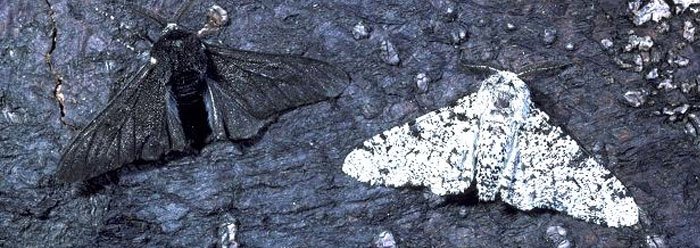
The trees these moths used to live on were white, but have been covered in soot from coal factories. Which moth will be more successful in this environment?
a)
Dark moth
b)
Light moth
c)
Both will be equally successful
d)
Neither will be successful
25.
Selective breeding is where ___________ decides which traits should be passed on
a)
Nature
b)
A human
c)
Mrs. Fox
d)
The illuminati
100 %

