
 Worksheets
Unit 8 Review-sjsbp
Total questions: 102
Worksheet time: 3hrs 56mins
Name
Class
Date
1.

What did Germany send to Mexico that offered to help them win land back from the United States if Mexico would start a war with the US?
a)
The Zimmerman Telegram
b)
The Outlandish Letter
c)
The Surprising Phone Call
2.

a)
A. Families to buy war bonds in order to support the war effort
b)
B. Families to conserve their resources during the war
c)
C. Women to seek jobs in war-related industries during the war
d)
D. Women to serve in the armed forces in Europe and the Pacific
3.

What was the nickname given to the popular poster that encouraged young men to join the U.S. Military?
a)
U.S. Army Wants you
b)
Uncle Sam
c)
Army Man
4.
__________________?_____________________
· Political tensions with Mexico · Discrimination against German Americans in Central Texas · Texas women serve as nurses · Texans plant “Victory Gardens” · Discrimination against African-American soldiers stationed in Texas
· Political tensions with Mexico · Discrimination against German Americans in Central Texas · Texas women serve as nurses · Texans plant “Victory Gardens” · Discrimination against African-American soldiers stationed in Texas
a)
Impact of the World War I on Texas
b)
Impact of the World War II on Texas
c)
Impact of the Great Depression on Texas
d)
Impact of the Roaring 20s on Texas
5.
In the early 20th century, a revolution in Mexico and a strong U.S. economy brought a large increase in Mexican immigration rates. Between 1910 and 1930, the number of Mexican immigrants counted by the U.S. census tripled from 200,000 to 600,000. El Paso, Texas, served as the Mexican Ellis Island--a gateway to a different life for Mexican immigrants and a powerful symbol of change and survival for their children and grandchildren. —adapted from Mexican Immigration—A Growing Community
Which factors most attracted Mexican immigrants to Texas, as described in this excerpt?
Which factors most attracted Mexican immigrants to Texas, as described in this excerpt?
a)
A. The availability of work and peace
b)
A. Fear of changes in the existing immigration laws
c)
A. Ellis Island and the promise of citizenship
d)
A. The opportunity to organize for political change in Mexico
6.
World War 2 helped America come out of _________________ by providing jobs for people.
a)
The Cold War
b)
The Dust Bowl
c)
The Great Depression
7.
This word means support for different sides during war; there were the Allied and Central powers during WWI.
a)
Nationalism
b)
Imperialism
c)
Alliances
d)
Militarism
8.
Germany used their U-boats to sink ships of the Allied powers; this British passenger liner was destroyed in 1917.
a)
Lusitania
b)
USS Maine
9.
Who won WWI?
a)
Allied powers
b)
Central Powers
10.
neutral
a)
not taking sides
b)
engaged in battle
11.
How did many Americans react to the Zimmermann Telegram?
a)
They became concerned about Russian expansion
b)
They wanted to avoid membership in the League of Nations.
c)
They wanted to fire Zimmermann
d)
They were outraged over a possible German-Mexican alliance.
12.
desire to remain separated in the affairs or interest of other groups
a)
avoidance
b)
isolationism
c)
stalemate
d)
internationalism
13.
The day of infamy refers to an attack on what naval base in the US
a)
Guadalcanal
b)
Pearl Harbor
c)
Philippines
d)
Midway
14.

The purpose of the New Deal program was to...
a)
improve working conditions in factories
b)
stop the sale of alcohol in states
c)
end discrimination against African Americans
d)
help the nation recover from the Depression
15.

$100 will buy this car. Must have cash. Lost all on the stock market.
The photograph best illustrates which cause of the Great Depression?
The photograph best illustrates which cause of the Great Depression?
a)
People over speculated on stocks.
b)
Government failed to prevent the collapse of banks.
c)
Tariffs discouraged trade.
d)
Drought occurred in the Midwest.
16.

Which conclusion is supported by the information on this graph?
a)
Unemployment began to increase in the early 1920s, which led to the Great Depression.
b)
The Depression ended by 1937, when unemployment dropped to a two-year low.
c)
The highest unemployment during the Great Depression occurred in the years 1932 to 1935
d)
By the end of the 1930s, unemployment had decreased to the level of 1926.
17.
Which event was caused by people over using their credit to buy more stocks than they could afford, allowing the market to crash?
a)
boll weevil
b)
drought
c)
Stock Market Crash
d)
Government
18.
What was the state of the US's economy after WWI?
a)
It immediately fell into the Great Depression.
b)
It was on a boom, and created the Roaring 20s.
c)
It was destroyed due to the destruction from the war.
d)
It leveled out then crashed.
19.
What contributions are made by Georgia during WWI?
a)
Food,
soldiers, housing POWs
b)
Food, Houses, and Money
c)
Money and Land
d)
Soldiers and Money
20.
What time period in United States history was marked by high unemployment and low economic activity?
a)
Great Recession
b)
Great Depression
c)
Black Tuesday
d)
Dark Ages
21.
What events contributed to the Great Depression.
a)
Farmer were in a depression
b)
over-speculation of stocks
c)
the stock market crashes
d)
All the Answer Choices are Correct
22.
What plan was devised by President Franklin Roosevelt to help the nation recover from the Great Depression?
a)
Great Deal
b)
New Deal
c)
My Awesome Plan
d)
The Great Depression Recovery Plan
23.
What event caused the United States to enter WWII?
a)
Pearl Harbor
b)
Invasion of Poland
c)
Battle of Midway
d)
Attack on 9/11
24.
What events draw the United States into World War I?
a)
Zimmerman telegraph
b)
Sinking of Lusitania
c)
US ships are sunk by Germany
d)
All of the Answer Choices are Correct
25.
How might have Hitler’s background have influenced the decisions he made concerning groups of people, especially the Jews?
a)
It made Hitler more sensitive and caring to the problems of others.
b)
Since childhood, Hitler blamed the Jews for his problems and failures.
c)
His love of painting humans inspired him to choose this group.
d)
His background had no effect on the decisions he made later in life.
26.
Which best describes the United States’ position when war began in Europe in 1939?
a)
Isolated/Neutral
b)
Eager
c)
Enthusiastic
d)
Willing
27.
The best reason as to why President Truman ordered the atomic bomb dropped was
a)
to show the power and might of the United States
b)
to save 1 million US soldiers lives that it would require to take the islands of Japan
c)
to force the Empire of Japan to surrender unconditionally
d)
to end the war with the Germans by forcing them to surrender
28.
Which of the following is not one of the ways the United States was affected by WWII?
a)
The war stimulated our economy and helped us get out of the Great Depression
b)
The US became the most powerful country in the world
c)
American women joined the workforce
d)
The US went into another great depression and repeated the 1930s
29.
How did the Dust Bowl impact Texas?
a)
A. Many impoverished farmers left the Great Plains for California.
b)
A. Ranchers abandoned raising livestock for growing wheat.
c)
A. Farmers stopped using conservation methods to preserve the soil.
d)
A. People moved from cities to rural areas to grow more food.
30.
Japan surrendered after the U.S. did the following:
a)
Bombed Japan from aircraft carriers
b)
Dropped 2 atomic bombs
c)
Surrounded Japan with submarines
d)
Nicely asked Japan to surrender
31.
The First Atomic Bomb was dropped on the city of __________, Japan in August of 1945
a)
Hiroshima
b)
Nagasaki
c)
Tokyo
d)
Koyto
32.
The war in the Pacific ended when Japan surrendered on Sept. 2,____?
a)
1941
b)
2017
c)
1945
d)
1936
33.
The war in Europe ended when Germany surrendered on May 7, ____?
a)
1939
b)
1941
c)
1001
d)
1945
34.
Which WWII alliance included Great Britain, USSR, France, China, and the United States?
a)
Central powers
b)
Axis powers
c)
Allied forces
d)
Totalitarian powers
35.
Which WWII alliance included Germany, Italy, and Japan?
a)
Central powers
b)
Axis powers
c)
Allied forces
d)
Totalitarian forces
36.
What two countries emerged as super powers at the end of WWII?
a)
the U.S. and Great Britain
b)
Great Britain and Soviet Union
c)
the U.S. and Soviet Union
37.
Germany's leader during WWII was __________?
a)
Hirohito
b)
Benito Mussolini
c)
Franklin Roosevelt
d)
Adolf Hitler
38.
Hitler's political party that ruled Germany during WWII was________?
a)
Democrats
b)
Republicans
c)
The Birthdays
d)
Nazis
39.
Who was the leader of Britain during WWII?
a)
Joseph Stalin
b)
Franklin Roosevelt
c)
Optimus Prime
d)
Winston Churchill
40.
Who led Italy during WWII?
a)
Charles de Gaulle
b)
Franklin Roosevelt
c)
Luke Skywalker
d)
Benito Mussolini
41.
WWII is generally considered to have begun when Germany invaded what country in 1939?
a)
Germany
b)
Italy
c)
Jurassic Park
d)
Poland
42.

The New Deal was set up to help Americans ________ the stock market crash.
a)
before
b)
after
43.

The stock market crash of 1929 happened ________the Great Depression.
a)
before
b)
after
44.

Munitions were produced in some factories in New Jersey to send to Europe during WWI. What were munitions?
a)
can foods
b)
furniture
c)
cars
d)
war materials
45.

What led to the Great Depression?
a)
falling food prices
b)
the beginning of WWI
c)
the beginning of WWII
d)
the stock market crash of 1929
46.
What ended the Great Depression?
a)
jobs created by WWII
b)
jobs created by the WPA
c)
jobs created by Social Security
d)
jobs created by new farms
47.
During the early 1900's, some people still faced _______, or unfair treatment based on the color of their skin.
a)
discrimination
b)
emancipation
c)
great jobs
d)
punishment
48.
When the war broke out in Europe in 1914, the United States at first tried to stay _______________.
a)
on strike
b)
in the war
c)
neutral
d)
economy
49.
When people want to invest their money in a company, they buy shares of _____________ in that company.
a)
keys
b)
goods
c)
paper
d)
stock
50.
Read the list of events being described below. Which event from World War II is being described?
-December, 1941 Japan used the strategy of surprise attack to bomb this harbor
-As a result, the United States Navy was seriously damaged
-President Roosevelt declared war on the Japan
-December, 1941 Japan used the strategy of surprise attack to bomb this harbor
-As a result, the United States Navy was seriously damaged
-President Roosevelt declared war on the Japan
a)
the attack called D-Day on the shores of France
b)
the bombing of Pearl Harbor
c)
the invasion of Poland
d)
the use of concentration camps against Jewish people
51.
Victory in Europe (V-E Day) came after
a)
Japan surrendered
b)
the atomic bombing
c)
Germany surrendered
d)
the Treaty of Versailles
52.
Americans at home had to make decisions about rationing materials at home. This was because many natural resources and products became scarce. Why were materials like gasoline and rubber scarce at this time?
a)
Rubber and gas were scarce because the United States government did not want to spend money on it.
b)
The United States had all the rubber and gas it needed. They did not care about the war effort.
c)
Americans were greedy with how they used rubber and gas.
d)
Gasoline and rubber were scarce because they were needed for the war effort.
53.
Which of the following events about life in the United States during World War II is NOT true?
a)
The United States entered World War II after the attack at Pearl Harbor.
b)
Factories in the United States produced war goods and natural resources were rationed so that supplies could be sent to soldiers in Europe.
c)
During World War II most women stayed at home to raise children and to take care of their husbands who were working.
d)
African American pilots named the Tuskegee Airmen fought many missions over Europe to help the allies defeat Italy, Germany, and Japan.
54.
Why were dictators able to rise to power during and after the Great Depression?
a)
Economies were ruined. People wanted strong leaders to solve their problems and to rebuild their country after World War I.
b)
Dictators promised people more freedoms.
c)
Dictators promised to join the League of Nations
d)
Dictators promised to end fascism and to allow citizens to vote.
55.
In 1933 the Nazi Party rose to power in Germany and a dictator seized power over the government. Who was thisdictator?
a)
Josef Stalin
b)
Winston Churchill
c)
Adolf Hitler
d)
Franklin Delano Roosevelt
56.
At the end of the Depression, militarism grew in Europe, and alliances formed. These alliances divided Europe into sections. Based on your knowledge of Social Studies, which countries belonged to the Axis powers?
a)
United States, Great Britain, and Germany
b)
United States, Britain, and France
c)
Germany, Italy, and Japan
d)
Germany, Britain, and France
57.
This natural disaster served to worsen the effects of the Great Depression on Farmers in the Midwest
a)
Tornados
b)
Dust Bowl
c)
Black Tuesday
d)
Hurricanes
58.
The collection of markets and exchange where the issuing and trading of equities, bonds and other sorts of securities takes place.
a)
Margin
b)
New Deal
c)
Deficit Spending
d)
Stock Market
59.
The name given to the programs enforced by FDR to ensure relief, recovery and reform.
a)
Stock Market
b)
Great Depression
c)
Margin
d)
New Deal
60.
Programs that were put into place to ensure the causes of the Great Depression were addressed and corrected to ensure the Depression would not happen again
a)
Relief
b)
Recovery
c)
Reform
61.
Programs that were put into place to put Americans back to work completing government funded projects
a)
Relief
b)
Recovery
c)
Reform
62.
This President enforced both New Deals and saw America through the Great Depression and World War II.
a)
Eisenhower
b)
Truman
c)
Hoover
d)
Roosevelt
63.
A time in America following the roaring 20's where America experience rising unemployment that did not end until the onset of World War II.
a)
New Deal
b)
Roaring 20's
c)
Great Depression
d)
Cold War
64.
The most popular home appliance in the 1930's
a)
Television
b)
Radio
c)
Movies
d)
Telephone
65.
What percentage of Americans were unemployed in 1933?
a)
25%
b)
35%
c)
50%
d)
2%
66.
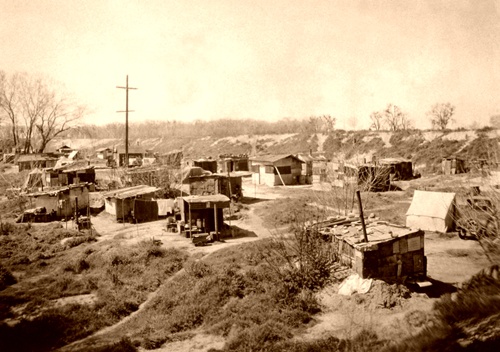
What was the main reason for the emergence of “Hoovervilles” like the one shown in the photograph?
a)
Many Americans had lost jobs during the Great Depression.
b)
Thousands of homes had been destroyed by the effects of the Dust Bowl.
c)
Housing projects could not keep up with the demand for homes needed by the poor.
d)
Preparations for World War I had created a shortage of building materials.
67.
During the 1930s, poor land management and severe drought conditions across parts of the Midwest resulted in the
a)
formation of the United States Department of Agriculture
b)
creation of wheat surpluses
c)
growth of the Populist movement
d)
development of Dust Bowl conditions on the Great Plains
68.
Which of the following was a major cause of the Great Depression?
a)
overproduction and underconsumption
b)
a decrease in the supply of consumer goods
c)
an increase in demand for imported products
d)
an increase in the price of wheat on the world market
69.
A major result of the New Deal was that it
a)
eliminated poverty in the US
b)
extended the merit system in the civil service
c)
destroyed the private enterprise system
d)
greatly increased the size and power of the Federal Government
70.

October 29th, 1929
a)
Black Monday
b)
Black Tuesday
c)
Black Wednesday
d)
Black Friday
71.

During the 1930s, the conditions shown in this photograph occurred mainly
a)
on the Atlantic Coast
b)
on the Great Plains
c)
in the Rocky Mountains
d)
in the Pacific Northwest
72.

What was the unemployment rate during the Great Depression?
a)
8.0%
b)
15.6%
c)
54.0%
d)
24.9%
73.
The _________ Bowl was an effect of farmers over planting, high winds, drought and a loss of topsoil and arable land in the central part of the United States during the 1920s-1930s.
a)
Super
b)
Melting Pot
c)
Dust
d)
Salad
74.

When was the Great Depression?
a)
1919-1929
b)
1929-1939
c)
1939-1949
d)
1999-2009
75.
Which of the following DID NOT cause the Dust Bowl?
a)
overproduction
b)
windstorms
c)
drought
d)
tornadoes
76.
What event during the 1920s created an unprecedented crop demand?
a)
The Dust Bowl
b)
The Gold Rush
c)
The Great Depression
d)
World War 1
77.
Which one of these was NOT a cause of the Great Depression?
a)
Consumer Debt
b)
Severe destruction of infrastructure during WW1
c)
Uneven Distribution of wealth
d)
Stock Market Crash
78.
Which was an immediate consequence of the Stock Market crash in 1929?
a)
Clients attempted to withdraw their money from the banks
b)
Investments were made with borrowed money
c)
Bankruptcies increased as businesses failed
d)
There was an excessive expansion of credit
79.

During the Great Depression people were worried because the economy was doing poorly. How did this fear affect their consumption of goods?
a)
People consumed more things because they thought they wouldn't be able to buy them later.
b)
People consumed fewer things because they wanted to save as much money as they could.
c)
People consumed more things because they wanted businesses to do better.
d)
People consumed fewer things because the government was rationing consumption.
80.

President during the 1930s who was considered a failure because he couldn't fix the Great Depression.
a)
Franklin D. Roosevelt
b)
Herbert Hoover
c)
Margaret Mitchell
d)
Jessie Owens
81.

The president who promised the people a "New Deal" during the Great Depression.
a)
Jesse Owens
b)
Herbert Hoover
c)
Franklin D. Roosevelt
d)
George Washington
82.

Which of the following is NOT a role that individuals play in the economy?
a)
Buying food, clothing, and other things that they need.
b)
Working to receive a paycheck.
c)
Taxing their fellow citizens.
d)
Starting businesses which offer services and goods to other individuals.
83.

What role do banks have in the economy?
a)
They provide loans to people who need money and help people invest money in stocks.
b)
They tax customers to pay for new programs.
c)
They decide how everyone should spend their money.
d)
They do not play a role in the economy.
84.

Which of the following is the government's role in the economy?
a)
Providing stocks to people who need to invest.
b)
The main provider of loans to people who want to buy homes.
c)
Giving interest to people who put their money into savings accounts.
d)
Building roads, schools, hospitals, and more with tax money.
85.

What role do private businesses have in the economy?
a)
They provide goods for people to buy. They provide jobs for people to work at.
b)
They help people open up savings accounts.
c)
They give interest to people who save money in a savings account.
d)
They do not play a role in the economy.
86.

Hundreds of thousands of people couldn't find jobs during the great depression. Many people who couldn't find work couldn't afford to buy food so they had to go to
a)
Homeless shelters
b)
Soup kitchens
87.

Which of the following was NOT a problem facing the United States from 1929-1939.
a)
Many banks were closing because they ran out of money.
b)
The economy struggled because of all the money that had been spent fighting in Europe.
c)
A drought hit the U.S. for several years causing many farmers' crops to fail.
d)
The stock market crashed causing people to lose millions and businesses to struggle.
88.

Why does the government tax people?
a)
Taxes pay for government programs and services, such as schools and military.
b)
The government does not tax people.
c)
Taxes help businesses make more money.
d)
The government taxes people so that no one gets too rich.
89.

Bob lived during a time when there were large dust storms and no rain for weeks or months at a time. This was known as the
a)
Great Recession
b)
TVA
c)
Dust Bowl
d)
CCC
90.

Which technological advance in the 1920s and 1930s caused over farming and the destruction of many farms when a drought hit?
a)
tractors
b)
contour farming
c)
plow
d)
windbreaks
91.
Which era of Texas history is described?
· Unemployment rose and banks and businesses failed.
· Dust storms blew across the Great Plains.
· Mexican immigrants were sent back to Mexico to reduce unemployment.
· The New Deal’s Agricultural Adjustment Administration helped cotton farmers.
· Thousand of Texans fought overseas.
· New military bases were built in Texas for training.
· Mexicans came to work in Texas under the Bracero Program.
· Federal money poured into Texas for wartime production
· Unemployment rose and banks and businesses failed.
· Dust storms blew across the Great Plains.
· Mexican immigrants were sent back to Mexico to reduce unemployment.
· The New Deal’s Agricultural Adjustment Administration helped cotton farmers.
· Thousand of Texans fought overseas.
· New military bases were built in Texas for training.
· Mexicans came to work in Texas under the Bracero Program.
· Federal money poured into Texas for wartime production
a)
Civil War and Reconstruction
b)
Cotton, Cattle, and Railroads
c)
Great Depression and World War II
d)
Oil
92.
Which set of time periods is in chronological order?
a)
1. Civil War 2. Reconstruction Era 3. Roaring Twenties 4. Great Depression
b)
1. Great Depression 2. Roaring Twenties 3. Reconstruction Era 4. Civil War
c)
1. Roaring Twenties 2. Reconstruction Era 3. Civil War 4. Great Depression
d)
1. Civil War 2. Great Depression 3. Roaring Twenties 4. Reconstruction Era
93.
This excerpt describes –
"And then the dispossessed were drawn west—from Kansas, Oklahoma, Texas, New Mexico; from Nevada and Arkansas ….families, tribes … Carloads, caravans, homeless and hungry; twenty thousand, fifty thousand, a hundred thousand, two hundred thousand ….They streamed over the mountains, hungry and restless …"
—John Steinbeck, The Grapes of Wrath (1939)
a)
economic impact of World War I
b)
political impact of World War II
c)
social impact of the Great Depression
d)
social impact of the Progressive Movement
94.
Before World War II, Texas was sparsely populated. Most Texans lived on farms, ranches or in small towns. Only 40 percent had a high school education. During the war, more than 1,500,000 military personnel came to Texas for training. War-related industries, including the oil industry, brought farmers and small-town residents to developing cities. Many workers were women and minorities. There were 142 major military installations in Texas, and more than 750,000 Texans served in uniform during the war. The state’s manufacturing, permanent population, and urbanization all increased. —adapted from the Texas Historical Commission
Which best summarizes the impact of World War II on Texas, according to the excerpt?
Which best summarizes the impact of World War II on Texas, according to the excerpt?
a)
A. Texas supplied most of the soldiers in the U.S. Army, whose return home increased the state’s population and caused its cities to grow.
b)
B. Texas changed from an agricultural to an industrial economy even though its cities stayed the same size.
c)
C. Then state’s economy grew, the roles of women and minorities expanded, Texas became less rural, and Texans had more contact with the rest of the nation.
d)
D. Texas changed politically and socially when more Texans moved to urban areas, but its manufacturing sector failed to change.
95.
What does impoverished mean?
a)
rich
b)
poor
96.
What is the name of the Treaty that ended World War I?
a)
Paris
b)
Versailles
97.
Which European country was blamed for World War I in the Treaty of Versailles?
a)
Germany
b)
Great Britain
98.
Which group of people did the Nazis blame for all of Germany’s problems?
a)
Arab
b)
Jewish
99.
How many atom bombs were dropped on Japan before they finally surrendered in WWII?
a)
1
b)
2
c)
3
d)
4
100.
What event cause the U. S. to join WWII?
a)
Zimmerman Telegram
b)
Bombing of Pearl Harbor
101.
The period in Germany between 1933-1945, when people were sent to concentration camps and then killed is known as
a)
Holocaust
b)
WWI
c)
WWII
102.
Although Hitler had already been annexing nearby countries with no interference, it was his attempt to invade ________________ that caused Neville Chamberlain of Great Britain to declare war on Germany, starting World War II.
a)
Great Britian
b)
France
c)
Italy
d)
Poland
100 %

