
 Worksheets
Ch.5 & 6 Forces & Motion
Total questions: 27
Worksheet time: 22mins
Name
Class
Date
1.

What is velocity?
a)
the quickness of an object
b)
the location of an object
c)
acceleration
d)
speed in a specific direction
2.
What happens when one force PULLS an object toward another?
a)
Friction
b)
Motion
c)
Gravity
d)
Magnetism
3.
What is a force that works AGAINST MOTION?
a)
Force
b)
Motion
c)
Gravity
d)
Friction
4.
How is gravity affected by mass?
a)
the larger the mass of the object, the greater the gravity
b)
small objects have no gravity
c)
gravity is not affected by mass of objects, whether large or small
5.
Which force produces a change in motion?
a)
unbalanced force
b)
balanced force
c)
gravitational force
d)
frictional force
6.
A push or pull that causes a change in motion
a)
Friction
b)
Gravity
c)
Force
d)
Mass
7.
The amount of matter in an object
a)
weight
b)
force
c)
gravity
d)
mass
8.
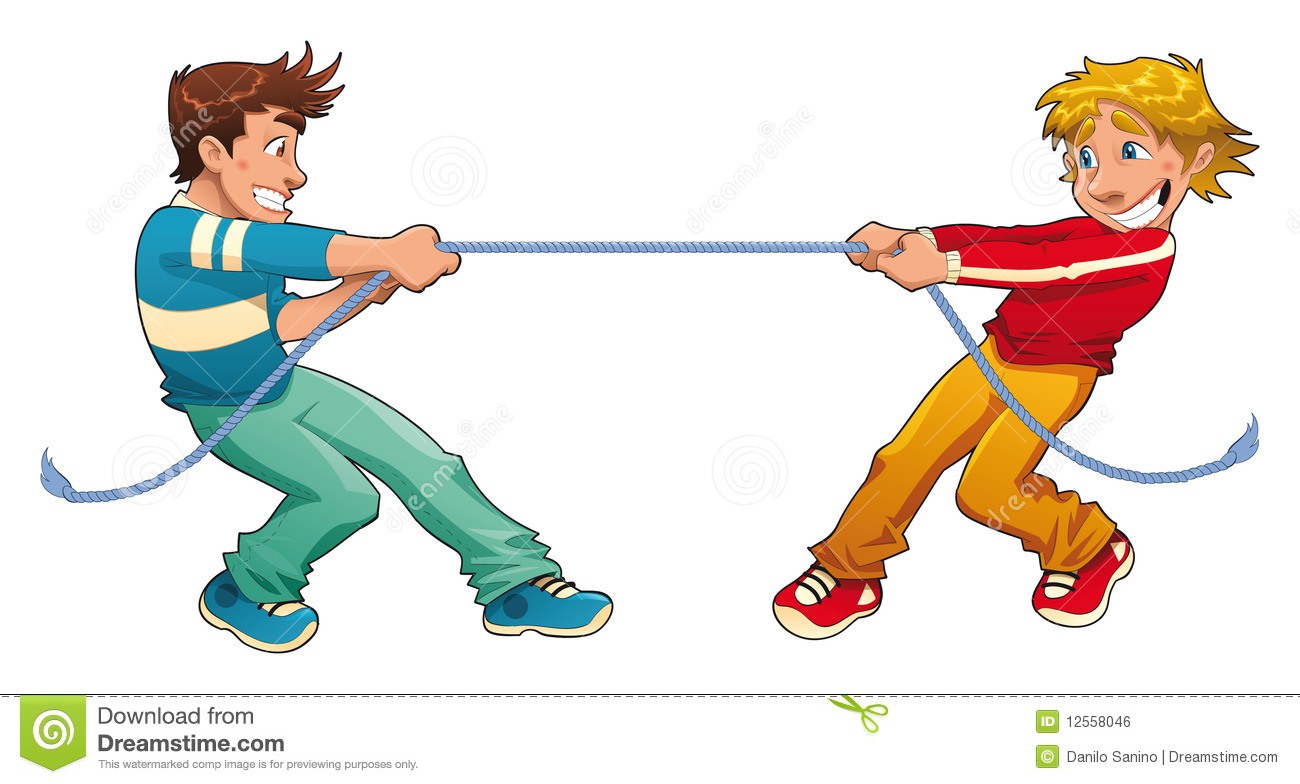
If these boys are pulling with the same amount of force. What will happen?
a)
The boy in blue will win.
b)
They will not move at all.
c)
The boy in red will win.
d)
Both will fall down.
9.
What pulls a ball back to earth?
a)
Gas
b)
Gravity
c)
Friction
d)
Molecules
10.
What is the standard unit force is measured in?
a)
Newtons
b)
pounds
c)
grams
d)
meters
11.
What is force?
a)
A force is a PUSH or a PULL upon an object resulting from the object's interaction with another object.
b)
something used in Star Wars
c)
It is the amount of space between two points.
d)
It is Superman's power
12.
Why does a rolling ball stop?
a)
Gravity
b)
Friction
c)
Waterfalls
d)
Sand
13.
Which of the following is a HELPFUL INCREASE in friction?
a)
sandpaper smoothing wood
b)
waxing wooden skis
c)
sand applied to a slick sidewalk
d)
switching from rolling to sliding friction
14.
Which of the following results in a HELPFUL DECREASE of friction?
a)
force applied while scrubbing
b)
oil added to a car engine
c)
sand applied to an icy road surface
d)
deep tread added to snow tires
15.
What are the two factors that determine speed?
a)
acceleration and time
b)
velocity and time
c)
distance and time
d)
motion and time
16.

What is speed?
a)
how far you go
b)
how much distance is covered over a period of time
c)
how fast you accelerate
d)
the change in the location of a object
17.
Which of the following best represents acceleration on a graph?
a)
motion change vs. time
b)
distance change vs. time
c)
speed change vs. time
d)
velocity change vs. time
18.
What two factors determine the amount of motion?
a)
force and the roughness of the surface
b)
Mr. Miller and Mr. Edmonson
c)
force and how much surfaces come in contact
d)
force and the weight exerted on the surfaces
19.
What is an object that appears to STAY IN PLACE that helps you detect motion in another object?
a)
a newton
b)
a lubricant
c)
a black hole
d)
a reference point
20.
In a game of tug of war, one dog is pulling with a force of 10N north and another dog is pulling with 5N south. What is the net force?
a)
5N north
b)
15N north
c)
50N north
d)
5N south
21.
Acceleration is caused by a force acting on a mass
a)
Newton's First Law
b)
Newton's Second Law
c)
Newton's Third Law
d)
Nature's Laws
22.
What type of friction will make work easier?
a)
static friction
b)
rolling kinetic friction
c)
sliding kinetic friction
d)
gravitational friction
23.
The rate of velocity change over time
a)
velocity
b)
speed
c)
acceleration
d)
motion
24.
A combination of all forces acting on an object
a)
newton
b)
force
c)
stress
d)
net force
25.
Without any force to change it, an object at rest stays at rest and an object in motion stays in motion
a)
Newton's First Law
b)
Newton's Second Law
c)
Newton's Third Law
d)
Newton's Millionth Law
26.
For a force on an object there is an equal and opposite force
a)
Newton's First Law
b)
Newton's Second Law
c)
Newton's Third Law
d)
Mrs. Quade-Wiedrich's Law
27.
Which of the following is an example of a balanced force?
a)
a baby pushed in a stroller on a sidewalk
b)
a child running down a path
c)
a car driving on a highway
d)
a TV hanging on the wall
100 %

