
 Worksheets
Clues to Earth's Past Pretest
Total questions: 15
Worksheet time: 14mins
Name
Class
Date
1.
The Law of Superposition helps scientists to determine what?
a)
The absolute age of rock layers
b)
The age of fossils
c)
The relative age of rock layers
d)
the super powers of rocks
2.
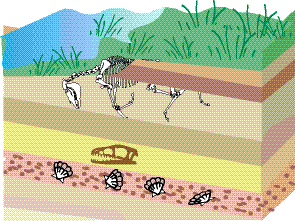
According to the law of superposition, the oldest fossils are found
a)
At the top of the rock layers
b)
Near the bottom of the rock layers
c)
In the middle of the rock layers
d)
Somewhat near the surface
3.
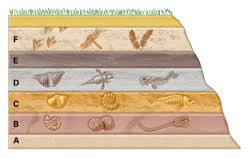
Which rock layer in the diagram seems to be the oldest?
a)
F
b)
E
c)
B
d)
A
4.

In this rock layer diagram there are two unconformities, a fault at E and an intrusion at D. Which unconformity occurred first? How do you know?
a)
Intrusion D occurred first because the instrusion has been moved by the fault.
b)
The fault occurred first because it has moved the intrusion D.
c)
Intrusion D occurred first because it can be seen in all of the rock layers.
d)
Fault E occurred first because it is a normal fault.
5.
Sometimes sea shells can be found in strange places. Like deserts and on mountains. Other than plate boundaries moving what is another reason for this?
a)
The earth's tilt on its axis has changed over the years and the equator use to be farther south
b)
Sea levels use to be much lower
c)
Plate boundary movement is the only correct explanation for marine fossils in strange places
d)
The sea levels use to be much higher and covered most of the land on earth. So marine fossils are found in places far from water
6.
How old do Paleontologists believe the Earth is?
a)
2015 years old
b)
3.6 billion years old
c)
4.6 billion years old
d)
4.6 million years old
7.
_______ are the preserved remains or traces of living things.
a)
bones
b)
fossils
c)
artifacts
d)
organic matter
8.
Fossils can provide evidence of how life has changed over time, how Earth's surface has changed, and clues about what past environments were like.
a)
True
b)
False
9.
In what type of rock would you typically find fossils?
a)
igneous
b)
metamorphic
c)
sedimentary
d)
rocky
10.
Which parts of an organism are more likely to fossilize?
a)
the soft parts - skin, muscle
b)
the hard parts - bones, shells, stems
c)
all parts can become fossilized easily because the organism becomes buried by sediments
11.
Becoming trapped in tar and amber, and freezing are other processes besides fossilization that organisms can be preserved.
a)
True
b)
False
12.
If you found a rock containing a very complex fossil, you could infer that the rock is
a)
relatively young
b)
very old
c)
igneous
d)
metamorphic
13.
Scientists who study fossils are called
a)
Geologists
b)
Paleontologists
c)
Fossil Scientists
d)
Meteorologists
14.
A(n) ______ is an organism that lived for a short amount of time , were plentiful, and lived in a wide range of places around the globe. Simply put, it's the most common type of fossil found
a)
index fossil
b)
cast fossil
c)
perserved fossil
d)
petrified fossil
15.

Why don't we know what many ancient plants looked like?
a)
They had too many soft parts.
b)
They were all eaten by dinosaurs.
c)
There weren't ancient plants.
d)
They had too many hard parts.
100 %

