
Font size
S
M
L
XL
 Worksheets
1st and 3rd law
Total questions: 130
Worksheet time: 2hrs 8mins
Name
Class
Date
1.
What is Newton's First Law known as? The Law of
a)
Friction
b)
Mass
c)
Inertia
d)
Gravity
2.
What kind(s) of objects have inertia?
a)
all objects with mass
b)
only objects at rest
c)
only objects in motion
d)
only objects whose motion is being changed
3.
Which type of force(s) will cause a change in an object's motion?
a)
gravity
b)
zero net force
c)
balanced forces
d)
unbalanced forces
4.
An object in motion will stay in what kind of motion as long as the net forces acting on it are zero?
a)
slowing motion in a straight line
b)
accelerating motion in a straight line
c)
constant motion in a straight line
d)
constant motion in an unpredictable direction
5.
What is the name for a push or pull?
a)
A movement
b)
A force
c)
Speed
d)
Density
6.
friction is a force that acts
a)
in the same direction as the motion
b)
opposite to the direction of the motion
c)
opposite to the applied forces
d)
the same direction as the applied force
7.
What is Newton's First Law
a)
F=ma
b)
Every action has an equal and opposite reaction
c)
An object at rest stays at rest, an object in motion stays in motion.
d)
Friction
8.
One object has twice as much mass as another object. The first object also has also twice as much...
a)
velocity
b)
gracitational acceleration
c)
inertia
d)
all of these
9.
Which one needs a greater net force to move, a kilogram of feathers or a kilogram of iron?
a)
feathers
b)
iron
c)
same
d)
depends on their friction
10.

What is the net force for this situation?
a)
17 N Right
b)
17 N Left
c)
3 N Right
d)
3 N Left
11.
Three people push a piano with the forces of 130 N to the right, 150 N to the left, and 165 N to the right. What is the net force and direction?
a)
145 N left
b)
145 N right
c)
185 N right
d)
445 N left
12.
A resistance to a change in motion is
a)
Acceleration
b)
Inertia
c)
Gravity
d)
Velocity
13.
The inertia of an object depends on its
a)
mass
b)
speed
c)
velocity
d)
direction
14.
Net Force not = 0
a)
Balanced
b)
Unbalanced
15.
Net Force = 0
a)
Balanced
b)
Unbalanced
16.
Does not cause a change in motion
a)
Balanced
b)
Unbalanced
17.
Causes a change in motion
a)
Balanced
b)
Unbalanced
18.
Three people push a piano with the forces of 130 N to the right, 150 N to the left, and 165 N to the right. What is the net force and direction?
a)
145 N left
b)
145 N right
c)
185 N right
d)
445 N left
19.
You hit a wall with a stick. The equal but opposite reaction is _____
a)
the wall pushes against you
b)
the stick pushes against you
c)
you push against the stick
d)
the wall pushes against the stick
20.
Describe the motion of a person not wearing a seat belt if the car stops suddenly.
a)
The person and car will stop together.
b)
The person will stop faster than the car because they are lighter.
c)
The car will stop and the person will keep moving forward because of inertia
d)
The car will stop and the person will speed up.
21.
Which one of the following objects has the least amount of inertia?
a)
ping pong ball
b)
golf ball
c)
soft ball
d)
bowling ball
22.
A pencil is thrown in the air and then falls back down
a)
Balanced
b)
Unbalanced
23.
A rock is sitting on the ground.
a)
Balanced
b)
Unbalanced
24.
Causes a change in motion
a)
Balanced
b)
Unbalanced
25.
Who created the Law of Inertia?
a)
Ms. Tomaszek
b)
Albert Einstein
c)
Galileo Galilei
d)
Sir Isaac Newton
26.
Inertia: An object that is moving will continue moving until acted upon by...
a)
An unbalanced force
b)
A balanced force
c)
Speed
d)
Distance
27.
The unit for acceleration is m/s.
a)
True
b)
False
28.
Objects at rest resist...
a)
Motion
b)
Rest
c)
Mass
d)
Gravity
29.
Objects in motion resist...
a)
Friction
b)
Rest
c)
Motion
d)
Mass
30.
Inertia: An object that is moving will continue moving until acted upon by...
a)
An unbalanced force
b)
A balanced force
c)
Speed
d)
Distance
31.
Inertia: An object that is still will stay still until acted upon by...
a)
An unbalanced force
b)
A balanced force
c)
Speed
d)
Velocity
32.
Who created the Law of Inertia?
a)
Ms. Tomaszek
b)
Albert Einstein
c)
Galileo Galilei
d)
Sir Isaac Newton
33.
A large truck is traveling down the highway. How does Mass affect inertia?
More mass = ?
More mass = ?
a)
More inertia
b)
Less inertia
c)
The same inertia
d)
No inertia
34.
What is a friction force acting on an NON- moving object.
a)
Static friction
b)
Fuild friction
c)
Rolling friction
d)
Sliding Friction
35.
The type of friction that occurs when two surfaces slip past each other describes...
a)
static friction
b)
sliding friction
c)
rolling friction
d)
fluid fiction
36.
The type of friction that occurs when two surfaces slip past each other describes...
a)
static friction
b)
sliding friction
c)
rolling friction
d)
fluid fiction
37.
What is a friction force acting on an NON- moving object.
a)
Static friction
b)
Fuild friction
c)
Rolling friction
d)
Sliding Friction
38.

Which force is so low that it causes the man to slip and fall?
a)
Gravity
b)
Friction
c)
Air Resistance
d)
Motion
39.
An object in motion will stay in what kind of motion as long as the net forces acting on it are zero?
a)
slowing motion in a straight line
b)
accelerating motion in a straight line
c)
constant motion in a straight line
d)
constant motion in an unpredictable direction
40.
Which type of force(s) will cause a change in an object's motion?
a)
gravity
b)
zero net force
c)
balanced forces
d)
unbalanced forces
41.
What kind(s) of objects have inertia?
a)
all objects with mass
b)
only objects at rest
c)
only objects in motion
d)
only objects whose motion is being changed
42.
What is Newton's First Law known as? The Law of
a)
Friction
b)
Mass
c)
Inertia
d)
Gravity
43.
An object will not have any inertia if it is _______________
a)
Accelerating
b)
Moving in a circle
c)
In space
d)
… Nonsense! All objects have inertia
44.
The scientist who is most famous for developing the Laws of Motion is _____.
a)
Albert Einstein
b)
Stephen Hawking
c)
Sir Isaac Newton
d)
Galileo Galilei
45.
An object and rest will stay at rest and an object in motion will stay in straight line motion unless acted on by a force, is which one of Newton's Laws of Motion?
a)
4th Law of Motion
b)
1st Law of Motion
c)
3rd Law of Motion
d)
2nd Law of Motion
46.
An object and rest will stay at rest and an object in motion will stay in straight line motion unless acted on by a force, is which one of Newton's Laws of Motion?
a)
4th Law of Motion
b)
1st Law of Motion
c)
3rd Law of Motion
d)
2nd Law of Motion
47.
When an object resits change, like a body in a turning car, it is called ________________.
a)
inertia
b)
force
c)
friction
d)
drag force
48.
Which law explains when a magician pulls a tablecloth out from under dishes and glasses on a table without disturbing them.
a)
Law 1
b)
Law 3
49.
According to Newton’s first law of motion, a moving object that is not acted on by an unbalanced force will
a)
remain in motion.
b)
eventually come to a stop.
c)
change its momentum.
d)
accelerate.
50.
Forces always act in equal and opposite pairs.
a)
Newton's 1st Law
b)
Newton's 3rd Law
c)
Newton's second law
51.

A person in car slides to the right when going through a very sharp left turn on the highway.
a)
1st Law
b)
2nd Law
c)
3rd Law
d)
4th Law
52.
For every action, thereʼs an equal and opposite reaction.
a)
Newton's First Law
b)
Newton's Second Law
c)
Newton's Third Law
d)
force
53.
What kind(s) of objects have inertia?
a)
all objects with mass
b)
only objects at rest
c)
only objects in motion
d)
only objects whose motion is being changed
54.
A sled sliding on a flat, icy surface with a constant velocity is best described by
a)
Newton’s first law of motion for objects at rest.
b)
Newton’s first law of motion for objects in motion.
c)
Newton’s second law of motion.
d)
Newton’s third law of motion.
55.

A person steps out of the boat and onto the dock. As the person moves forward onto the dock, the boat moves backward. Which statement best describes the backward motion of the boat as the person steps forward?
a)
For every action there is an equal and opposite reaction.
b)
Every mass exerts a force on every other mass.
c)
An object at rest tends to stay at rest.
d)
Friction opposes the motion of an object.
56.
When air rushes out of a balloon and it moves upward. This is an example of which Law of Motion.
a)
Newton's First Law
b)
Newton's Second Law
c)
Newton's Third Law
d)
Newton's Fourth Law
57.
Forces always occur in pairs
a)
True
b)
False
58.
When a heavy football player and a light one run into each other, who exerts more force?
a)
The heavy one
b)
The light one
c)
They are equal
d)
there is no such thing as force
59.
What causes a rocket to lift off and accelerate?
a)
The rocket is propelled by the impact of exhaust gases against the atmosphere.
b)
The rocket is propelled by the recoil from the ejected gas.
c)
Magic
60.
Newton's third law is the law of __________________.
a)
action and reaction
b)
inertia
c)
acceleration
d)
science rocks
61.
When you hold an apple above your head, how many force pairs act on the apple?
a)
1
b)
2
c)
3
d)
4
62.
Suppose two carts, one twice as massive as the other, fly apart when the compressed spring that joins them is released. How fast does the heavier cart roll compared with the lighter cart?
a)
twice as fast
b)
the same
c)
half as fast
63.
When a heavy football player and a light one run into each other, who exerts more force?
a)
The heavy one
b)
The light one
c)
They are equal
d)
there is no such thing as force
64.
A bus hits a bug and the bug splatters on the windshield, which force is greater?
a)
The Bus
b)
The Bug
c)
They're the same
d)
Gravity acting on the bus
65.

When Ronda Rousey got kicked in the face, What is the interaction pair?
a)
The foot and the face
b)
Ronda Rousey and media criticism
c)
The foot and the air flow
d)
Ronda Rousey and the floor
66.
Newton's third law states that any action will have a(n) _______ and ______ reaction
a)
Equal and similar
b)
Equal and opposite
c)
Equal and different
d)
Greater and opposite
67.
A book rests on a table. The force of gravity pulls down on the book with a force of 20 newtons. What prevents the books from accelerating downward at 9.8 m/sec2
a)
The table presses back up on the book with an equal and opposite force of 20 newtons.
b)
The table presses back up on the book with a force greater than 20 newtons.
c)
The table and the book together are accelerating downwards at 9.8 m/sec2
d)
The inertia of the book holds it up
68.
You hit a wall with a stick. The equal but opposite reaction is _____
a)
the wall pushes against you
b)
the stick pushes against you
c)
you push against the stick
d)
the wall pushes against the stick
69.

When the same force is applied to both the male African elephant and the female Asian elephant, their acceleration is different. Why?
a)
Male and female elephants have different heights.
b)
The male elephant has more mass
c)
The female elephant has probably eaten more
d)
The male elephant has less mass
70.
When a hammer strikes a nail, the nail...
a)
exerts an equal and opposite force back on the hammer.
b)
exerts balanced forces that helps it from moving.
c)
exerts a force equal to the weight of the hammer.
d)
exerts an unbalanced force that changes its velocity.
71.
Many people are familiar with the fact that a rifle recoils when fired. This recoil is the result of action-reaction force pairs. A gunpowder explosion creates hot gases that expand outward allowing the rifle to push forward on the bullet. Consistent with Newton's third law of motion, the bullet pushes backwards upon the rifle. The acceleration of the recoiling rifle is ...
a)
smaller than the acceleration of the bullet.
b)
greater than the acceleration of the bullet.
c)
the same size as the acceleration of the bullet.
d)
Monty the snake is slower than the bullet.
72.

this is an example of ...
a)
unblanced force
b)
friction
c)
balanced force
d)
centriple force
73.

this is an example of ...
a)
balanced force
b)
friction
c)
unbalanced force
74.

true or false this is friction
a)
true
b)
false
75.
What is Newton's First Law
a)
F=ma
b)
Every action has an equal and opposite reaction
c)
An object at rest stays at rest, an object in motion stays in motion.
d)
Friction
76.
The law of inertia is also known as which law of motion?
a)
Newtons first law of motion.
b)
Newtons second law of motion.
c)
Newtons third law of motion.
d)
Inertia has nothing to do with the laws of motion.
77.
If you increase the mass on an object, its acceleration
a)
decreases
b)
stays the same
c)
also increases
d)
stops
78.
In a car accident, a passenger not wearing a seat belt may crash through a windshield because of his or her inertia.
a)
False
b)
True
79.

In this scenario, which law does this represent?
a)
Law of Inertia
b)
Law of Force and Acceleration
c)
Law of Action-Reaction
80.
What is the unit for force?
a)
kg
b)
m/s/s
c)
m/s
d)
N
81.
An object at rest, stays _____.
a)
at rest
b)
at a constant speed
c)
accelerating
d)
in bed and doesn't come to school
82.
"The resistance to change motion", is the definition for what term?
a)
Subborn
b)
Newton's 2nd Law
c)
Newton's 1st Law
d)
Inertia
83.
According to Newton's 3rd Law, reactions always go in the ___ direction of the action.
a)
same
b)
opposite
84.
According to Newton's 3rd Law, Newtons Third Law explains what happens when two objects__.
a)
interact
b)
seperate
85.
A person in car slides to the right when going through a very sharp left turn on the highway.
a)
1st Law
b)
2nd Law
c)
3rd Law
d)
4th Law
86.
Forces always act in equal and opposite pairs.
a)
Newton's 1st Law
b)
Newton's 3rd Law
c)
Newton's second law
87.
According to Newton’s first law of motion, a moving object that is not acted on by an unbalanced force will
a)
remain in motion.
b)
eventually come to a stop.
c)
change its momentum.
d)
accelerate.
88.
Which law explains when a magician pulls a tablecloth out from under dishes and glasses on a table without disturbing them.
a)
Law 1
b)
Law 3
89.
one or more forces acting on a single object which produce a change in movement
a)
unbalanced forces
b)
balanced forces
c)
forces
d)
gravitational forces
90.
equal and opposite reactions
a)
Newton's 1st Law
b)
Newton's 2nd Law
c)
Newton's 3rd Law
d)
Law of Gravitational Attraction
91.
____________ says that all forces act in pairs.
a)
Newton's First Law of Motion
b)
Newton's Second Law of Motion
c)
Newton's Third Law of Motion
d)
inertia
92.
______________ says that an object at rest remains at rest, and an object in motion remains in motion at a constant speed and in a straight line unless acted on by an unbalanced force.
a)
Newton’s First Law of Motion
b)
Newton’s Second Law of Motion
c)
Newton’s Third Law of Motion
d)
inertia
93.
Newton's third law states that any action will have a(n) _______ and ______ reaction
a)
Equal and similar
b)
Equal and opposite
c)
Equal and different
d)
Greater and opposite
94.
When you are riding in the car, and the car stops, you keep going forward because of THIS property of matter
a)
friction
b)
inertia
c)
gravity
d)
mass
95.
Which of the following has the most inertia?
a)
pencil
b)
phone
c)
elephant
d)
mouse
96.
What is the term for all the forces acting on an object?
a)
gravity
b)
mass
c)
force
d)
net force
97.
Someone kicked a soccer ball across the field. It eventually slows down and stops due to this force:
a)
gravity
b)
net force
c)
friction
d)
there's no one pushing it anymore
98.
You push an empty grocery cart in the store. You decide to add 100 gallons of milk to your car and increase the mass. If force stays the same, what happens to how fast you're going?
a)
You speed up
b)
You slow down
c)
You stay the same speed
d)
Nothing happens
99.
What is Newton's First Law known as? The Law of
a)
Friction
b)
Mass
c)
Inertia
d)
Gravity
100.
Which has more Inertia? (so need more force to move)
a)
Truck
b)
Ant
c)
A cat
d)
A skateboard
101.
What is Newton's First Law
a)
F=ma
b)
Every action has an equal and opposite reaction
c)
An object at rest stays at rest, an object in motion stays in motion.
d)
Friction
102.
How many Laws does Newton have?
a)
4
b)
6
c)
1
d)
3
103.
What is the unit of measurement for force?
a)
AMP
b)
Seconds
c)
Newtons
d)
Miles
104.
What is Newton's Third Law?
a)
Object in motion stays in motion and an object at rest stays at rest unless acted on by a outside force
b)
Force = mass x acceleration
c)
For every action there is an equal and opposite reaction
105.
According to Newton's second law, if you increase the force applied to an object :
a)
it accelerates more
b)
it doesn't move
c)
you get more inertia
d)
it decelerates
106.
Who is the scientist who came up with the Laws of Motion?
a)
Sir Issac Newton
b)
The Greeks
c)
John Dalton
d)
Sir John Newt
107.

What law of motion does this picture represent?
a)
Newtons 3rd law
b)
Newtons 4th law
c)
Newtons 1st law
d)
Newtons 2nd law
108.
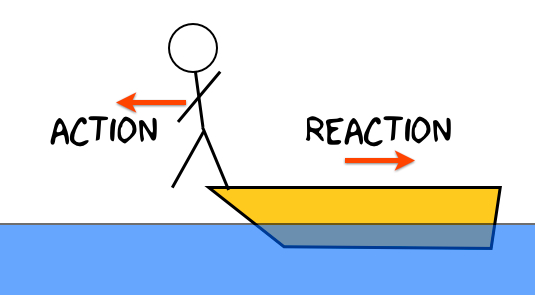
What law of motion does this picture represent?
a)
Newtons 1st law
b)
Newtons 4th law
c)
Newtons 3rd law
d)
Newtons 2nd law
109.
What law of motion does this picture represent?
a)
Newtons 1st law
b)
Newtons 4th law
c)
Newtons 3rd law
d)
Newtons 2nd law
110.
What is Newton's First Law?
a)
F=ma
b)
Every action has an equal and opposite reaction
c)
An object at rest stays at rest, an object in motion stays in motion.
d)
Friction
111.
For every action there is an equal and opposite re-action.
a)
Newton's First Law of Motion
b)
Newton's Second Law of Motion
c)
Newton's Third Law of Motion
d)
Newton's Fourth Law of Motion
112.

Relating to Newton’s Third Law, action and reaction, what is the reaction when a rocket expels gas, smoke and flames from the nozzle end of the rocket engine?
a)
Nothing
b)
Propels in the opposite direction
c)
Creates a balanced force
d)
Creates friction
113.
Relating to Newton’s Third Law, action and reaction, what is the reaction when a rocket expels gas, smoke and flames from the nozzle end of the rocket engine?
a)
Nothing
b)
Propels in the opposite direction
c)
Creates a balanced force
d)
Creates friction
114.
What law of motion does this picture represent?
a)
Newtons 1st law
b)
Newtons 4th law
c)
Newtons 3rd law
d)
Newtons 2nd law
115.
Newton's third law states that any action will have a(n) _______ and ______ reaction
a)
Equal and similar
b)
Equal and opposite
c)
Equal and different
d)
Greater and opposite
116.
What is Newton's Third Law?
a)
Object in motion stays in motion and an object at rest stays at rest unless acted on by a outside force
b)
Force = mass x acceleration
c)
For every action there is an equal and opposite reaction
117.
As the acceleration of an object increases, what happens to the force of the object?
a)
force increases
b)
force decreases
c)
force remain the same
d)
mass increases
118.
Which of Newtons Laws of motion describes the a moving object that keeps moving at the same speed unless an force acts on it?
a)
Law 1
b)
Law 2
c)
Law 3
119.
What one of Newton's laws talks about action forces and reaction forces?
a)
Law 1
b)
Law 2
c)
Law 3
120.
A swimmer pushes off the wall of a pool what is the action force?
a)
The feet pushing on the wall.
b)
The swimmer's body moving foward.
121.
When some books hit a desk top, where is the reaction force?
a)
The force of the books on the desk top.
b)
The force of the desk top hitting the books.
122.
People in the back seat of a car ended up in the front seat when the breaks were hit. What law of Newtons was this showing?
a)
Law 1
b)
Law 2
c)
Law 3
123.
A person steps out of the boat and onto the dock. As the person moves forward onto the dock, the boat moves backward. Which statement best describes the backward motion of the boat as the person steps forward?
a)
For every action there is an equal and opposite reaction.
b)
Every mass exerts a force on every other mass.
c)
An object at rest tends to stay at rest.
d)
Friction opposes the motion of an object.
124.

Why is the net force 0 in the image?
a)
Because the elephants are the same size
b)
Because they are both pulling the same amount of force in opposite directions
c)
Because they are elephants
d)
Because they are pulling away from each other.
125.
Newton's 1st law is often called the _______.
a)
Newton's 2nd law
b)
action-reaction law
c)
law of equality
d)
law of inertia
126.

The law in the picture represents---
a)
Newton's 1st law
b)
Newton's 2nd law
c)
Newton's 3rd law
d)
Newton's 4th law
127.

If an object is stationary (not moving) the forces acting upon it are---
a)
Balanced
b)
Unbalanced
c)
Weak
d)
Hulk Smash?
128.
Forces always act in equal and opposite pairs.
a)
Newton's 1st Law
b)
Newton's 2nd Law
c)
Newton's 3rd Law
d)
Newton's 4th Law
129.
An object at rest will _____ if not outside forces are applied.
a)
Stay at rest
b)
Decrease mass
c)
Increase velocity
130.
Forces always act in equal and opposite pairs.
a)
Newton's 1st Law
b)
Newton's 2nd Law
c)
Newton's 3rd Law
d)
Newton's 4th Law
Reset

