
NEW
Font size
S
M
L
XL
 Worksheets
Science Review 4
Total questions: 38
Worksheet time: 27mins
Name
Class
Date
1.

What is the net force in this diagram?
a)
6N left
b)
2N left
c)
6N right
d)
2N right
2.

What is the formula to calculate speed?
a)
S = t/d
b)
S = d/t
c)
S = d x t
d)
S = t x d
3.
You and your friend, are playing tug of war. Your friend pulls with a force of 55 N, to the right. You pull with a force of 65 N, to the left. What is the net force on the rope?
a)
15 N left
b)
20 N right
c)
10 N left
d)
10 N right
4.
Pam ran down the sidewalk to school with her empty backpack. After school Pam’s backpack was loaded with books. Which best describes the force required to carry her book bag home?
a)
It took the same amount of force to carry the loaded book bag home.
b)
It took a greater amount of force to carry the loaded book bag home.
c)
It took less force to carry the loaded book bag home.
d)
It did not take any force to carry the loaded book bag home.
5.
Two toy race cars are going to be raced down the same ramp. Which information is most helpful in predicting which car will win the race?
a)
length of the ramp
b)
volume of the cars
c)
slope of the ramp
d)
mass of the cars
6.
Which is true of a green grape?
a)
It absorbs green light.
b)
It absorbs white light.
c)
It reflects green light.
d)
It reflects white light.
7.
Which is translucent?
a)
tissue paper
b)
air
c)
wood
d)
clear plastic
8.
Which is transparent?
a)
a wooden fence
b)
clean water
c)
aluminum foil
d)
a purple balloon
9.
What is reflection?
a)
When light changes direction
b)
When light bounces off a surface
c)
When light is absorbed
d)
When light spreads out
10.

All of the following are sources of light except ______________
a)
the sun
b)
a light bulb
c)
fire
d)
the moon
11.
Where would you be traveling in complete silence?
a)
outer space
b)
under the ocean
c)
in a solid wood room
d)
at the top of a mountain
12.
Why is sound able to travel faster through a solid than a gas?
a)
Gas molecules are packed tightly.
b)
Sound does not travel faster through a solid than a gas.
c)
Solid molecules are packed tightly.
d)
Gas molecules move slowly.
13.
A short string makes a _______ pitch than a long string.
a)
louder
b)
softer
c)
higher
d)
lower
14.
This is what you get when sound waves are reflected, or bounce back, off of a hard surface.
a)
Amplitude
b)
Pitch
c)
Volume
d)
Echo
15.
This is the unit used to measure the volume of a sound.
a)
Decibel
b)
Hertz
c)
Vibration
d)
Oscilloscope
16.
What do consumers do in the food chain?
a)
They obtain energy from other organisms.
b)
They break down dead plant and animal material.
c)
They use sunlight to make food.
d)
They are parasites of plants.
17.
Which of the following food chains shows the correct energy flow left to right?
a)
rabbit-coyote-grass
b)
grass-rabbit-coyote
c)
coyote-rabbit-grass
d)
grass-coyote-rabbit
18.
A certain plant needs light but also a lot of water to survive. In which of the following ecosystems would this plant most likely be found?
a)
grassland
b)
ocean
c)
desert
d)
rain forest
19.
What is the most important role of earthworms, pill bugs, and bacteria in an ecosystem?
a)
to serve as a major food source for large animals.
b)
to convert the Sun's light energy into stored energy.
c)
to return dead plant and animal nutrients to the soil.
d)
to withstand extreme temperature and drought conditions.
20.
Which of the following ecosystems would best support a population of deer?
a)
desert
b)
swamp
c)
forest
d)
coastline
21.
Why are decomposers necessary in the food chain?
a)
They provide nutrients for plants.
b)
They photosynthesize.
c)
They are food for carnivores.
d)
They prey on herbivores.
22.

Is this object biotic or abiotic?
a)
biotic
b)
abiotic
c)
Partially biotic
d)
Partially abiotic
23.

What does a food chain represent?
a)
How all living organisms within a habitat are connected.
b)
All of the things that a particular animal eats.
c)
How plants create their own food.
d)
A single path of energy transfer within a habitat.
24.

A connection of food chains with many food energy paths in an ecosystem is a(n) ____________.
a)
ecosystem
b)
food web
c)
environment
d)
population
25.

An organism that gets energy from eating other organisms is a ______________.
a)
producer
b)
consumer
c)
decomposer
d)
prey
26.

Which of the following best describes the deer's role in the ecosystem?
a)
herbivore
b)
omnivore
c)
carnivore
d)
decomposer
27.
A frog eats a fly. The frog and fly are examples of ________.
a)
mutualism
b)
competition
c)
predator/prey
d)
parasitism
28.

Which organism do the owl and the weasel compete for in the food web?
a)
Hawk
b)
Spider
c)
Grasshopper
d)
Shrew
29.
The streak of light that a falling meteoroid produces is called a
a)
shadow
b)
meteor
c)
moon phase
d)
meteorite
30.
A(n) ______________ is a curved path that an object makes around another object.
a)
rotation
b)
orbit
c)
gravitational pull
d)
planet
31.
To rotate means to _______
a)
spin
b)
twist
c)
go around
d)
stop
32.
The imaginary line going from the North and South Poles through the middle of the Earth is called ______.
a)
axis
b)
equator
c)
time zone
d)
orbit
33.
The star at the center of our solar system.
a)
Sun
b)
moon
c)
orbit
d)
axis
34.
What causes Earth's seasons?
a)
the tilt of Earth's axis
b)
Earth's rotation
c)
the revolution of the Moon
d)
Earth's distance from the Sun
35.
The rotation of Earth on its axis causes the pattern of _____.
a)
night and day
b)
constellations
c)
Earth's seasons
d)
the phases of the moon
36.
It takes about _____________ for the moon to go through all of its phases.
a)
28 days
b)
365 days
c)
24 hours
d)
24 days
37.

How many planets are there?
a)
6
b)
7
c)
8
d)
9
38.
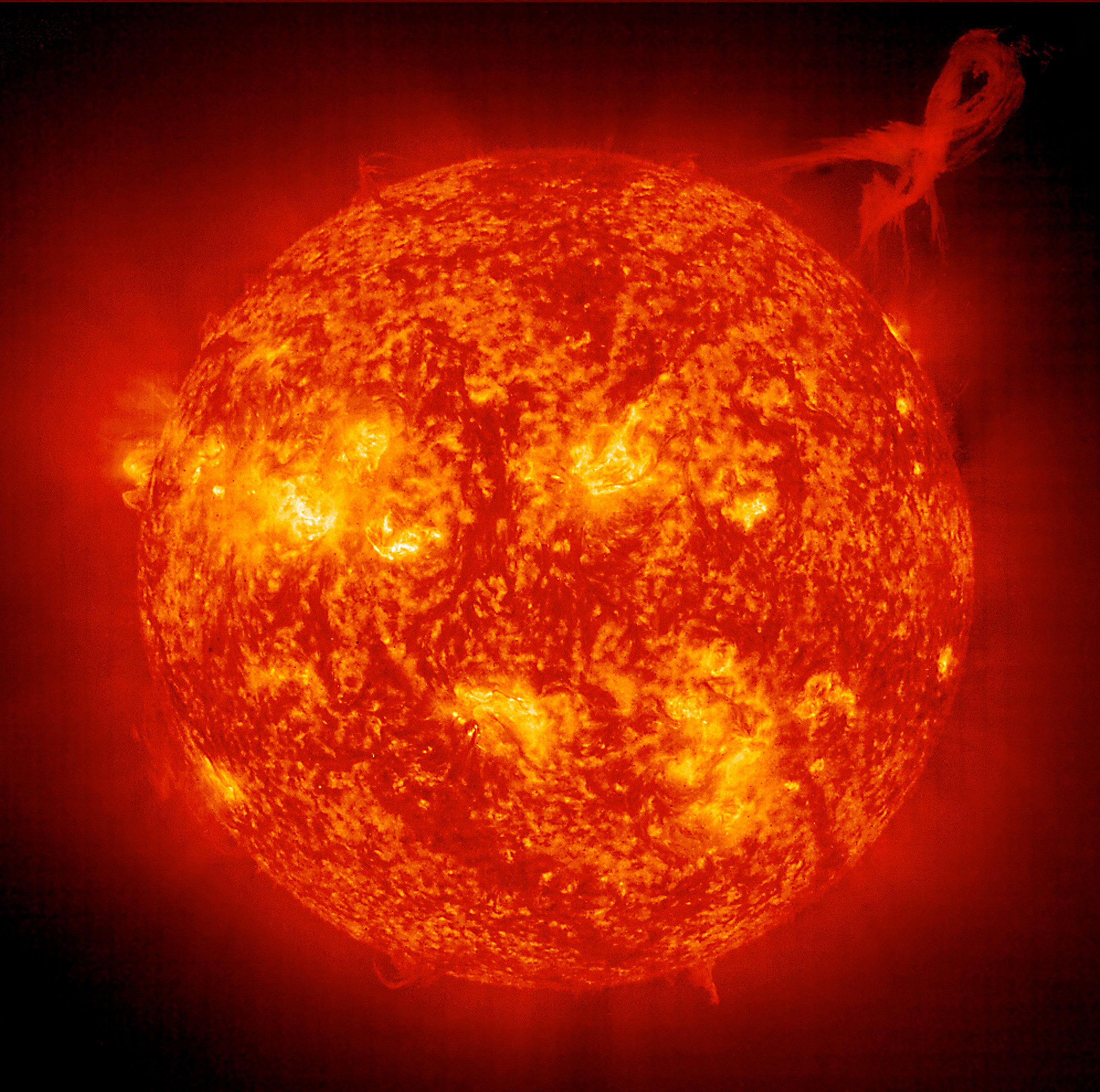
Why does the sun appear to be the largest star in the sky?
a)
It is far away
b)
It is very big
c)
It is the closest star to earth
d)
It is a planet
Reset

