
NEW
Font size
S
M
L
XL
 Worksheets
CMS Unit 10- Evolution Pre-Assessment
Total questions: 26
Worksheet time: 21mins
Name
Class
Date
1.

Charles Darwin came up with this theory
a)
Natural Selection
b)
Mutation
2.

To adjust to a changing environment
a)
Mutation
b)
Adapt
3.

Darwin wrote that organisms with traits that are best suited to the environment will ________________
a)
increase in number
b)
become extinct
4.

Another word for adapt is ____________.
a)
change
b)
create
5.
Which of the following is NOT an example of natural selection?
a)
People selectively breeding hamsters.
b)
Insect populations developing resistance to certain pesticides.
c)
Bacteria becoming resistant to antibiotics.
d)
Male birds of certain species developing colorful feathers to attract female mates.
6.
What characteristic did Darwin observe about the finches on the Galapagos Islands?
a)
Their feathers
b)
Genotypes
c)
Their beaks
d)
Their body sizes
7.
Which term refers to the process by which individuals that are better suited to the environment survive and reproduce therefore passing down their genes to their offspring?
a)
Evolution
b)
Variation
c)
Adaptation
d)
Natural Selection
8.
The environment around Manchester, England, changed during the Industrial Revolution. How did this change affect peppered moths living in the area?
a)
Natural selection favored moths with dark wings because predators could not see them on the soot-colored trees.
b)
Natural selection favored moths with white wings that were easy for predators to see.
c)
Natural selection favored moths with white wings because predators could not see them on the soot-colored trees.
d)
Natural selection caused moths with white wings to become extinct.
9.

Which species’ DNA is most similar to the DNA of the toothed whale?
a)
Hippopotamus
b)
Baleen Whale
c)
Grazing Mammals
d)
Camels
10.
When an organism completely dies out, it is called.....
a)
Adaption
b)
Extinction
c)
Fossilization
d)
Mutation
11.
The separation of a group of individuals from the rest of the population is referred to as
a)
genetic drift
b)
natural selection
c)
geographic isolation
d)
survival of the fittest
12.
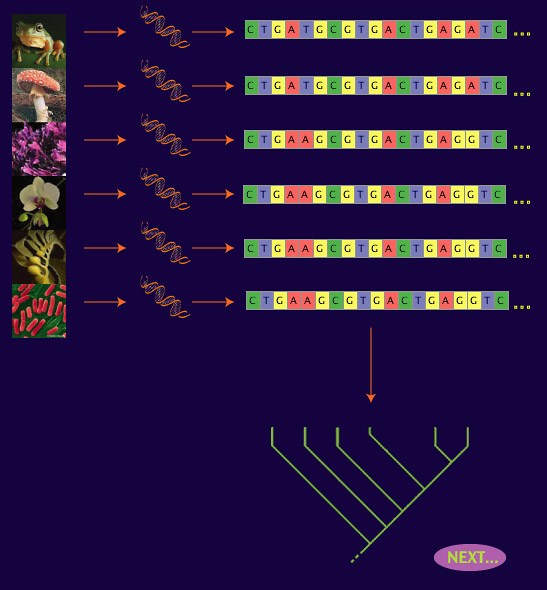
Two organisms that are closely related would have
a)
very similar DNA sequence
b)
exactly the same DNA sequences
c)
no proteins in common
d)
completely different DNA sequence
13.

Change over time...
a)
Evolution
b)
Nucleotide
14.

Which of the following is a term for a group of similar organisms that can reproduce fertile offspring?
a)
individual
b)
population
c)
species
d)
fossil
15.

If an organism has a vestigial structure, that structure likely once had a function in a(n)
a)
close relative
b)
early ancestor
c)
unrelated organism
d)
embryological stage
16.
Mutations are important because they bring about
a)
death of the organism in which they develop
b)
genetic variation needed for a population to evolve
c)
benefits for the individual, not for the population
d)
Hardey-Weinberg equilibrium within a population
17.
What is speciation?
a)
combining of tow species to form one with different traits
b)
isolation that affects mating behaviors
c)
timing of mating that prevents normal sexual selection
d)
divergence of two or more species from an existing one
18.
Group of organisms capable of interbreeding and producing fertile offspring.
a)
species
b)
gene pool
c)
population
d)
homologous structure
19.

Which two species are most related?
a)
B&C
b)
A&B
c)
A&C
d)
C&B
20.
Extinction can occur because of which of the following?
a)
All can be causes of extinction.
b)
Increased competition with other species
c)
New predators within the environment
d)
Loss of habitat and/or catastrophes
21.
Finches on the Galapagos Islands had different beaks in order to help them do what?
a)
Build nests
b)
Fight off predators
c)
Collect food sources
22.
Butterflies blending their wing color with their environment is an example of what?
a)
Adaptation
b)
Evolution
c)
Camouflage
d)
None of the above
23.
A remnant or trace of an organism from the past is called a _______.
a)
Ancestor
b)
Skeleton
c)
Fossil
d)
Imprints
24.
An idea that is probably true, but has not yet been proven to be true; based on research and data.
Example: "Modern day humans and apes evolved from a common ancestor.
Example: "Modern day humans and apes evolved from a common ancestor.
a)
Fact
b)
Theory
c)
Law
d)
Belief
25.

This is an example of:
a)
Survival
b)
Eating
c)
Camouflage
d)
Growth
26.

What species of hominid are we?
a)
Homo Sapien
b)
Homo Neanderthalensis
c)
Sahalenthropis Tchadensis
d)
Homo Erectus
Reset

