
 Worksheets
Day 11 Plants vs. Body Systems
Total questions: 10
Worksheet time: 41mins
Name
Class
Date
1.
In vascular plants, _________ transports water and minerals from the roots to the rest of the plant.
a)
Phloem
b)
Xylem
c)
Roots
d)
Cotyledons
2.

What are the openings on the underside of leaves that let carbon dioxide into the leaf and let oxygen out?
a)
Chloroplasts
b)
Stomata
c)
Stomach
d)
Cuticle
3.

In which type of growth response does the plant grow toward a light source?
a)
Phototropism
b)
Heliotropism
c)
Geotropism
d)
Hydrotropism
4.
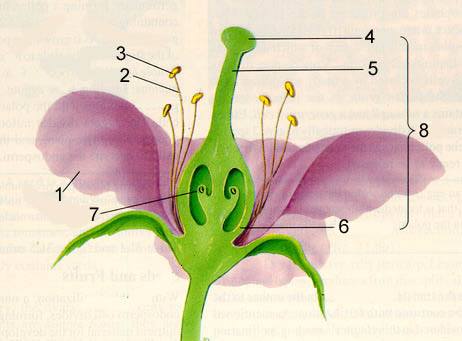
What is #4 pointing to?
a)
anther
b)
style
c)
stigma
d)
ovary
5.
A young boy cuts his hand on a piece of glass. To prevent infection, white blood cells travel to the site of the cut through the bloodstream. During this response to injury, the circulatory system works with which body system?
a)
Muscular system
b)
Integumentary system
c)
Excretory system
d)
Immune system
6.
Growth and development of human beings requires a very coordinated effort between many body systems. Most importantly, hormones must interact with other body systems to activate growth. Which two body systems are responsible for transporting hormonal messages throughout the body?
a)
Endocrine and circulatory
b)
Respiratory and nervous
c)
Integumentary and digestive
d)
Muscular and skeletal
7.
What tissues in the plant are similar to the circulatory system?
a)
Xylem and Phloem
b)
Dermal Tissue
c)
Ground Tissue
d)
Nothing
8.
When you get cut, your skin cells release hormones that signal platelets to come and stop the bleeding. Platelets then release more hormones that signal even more platelets to help stop bleeding (moving away from homeostasis). The hormone signals continue until the cut is closed.
a)
Positive Feedback Response
b)
Negative Feedback Loop
9.

According to the cladogram, which two orgainsms have hair?
a)
Sharks & Ray Finned Fish
b)
Primates & Rodents
c)
Birds & Crocodiles
d)
Rabbits & Birds
10.

Members of this kingdom live in unusual and extreme conditions such as deep ocean trenches or volcanoes
a)
Eubacteria
b)
Protista
c)
Fungi
d)
Archaea
100 %

