
 Worksheets
Thermal Energy
Total questions: 17
Worksheet time: 13mins
Name
Class
Date
1.

Heat transfer in the image.
a)
conduction
b)
convection
c)
radiation
2.

Heat transfer in boiling water.
a)
Conduction
b)
Convection
c)
Radiation
3.

The heat transfer in the image is by
a)
convection
b)
conduction
c)
radiation
4.

On a cold rainy day a baby is touching a cold window. It feels so cold. Which way is the heat moving moving?
a)
Cold is moving from the window to the hand.
b)
Heat is moving from the hand to the window.
c)
Heat doesn't move.
d)
It moves in currents
5.

Heat transfer in wind.
a)
conduction
b)
convection
c)
radiation
6.

Which ice cube will melt first?
a)
The large cube
b)
The small cube
c)
They will melt at the same rate
7.
When you use a microwave, what is the main way that heat is transferred?
a)
Convection
b)
Conduction
c)
Radiation
8.

The Gulf Stream is a current that brings warm ocean water from the south to the north. What type of heat transfer is this?
a)
conduction
b)
convection
c)
radiation
d)
insulation
9.
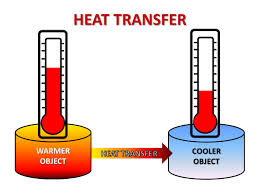
Heat transfers from an area of ____temperature to an area of ___ temperature.
a)
high to low
b)
low to high
c)
high to high
d)
It can travel high to low and low to high.
10.

The baby chickens are kept warm from the heat lamps demonstrates this type of heat transfer.
a)
conduction
b)
convection
c)
radiation
11.
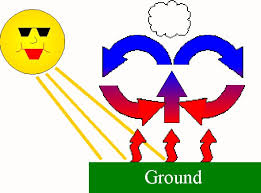
Warm air rises and the cool air sinks demonstrates this type of heat transfer.
a)
conduction
b)
convection
c)
radiation
d)
Insolation
12.

An iron bar is placed in a flame, as shown, and is heated until the end glows.The other end of the iron bar soon becomes hot, too. Which of the following statements best describes why the iron bar becomes hot to the touch?
a)
a convective flow of energy is set up inside the iron bar.
b)
energy is conducted from atom to atom along the length of the iron bar.
13.
Heat transfer occurs
a)
in many directions
b)
both from warm objects to colder ones and from cold objects to warmer ones.
c)
only from warm objects to colder ones.
d)
only from cold objects to warmer ones.
14.
A cup of tea with a temperature of 80 degrees Celsius is placed on a table in a 20 degree Celsius room. What happens to the thermal energy and the molecular motion of the tea when it is left on the table?
a)
The thermal energy increases and the molecules move faster.
b)
The thermal energy decreases and molecules move more slowly.
c)
The thermal energy increases and the molecules move more slowly.
15.
A student touches a metal sink with her finger and notices that her finger feels cold. Which of the following statements explains this observations?
a)
Heat energy flows from the student's finger to the metal.
b)
Heat energy flows from the metal sink to the student's finger.
c)
The student's finger was originally at the same temperature as the sink.
16.
Measurements inside a sealed container show that the pressure exerted by a gas increases as the thermal energy of the gas increases. Which of the following best explains this pressure increase?
a)
The gas molecules stick to the walls of the container.
b)
The gas molecules begin to bond together into heavier molecules.
c)
The gas molecules move faster and strike the container walls more frequently.
17.
The average distance between molecules always increases during which of the following phase changes?
a)
gas to solid
b)
gas to liquid
c)
liquid to gas
d)
liquid to solid
100 %

