
 Worksheets
SES Weather Review
Total questions: 49
Worksheet time: 53mins
Name
Class
Date
1.

This is the symbol for a...
a)
Cold Front
b)
Warm Front
c)
Stationary Front
d)
Occluded Front
2.

This is the symbol for a...
a)
Occluded Front
b)
Stationary Front
c)
Warm Front
d)
Cold Front
3.

Identify the type of front that is shown in the image.
a)
Occluded Front
b)
Cold Front
c)
Stationary Front
d)
Warm Front
4.

Identify the type of front that is shown in the image.
a)
Occluded Front
b)
Cold Front
c)
Stationary Front
d)
Warm Front
5.
Located at the leading edge of a temperature drop off. Bring heavy thunderstorms, rain, and hail. Cool, fair weather is likely to follow.
a)
Warm Front
b)
Cold Front
c)
Occluded Front
d)
Stationary Front
6.
Located at the leading edge of a warm air mass. Brings gentle rain or light snow, followed by warmer, milder weather.
a)
Warm Front
b)
Cold Front
c)
Occluded Front
d)
Stationary Front
7.
A severe storm which involves a funnel cloud forming over land is:
a)
hurricane
b)
tornado
c)
thunderstorm
d)
blizzard
8.
This severe weather involves low temperatures and snow either falling or drifting
a)
hurricane
b)
thunderstorm
c)
tornado
d)
blizzard
9.
This severe weather involves lightning, rain, and possibly hail
a)
thunderstorm
b)
tornado
c)
hurricane
d)
blizzard
10.
The boundary between two air masses is known as:
a)
front
b)
storm
c)
climate
d)
flood
11.
When severe weather conditions are present, a _______ is issued
a)
watch
b)
warning
12.
Why do hurricanes inflict more damage than tornadoes?
a)
they are larger
b)
longer duration
c)
also associated with flooding and strong rains
d)
all of the rest
13.
This type of front can bring strong storms
a)
cold
b)
warm
c)
stationary
d)
occluded
14.
This weather tool measures wind speed and direction
a)
thermometer
b)
barometer
c)
anemometer
d)
psychrometer
15.
Which weather tool measures the amount of kinetic energy in molecules?
a)
thermometer
b)
barometer
c)
psychrometer
d)
anememeter
16.
This means that the conditions are right for severe weather
a)
watch
b)
warning
17.

Which number illustrates Condensation?
a)
1
b)
2
c)
3
d)
4
18.
Which weather tool measures air pressure?
a)
thermometer
b)
barometer
c)
anemometer
d)
psychrometer
19.
This weather tool measures wind speed and direction
a)
thermometer
b)
barometer
c)
anemometer
d)
psychrometer
20.
Which type of cloud is most often observed during a thunderstorm?
a)
cirrus
b)
stratus
c)
cumulus
d)
cumulonimbus
21.
Which condition usually means cloudy, stormy weather?
a)
high pressure
b)
low pressure
22.
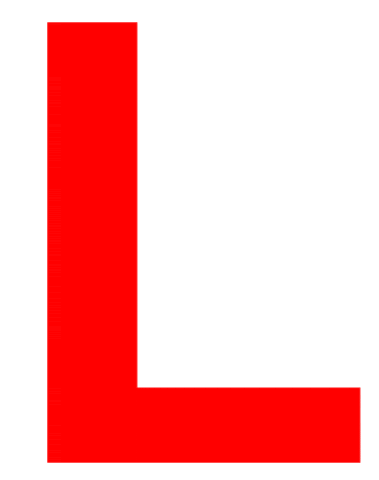
What does this symbol on a weather map indicate?
a)
High pressure system
b)
Low pressure system
c)
Cold front
d)
Warm front
23.
Rain, snow, sleet, and hail are all forms of _____.
a)
precipitation
b)
condensation
c)
evaporation
d)
climate
24.

A(n) _____ is a large body of air that has properties similar to the part of Earth's surface over which it depends.
a)
tornado
b)
pressure system
c)
front
d)
air mass
25.
what kind of pressure predicts good weather?
a)
high
b)
low
c)
cold
d)
stationary
26.

What part of the illustration shows Evaporation?
a)
1
b)
2
c)
3
d)
4
27.

White, thin, feathery clouds, usually made of ice crystals are...
a)
Stratus
b)
Cumulus
c)
Cirrus
28.

The layer of the atmosphere where weather occurs is the _.
a)
thermosphere
b)
stratosphere
c)
mesosphere
d)
troposphere
29.

An instrument used to measure the amount of rainfall
a)
barometer
b)
thermometer
c)
rain guage
d)
wind sock
30.

the amount of water vapor in the air
a)
warm front
b)
precipitation
c)
humidity
d)
air pressure
31.
The ozone is in the stratosphere layer of the atmosphere. The purpose of the ozone is
a)
To generate heat for the earth
b)
To protect earth from the harmful solar radiation
c)
To produce weather
d)
To allow satellites to circle the earth
32.
Which of the following are used to study and forecast most weather-related events?
a)
Doppler radar
b)
satellites and satellite images
c)
weather maps
d)
all of the above
33.
Which of the following will heat the fastest?
a)
water
b)
land
c)
both heat at equal rates
34.
____________ air rises because it is ____________dense.
a)
Cool, Less
b)
Warm, Less
c)
Cold, More
d)
Warm, More
35.
The weight of air as it presses down on Earth's surface
a)
front
b)
air pressure
c)
air mass
d)
evaporation
36.
The conditions of the atmosphere at a certain time and place.
a)
weather
b)
climate
c)
precipitation
d)
atmosphere
37.

What type of cloud looks like cotton and is in the lower altitudes?
a)
Cumulus
b)
Stratus
c)
Cirrus
38.
What is the most abundant gas found in the atmosphere?
a)
Carbon Dioxide
b)
Nitrogen
c)
Oxygen
d)
Water Vapor
39.
________________ are made of water vapor that condenses in the troposphere.
a)
dew
b)
clouds
c)
evaporation
d)
transpiration
40.
Where does a hurricane form?
a)
Over a cold body of water
b)
Over a warm body of water
c)
Over cold land
d)
Over warm land
41.
In what direction do winds always blow?
a)
From areas of high pressure to areas of low pressure
b)
From areas of low pressure to areas of high pressure
42.

This weather tool is used to determine...
a)
Temperature
b)
Wind Vain
c)
Wind Direction
d)
Rainfall
43.

What does this symbol on a weather map indicate?
a)
High pressure system
b)
Low pressure system
c)
Cold Front
d)
Warm Front
44.

What type of weather would you predict for Columbia, SC based on this weather map?
a)
Cooler and potential for storms
b)
Warm and clear
c)
Consistently hot and sunny
d)
Record highs
45.
the pattern of weather in an area over time
a)
weather
b)
climate
c)
air mass
d)
front
46.
A student places a cup of water outside on a cold day. At what temperature will the cup of water in the cup change to ice
a)
32 °F
b)
32°C
c)
0°F
d)
100°C
47.
What does a rising barometer often tell you about the weather?
a)
good, fair weather
b)
rain
c)
storms
d)
snow
48.
What happens during the process of evaporation? Give an example.
a)
evaporation is when water changes from a liquid to a gas - example - a puddle disappearing on a hot day
b)
evaporation - changing from a gas to a liquid example - rain
c)
evaporation - water vapor cools and condenses on dust particles example - clouds
d)
evaporation - water droplets get to heavy in the clouds and fall back to earth example - snow
49.
What happens during the process of condensation? Give an example.
a)
condensation is when water changes from a liquid to a gas - example - a puddle disappearing on a hot day
b)
condensation - changing from a gas to a liquid example - rain
c)
condensation - water vapor cools and condenses on dust particles example - clouds
d)
condensation - water droplets get to heavy in the clouds and fall back to earth example - snow
100 %

