
 Worksheets
MCA Review-Earth Science
Total questions: 40
Worksheet time: 40mins
Name
Class
Date
1.

Which season is taking place in the Northern Hemisphere at Position 3?
a)
Winter
b)
Spring
c)
Summer
d)
Fall
2.

Which season is taking place in the Northern Hemisphere at Position 4?
a)
Winter
b)
Spring
c)
Summer
d)
Fall
3.
The term equinox means....
a)
equal amount of day light and equal amount of night
b)
Equal amount of winter and summer
c)
Equal amounts of direct sunlight for everyone
d)
The longest day of the year
4.
Which of the following best describes the solstices?
a)
Either the longest or shortest day of the year for a hemisphere
b)
Direct sunlight hits the Tropic of Cancer or Tropic of Capricorn
c)
Happens in June and December
d)
All of the above
5.
One rotation of Earth is equal to
a)
a day.
b)
a year.
c)
a month
d)
a week
6.

What are the reasons for the season?
a)
Earth's tilt & rotation
b)
Earth's tilt & revolution
c)
Earth's rotation & revolution
d)
Earth's tilt & distance from the sun
7.
What is the darkest inner part of the shadow cone called, where a total eclipse can be viewed.
a)
Total
b)
Umbra
c)
Penumbra
d)
Partial
8.
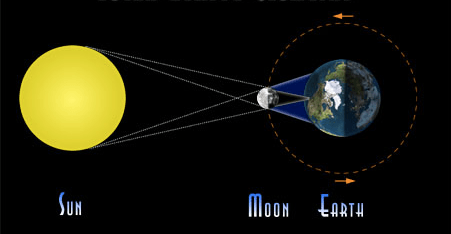
Which type of eclipse is shown in this picture?
a)
Solar Eclipse
b)
Orbit
c)
Lunar Eclipse
d)
Total Eclipse
9.
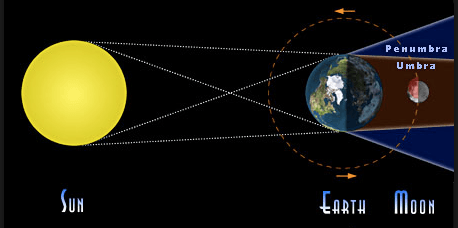
Which type of eclipse is shown in the diagram?
a)
Solar Eclipse
b)
Lunar Eclipse
c)
Total Eclipse
d)
Partial Eclipse
10.
Phases of the moon in which the moon appears to be getting larger are referred to as ____________.
a)
waxing
b)
waning
c)
new
d)
eclipse
11.

What Moon phase is this?
a)
Waxing Crescent
b)
Waning Gibbous
c)
Waning Crescent
d)
Waxing Gibbous
12.

What Moon phase is this?
a)
Last Quarter
b)
New Moon
c)
Third Quarter
d)
First Quarter
13.

What Moon phase is this?
a)
Waning Crescent
b)
Waxing Crescent
c)
Waxing Gibbous
d)
Waning Gibbous
14.
Which term describes the motion of the planets around the sun?
a)
rotation
b)
revolution
c)
completion
d)
galaxy
15.
The amount of time it takes Earth to revolve around the sun is a
a)
day
b)
24 hrs
c)
month
d)
year
16.
What does the Mohs Scale measure?
a)
Streak
b)
Luster
c)
Hardness
d)
Cleavage
17.
________________ describes how light reflects off a mineral.
a)
Luster
b)
Hardness
c)
Fracture
d)
Color
18.
When a mineral breaks in an uneven, rough, or jagged way
a)
Luster
b)
Cleavage
c)
Hardness
d)
Fracture
19.

Which mineral property is being shown here?
a)
luster
b)
hardness
c)
cleavage
d)
streak
20.
Many minerals form from the cooling of magma. If the magma cools slowly, what size are the crystals?
a)
small
b)
large
c)
no crystals
21.
Why is coal not a mineral?
a)
It's not a solid
b)
It is not naturally occuring
c)
It is not inorganic
d)
It is made of carbon
22.
During the rock cycle, what forms when magma or lava cools?
a)
igneous rocks
b)
sedimentary rock
c)
metamorphic rock
d)
foliated rock
23.
Extreme Heat and Pressure creates a _________ rock.
a)
Igneous
b)
Metamorphic
c)
Sedimentary
d)
Mineral
24.
True or False: Once a rock is sedimentary, it cannot become an igneous rock.
a)
True
b)
False
25.

This rock started as lava that cooled and then was heated and put under pressure over time. What type of rock is this?
a)
Sedimentar
b)
Igneous
c)
Metamorphic
26.

Deposition & lithification or compacting & cementing produce
a)
sedimentary rocks
b)
igneous rocks
c)
metamorphic rocks
27.
This type of weathering occurs when rock is physically broken down into smaller pieces of rock.
a)
mechanical weathering
b)
chemical weathering
c)
erosion weathering
d)
deposition
28.
The process that breaks down rocks and other materials on Earth's surface is called
a)
weathering
b)
erosion
c)
lithification
d)
deposition
29.
What is the process of transporting sediments from one location to another?
a)
Deposition
b)
Erosion
c)
Weathering
d)
Compaction
30.
Lichens create weak acid that extracts certain minerals from the rock, weakening it.
a)
Mechanical/Physical Weathering
b)
Chemical Weathering
c)
Erosion
31.
Glaciers take large rock material and push it forward, as the ice melts, it leaves the rock behind.
a)
Weathering
b)
Erosion
c)
Compaction
32.
Extreme temperature changes in the desert cause the rock to expand and contract and eventually split.
a)
Mechanical/Physical Weathering
b)
Erosion
c)
Chemical Weathering
33.
The type of plate boundary where two plates come together is a .....
a)
Convergent Boundary
b)
Divergent Boundary
c)
Transform Boundary
d)
Plate Boundary
34.

What type of event will occur at this boundary?
a)
Earthquake
b)
Volcano
c)
Mid Ocean Ridge
d)
Mountain
35.
A divergent boundary occurs when plates ....
a)
Pull apart
b)
Come together
c)
Slide past each other
d)
Subduct
36.
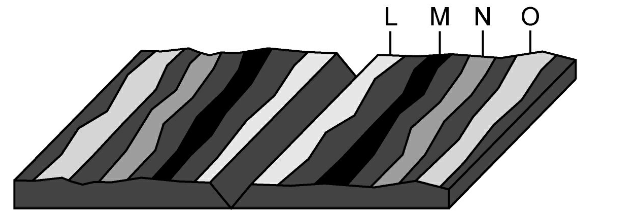
Where would the oldest rock be found?
a)
L
b)
M
c)
N
d)
O
37.

The diagram shows a cross section of rocks beside a highway.
Which rock type is the oldest?
Which rock type is the oldest?
a)
rock type 1
b)
rock type 2
c)
rock type 3
d)
rock type 4
38.

The picture shows a close-up view of fossils found with the cliff wall.
This cliff is most likely composed of?
This cliff is most likely composed of?
a)
igneous rock
b)
molten rock
c)
metamorphic rock
d)
sedimentary rock
39.

Which conclusion correctly describes the youngest rock layer in the diagram?
a)
Layer W is the youngest because it is the top layer of sedimentary rock and the only layer that contains fossils.
b)
Layer X is the youngest because it is the middle layer of sedimentary rock.
c)
Layer Y is the youngest because it is the bottom layer of sedimentary rock.
d)
Layer Z is the youngest because it was once molten rock that moved through all three layers of sedimentary rock.
40.
This law states that if something cuts through rock layers, the layers must be older than the thing cutting through them.
a)
original horizontality
b)
uniformitarianism
c)
superposition
d)
crosscutting
100 %

