
 Worksheets
Big Bang and Life Cycles of Stars
Total questions: 27
Worksheet time: 17mins
Name
Class
Date
1.
Big Bang theory says that
a)
the early universe was small, hot, and dense
b)
there is no God.
c)
something came from nothing
d)
the universe's age can't be known
2.
Galaxies that are moving away from us look more _____ than expected.
a)
white
b)
blue
c)
yellow
d)
red
3.
Which is *not* evidence for the Big Bang theory?
a)
red-shifted galaxies
b)
hieroglypiphics describing the instant of the Big Bang
c)
smooth cosmic background radiation
d)
amounts of hydrogen and helium
4.
As galaxies move away from us, the light waves we see coming from them are
a)
scrunched together.
b)
louder.
c)
not affected in any way.
d)
stretched out.
5.
The change in wavelength of light or sound that is due to the relative motion of the source towards or away from an observer.
a)
Radar Effect
b)
Doppler Effect
c)
Light Effect
d)
Reflection
6.
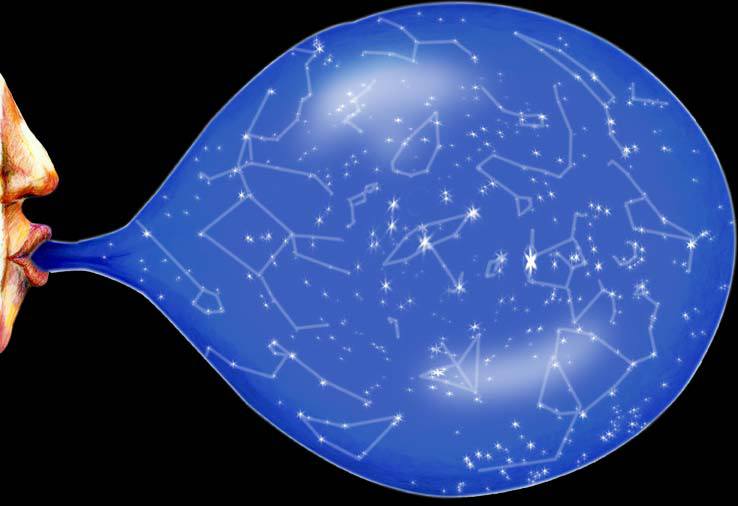
What does the Big Bang theory suggest?
a)
The universe was just there
b)
The Milky Way is the only solar system
c)
The universe is continually expanding
d)
The universe started as a point and is moving towards each other
7.
According to the Doppler effect, what happens to the sound waves in a car moving away from you?
a)
They move more quickly, so their pitch increases
b)
Their frequency increases, so their pitch increases
c)
Their wavelength increases, so their pitch increases
8.
The only force acting on the nebulae is ________.
a)
thermal
b)
singular
c)
gravity
d)
microscopic
9.
A star is born when ________________ begins to happen.
a)
nuclear fusion
b)
nuclear abrasion
c)
crying
d)
nuclear fission
10.
Larger, cooler stars are called ___________.
a)
Blue Giants
b)
White Dwarfs
c)
Red Giants
d)
Yellow Giants
11.
When our Sun becomes a Red Giant, it will engulf _______.
a)
just Mercury
b)
all the inner planets.
c)
the entire solar system
d)
just Mercury and Venus
12.
The core of a Red Giant collapses and becomes a ___________________.
a)
White Dwarf
b)
Blue Supergiant
c)
Red Supergiant
d)
Black Hole
13.
When a massive star begins to cool and expand it is known as a _______________.
a)
Blue Supergiant
b)
Red Giant
c)
Red Supergiant
d)
White Dwarf
14.
When the core of a Red Supergiant collapses, a bright event known as a ___________ occurs.
a)
superdupernova
b)
supernova
c)
big bang
d)
black hole
15.
After a supernova, the core can collapse into a neutron star, or if massive enough even a ___________.
a)
Black Hole
b)
White Dwarf
c)
Brown Dwarf
d)
Black Dwarf
16.
When a Red Giant's outer atmosphere drifts away it is now known as a ____________.
a)
planetary cloud
b)
White Dwarf cloud
c)
planetary nebula
d)
expanding nebula
17.
More massive stars continue to fuse elements in their cores all the way up to ________.
a)
silicon
b)
iron (Fe)
c)
carbon
d)
plutonium
18.
One possible outcome that is left after a supernova is a super dense core called a _____________.
a)
neutron star
b)
Yellow Star
c)
Red Giant
d)
Black Dwarf
19.
A black hole is an object so dense with so much gravity that even ________ cannot escape.
a)
man
b)
bacon
c)
spaceships
d)
light
20.
Hotter stars appear to be what color?
a)
Red
b)
Blue
c)
Yellow
d)
Green
21.
Cooler stars appear to be what color?
a)
Red
b)
Blue
c)
Yellow
d)
Green
22.
A star at the stage in its life cycle when it stops burning hydrogen, begins burning helium, and expands to a large, low-density star.
What stage in the life cycle does this describe?
What stage in the life cycle does this describe?
a)
Supernova
b)
Black Hole
c)
Main Sequence
d)
Red Giant or Red Supergiant
23.
A large cloud of gas and dust in outer space ejected by an aging star near the end of its life cycle.
What stage in the life cycle is this describing?
What stage in the life cycle is this describing?
a)
Main Sequence
b)
Planetary Nebula
c)
Black Hole
d)
Neutron Star
24.

what stage of the life cycle of a star is this?
a)
Planetary Nebula
b)
Black Hole
c)
Neutron Star
d)
Giant/Supergiant
25.

What stage of the life cycle of a star is this?
a)
Main Sequence
b)
Red Giant
c)
Black Hole
d)
Neutron star
26.
In the death of a large mass star gravitational collapse is so complete that no energy or matter can escape. This is called a...
a)
Neutron Star
b)
Black Hole
c)
Black Dwarf
d)
Supernova
27.

This is an image of the formation of a star, also known as a ....
a)
Main Sequence
b)
Planetary Nebula
c)
Supernova
d)
Stellar Nebula
100 %

