
 Worksheets
Light: Review Part 1
Total questions: 36
Worksheet time: 19mins
Name
Class
Date
1.
When does light refract?
a)
When light travels in a vacuum.
b)
When light moves through cold air.
c)
When light travels in only one medium.
d)
When light moves from one medium to another.
2.
What part of the EMS can be seen by humans?
a)
Visible light
b)
microwaves
c)
ultraviolet
d)
infrared
3.

Images A & B represent reflection of light rays. Which one would NOT produce a clear image?
a)
A would not because it is specular reflection
b)
A would not because it is diffused reflection
c)
B would not because it is specular reflection
d)
B would not because it is diffused reflection
4.

Which diagram shows light being refracted through a liquid?
a)
Image A
b)
Image B
c)
Image C
d)
Image D
5.

Red has a ______, _____ wavelength.
a)
long, slow
b)
long, fast
c)
short, slow
d)
short, fast
6.

The combination of two or more waves that result in a single wave
a)
diffraction
b)
refraction
c)
reflection
d)
interference
7.
The bending of a wave as it travels from one medium to another and as a result changes speed is called
a)
reflection
b)
refraction
c)
diffraction
d)
interference
8.

The bouncing back of a wave when it hits a surface through which it can NOT pass is called —
a)
rarefaction
b)
reflection
c)
diffraction
d)
refraction
9.

White light is made up of ________ colors.
a)
10
b)
3
c)
7
d)
70
10.

Light that bounces back has been _______________
a)
transferred
b)
heated up
c)
absorbed
d)
reflected
11.

As wavelength decreases in the electromagnetic spectrum the frequency _____.
a)
decreases
b)
stays the same
c)
increases
d)
doubles
12.

How does light travel from a source?
a)
Around corners
b)
In circles
c)
Very slowly
d)
In a straight line
13.
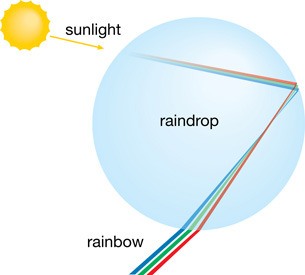
Light bending as it passes through a rain drop is an example of...
a)
Refraction
b)
Reflection
c)
Diffraction
d)
Interference
14.
Why do leaves appear to be green?
a)
They absorb all light wavelengths except green
b)
They refract all light wavelengths except green
c)
They reflect all light wavelengths except green
d)
They emit all light wavelengths except green
15.

High frequency waves have _________ wavelengths.
a)
varying
b)
long
c)
the same
d)
short
16.
When light reflects off of a completely smooth surface it reflects in which way?
a)
Regular Reflection
b)
Diffuse Reflection
c)
Refraction
d)
Color Reflection
17.
Light refracts when traveling from air into glass because light
a)
travels at the same speed in air and in glass.
b)
frequency is greater in air than in glass.
c)
frequency is greater in glass than in air.
d)
travels slower in glass than in air.
18.
Which of the following electromagnetic waves is given off as heat?
a)
Radio Waves
b)
Infrared Rays
c)
Visible Light
d)
Gamma Rays
19.

When two waves have displacement in opposite directions, it is called
a)
Refraction
b)
Constructive Interference
c)
Resonance
d)
Destructive Interference
20.

Which letter shows reflection?
a)
Pathway A
b)
Pathway B
c)
Pathway C
d)
Pathway D
21.

Which statement best explains what is seen on the building in the front left side of this image?
a)
Sunlight passes through the buildings on the left to show the buildings behind them.
b)
The sunlight changes direction when it strikes the buildings on the left, so the buildings up the street are visible
c)
The light waves from the sun are taken into the buildings on the left, so parts of them are hidden from view.
d)
Light bounces back from the buildings across the way at the same angle and intensity that the buildings received the light
22.

What enables humans to "see" light in this infrared image?
a)
thermogram
b)
RFID chip
c)
UV sensor
d)
video camera
23.

When two waves have the same direction of displacement, it is called
a)
Diffraction
b)
Destructive Interference
c)
Resonance
d)
Constructive Interference
24.
How have scientists proved that supernova explosions occur?
a)
Infrared rays emitted by a supernova explosion allow scientists to create a thermogram of the event.
b)
Photons of light travel to Earth, allowing astronomers to see the explosion through a telescope.
c)
Ultraviolet rays produced when a supernova explodes are detected on Earth using special sensors.
d)
Bursts of gamma rays are given off during supernova explosions that can be detected by special instruments.
25.
These types of light (electromagnetic waves) can only be studied from a space telescope because they are blocked by our atmosphere.
a)
infrared, microwaves, and gamma rays
b)
radio waves, ultraviolet, and visible light
c)
x-rays, gamma-rays, and most ultraviolet
d)
x-rays, visible light, and microwaves
26.
Which statement correctly compares radio waves and microwaves?
a)
Radio waves have shorter wavelengths than microwaves.
b)
Radio waves have lower radiant energy than microwaves.
c)
Only radio waves are used in communication.
d)
Radio waves have a higher frequency than microwaves.
27.

What enables this young man (in the image) to "see" light in the infrared range?
a)
RF technology
b)
night-vision goggles
c)
UV converter
d)
microwave sensor
28.
Which statement accurately describes how electromagnetic waves are produced?
a)
A region in space produces magnetic force fields and causes electrically charged particles to accelerate through space.
b)
Accelerating charged particles cause magnetic fields in space to constantly change, thus producing electromagnetic waves.
c)
Constantly changing electric and magnetic fields cause electrically charged particles to vibrate or accelerate.
d)
Magnetic fields in space cause electrically charged particles to accelerate through the vacuum of space causing radiation.
29.
Which statement correctly compares ultraviolet light to visible light?
a)
Ultraviolet light has both a higher frequency and longer wavelengths than visible light.
b)
Ultraviolet light has both a lower frequency and longer wavelengths than visible light.
c)
Ultraviolet light has both shorter wavelengths and a lower radiant energy than visible light.
d)
Ultraviolet light has both a higher frequency and a higher radiant energy than visible light.
30.
Why does an apple appear red?
a)
All colors are absorbed & none are reflected
b)
All colors are absorbed except for blue, which is reflected
c)
All colors are reflected and none are absorbed
d)
All colors are absorbed except for red, which is reflected
31.
What makes astronomers think there are black holes in space?
a)
At the end of a star's life cycle, it runs out of hydrogen and stops emitting visible light.
b)
There are areas of space from which no electromagnetic energy of any kind has been detected.
c)
When galaxies disappear, they stop emitting infrared radiation, and a hole in space is formed.
d)
Bursts of light that release large amounts of radio waves precede the formation of a black hole.
32.
The EMS goes from left to right in the order of
a)
Low energy waves to high energy waves.
b)
High energy to low energy
c)
long wavelengths to short wavelengths
d)
low energy to high energy and long wavelengths to short wavelengths
33.

Light that bends has been ____________________
a)
teleported
b)
reflected
c)
charged
d)
refracted
34.

The higher the frequency the ______ the energy.
a)
higher
b)
lower
c)
zero
d)
no
35.

It's called _______ when light bounces off the smooth surface of an object.
a)
Refraction
b)
Reflection
c)
Diffraction
d)
Interference
36.
In which of these situations would light slow down?
a)
from glass to air
b)
from ice to water
c)
from plastic to air
d)
from a vacuum to air
100 %

