
 Worksheets
Genetics and Reproduction
Total questions: 42
Worksheet time: 1hrs 24mins
Name
Class
Date
1.
the passing of genetic traits from parent to offspring.
a)
heredity
b)
trait
c)
gene
d)
allele
2.
An allele whose trait always shows up in the organism when the allele is present.
a)
recessive allele
b)
dominant allele
c)
hidden allele
d)
present allele
3.
An allele whose trait only shows up when no dominant allele is present.
a)
hidden allele
b)
dominant allele
c)
recessive allele
d)
present allele
4.
an organism's appearance or other detectable characteristic
a)
genotype
b)
phenotype
c)
genetics
d)
heterozygous
5.
genetic makeup
a)
phenotype
b)
genotype
c)
heterzygous
d)
allele
6.
the chances of something happening
a)
dominant
b)
genotype
c)
phenotype
d)
probability
7.
having two of the same genes for the trait (sometimes called purebred).
a)
homozygous
b)
hetrozygous
c)
protein
d)
chromosome
8.
having two different genes for a trait (sometimes called hybrid).
a)
protein
b)
homozygous
c)
heterozygous
d)
genotype
9.
father of genetics
a)
Gregor Mendel
b)
James Watson
c)
Dr. Robbins
d)
Francis Crick
10.
which is heterozygous ?
a)
Tt
b)
TT
11.
The study of heredity and the variation of inherited characteristics
a)
gene
b)
genetics
c)
meiosis
d)
hybrid
12.
Which is homozygous ?
a)
Zz
b)
SS
13.

What is the percentage of offspring that have green pods?
a)
100%
b)
75%
c)
50%
d)
25%
14.
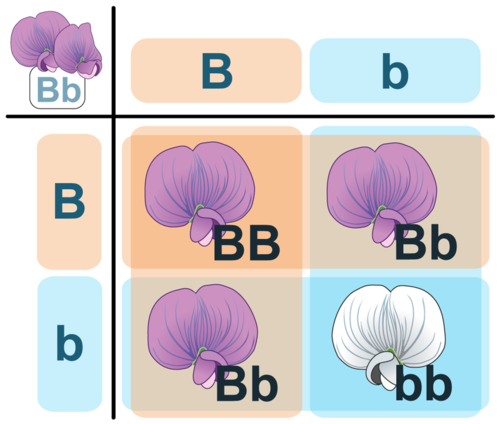
In this punnett square, which is the dominant trait?
The B stands for bud.
The B stands for bud.
a)
purple flower bud
b)
white flower bud
c)
dominant
d)
recessive
15.
G = green, g = yellow
The genotype for a yellow plant is...
The genotype for a yellow plant is...
a)
GG
b)
Gg
c)
gg
d)
all of the choices result in yellow
16.
A homozygous dominant dog with brown fur is crossed with a heterozygous dog with brown fur. What are the percentages of the possible genotypes?
a)
100% BB
b)
75% BB and 25%Bb
c)
50 % BB and 50% Bb
d)
50% Bb and 50% bb
17.

How many parents does asexual reproduction involve?
a)
one
b)
two
c)
three
d)
four
18.
In sexual reproduction the female produces ___ cells.
a)
Femalex
b)
Quack
c)
Egg
d)
Sperm
19.
In sexual reproduction the male produces ___ cells.
a)
Malex
b)
Quack
c)
Egg
d)
Sperm
20.
What are some of the facts about sexual reproduction?
a)
Takes two mates to reproduce and takes a longer time to reproduce
b)
Takes one mate to reproduce and takes a shorter amount of time to reproduce
c)
Takes two mates to reproduce and takes a shorter amount of time to reproduce
d)
Takes one mate to reproduce and takes a shorter amount of time to reproduce
21.
What are some of the facts about asexual reproduction?
a)
Takes only one mate to reproduce and takes a longer time to reproduce
b)
Takes a shorter amount of time to reproduce and it takes two mates to reproduce
c)
Reproduces diverse offspring and takes a longer time to reproduce
d)
Takes only one mate to reproduce and takes a shorter time to reproduce
22.
Which of the following is a disadvantage for sexual reproduction?
a)
a lot of time and energy is required for making gametes and finding mates
b)
offspring can be produced more quickly than by asexual means
c)
the genetic diversity makes organisms respond differently to environmental changes
d)
the offspring are genetically different
23.
Where is all the genetic material inside a cell?
a)
nucleus
b)
vacuole
c)
cell membrane
d)
ribosome
24.
Organisms that reproduce asexually generally have offspring that are
a)
unicellular.
b)
multicellular.
c)
genetically varied.
d)
genetically identical.
25.
Which is the greatest benefit of sexual reproduction?
a)
capable of reproducing by meiosis
b)
ability to reproduce without a mate
c)
ability to produce genetically different offspring
d)
capable of producing offspring genetically identical to parent
26.
In order to grow two of the exact same plants, a person would reproduce them asexually because the
a)
genetic diversity is greater.
b)
offspring would be genetically identical.
c)
recessive traits would emerge.
d)
negative traits are suppressed.
27.

Identify type of asexual reproduction in the picture.
a)
binary fission
b)
fragmentation
c)
regeneration
d)
vegetative reproduction
28.

Identify the type of asexual reproduction in the picture.
a)
binary fission
b)
regeneration
c)
budding
d)
vegetative reproduction
29.

Identify the type of asexual reproduction in the picture.
a)
binary fission
b)
fragementation
c)
regeneration
d)
vegetative reproduction
30.

Identify the type of asexual reproduction in the picture.
a)
binary fission
b)
budding
c)
vegetative reproduction
d)
fragmentation
31.

Which of the following describes the picture.
a)
male chromosomes
b)
female chromosomes
c)
neither of the above
32.

Which of the following describes the picture?
a)
male chromosomes
b)
female chromosomes
c)
neither of the above
33.

The joining of the egg and sperm describes which process?
a)
duplication
b)
fertilization
c)
fragmentation
d)
meiosis
34.

A fertilized egg is called a _______.
a)
super egg
b)
bud
c)
zygote
d)
fetus
35.

A change in a DNA sequence describes _____.
a)
fertilization
b)
mutation
c)
duplication
d)
altercation
36.

This is when a new organism grows by cell division on the body of its parent. The bud, or offspring is identical to the parent. The bud, when large enough, can break off of the parent and live on its own. Examples of this include yeast, hydra and potatoes.
a)
Regeneration
b)
Vegetative propagation
c)
Fission
d)
Budding
37.

Two types of fertilization include ______.
a)
exterior fertilization and interior fertilization
b)
budding and fragmentation
c)
XX and XY fertilization
d)
internal and external fertilization
38.

How do humans reproduce?
a)
sexually
b)
asexually
c)
both
39.
creates genetically different offspring
a)
sexual
b)
asexual
40.

In order to predict whether an organism would produce offspring that are diverse or uniform, it would be most helpful to know which of the following about the organism?
a)
Does its diet consist of many foods?
b)
Does it reproduce sexually or asexually?
c)
What is the approximate mass of an adult?
d)
What is the climate like in its habitat?
41.

Is the following asexual or sexual reproduction?
A labradoodle is a type of dog that is crossed between a labradoor retriever and a poodle. The labradoodle puppy takes on the traits of both of its parents. Female dogs have a pregnancy period of almost 70 days.
A labradoodle is a type of dog that is crossed between a labradoor retriever and a poodle. The labradoodle puppy takes on the traits of both of its parents. Female dogs have a pregnancy period of almost 70 days.
a)
Sexual
b)
Asexual
42.

Like other conifers, redwood trees have male and female cones that rely on wind for pollination. New trees also sprout from shallow roots which generate trees identical to the parent. What type of reproduction do redwoods use?
a)
Sexual
b)
Asexual
c)
Both
100 %

