
 Worksheets
REVIEW
Total questions: 31
Worksheet time: 27mins
Name
Class
Date
1.
What is responsible for delivering oxygen and removing carbon dioxide from the body?
a)
cell nucleus
b)
excretory system
c)
nervous tissue
d)
respiratory system
2.
The circulatory system uses _________ to deliver oxygen to the rest of the body.
a)
blood cells
b)
lungs and nose
c)
blood vessels
d)
brain and spinal cord
3.
When tissues come together, they form ___________.
a)
cells
b)
atoms
c)
organs
d)
systems
4.
Which of the following body systems work together for support, protection, and movement?
a)
respiratory and cardiovascular
b)
skeletal and muscular
c)
skeletal and integumentary
d)
digestive and respiratory
5.
Which of the following shows the levels of organization of an organism from LEAST to MOST complex.
a)
cells-tissues-systems-organs
b)
organs-cells-systems-tissues
c)
systems-organs-tissues-cells
d)
cells-tissues-organs-systems
6.
What catastrophic event would be of greatest risk to a coastal area?
a)
hurricane
b)
drought
c)
none of the above
d)
all of the above
7.
Waves dropping sand on the beach
a)
Weathering
b)
Erosion
c)
Deposition
8.
Muddy water being carried away by a fast-moving river
a)
Weathering
b)
Erosion
c)
Deposition
9.
Hurricanes develop in ________ regions.
a)
Arctic
b)
Tropical
c)
Arid
d)
None of the above
10.
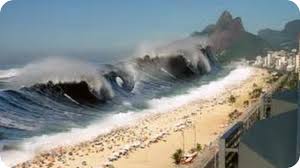
A long high sea wave caused by an underwater Earthquake, landslide or underwater volcanic
a)
Typhoon
b)
Flood
c)
Tornado
d)
Tsunami
11.
What catastrophic event results in destruction along a narrow path?
a)
a volcanic eruption
b)
a tsunami
c)
a hurricane
d)
a tornado
12.
How does freezing water cause the weathering of rocks? The freezing water—
a)
keeps the rocks in place
b)
makes the rocks last longer
c)
expands in the cracks and breaks rocks
d)
causes rocks to fall in landslides
13.
Which of the following natural disasters have had the LEAST impact on TEXAS
a)
hurricanes
b)
floods
c)
tornadoes
d)
earthquakes
14.

This is a picture of the _________ ecoregion of Texas.
a)
Hill Country/Edwards Plateau
b)
Piney Woods
c)
Gulf Coast Plains and Marshes
d)
High Plains
15.
What is the name for the phenotype Hh?
a)
Homozygous Dominant
b)
Heterozygous
c)
Homozygous Recessive
16.
Which of the following is homozygous recessive?
a)
rr
b)
AA
c)
TT
d)
Ff
17.

T - tall and t = short
In the punnett square below, what belongs in the missing square
In the punnett square below, what belongs in the missing square
a)
tt
b)
Tt
c)
Bb
d)
TT
18.
Two brown eyed parents (Bb) have a baby. What is the chance the baby is blue eyed?
a)
0 %
b)
25%
c)
50%
d)
75%
19.
What did Gregor Mendel use to discover the principles that rule heredity?
a)
Pea Plant
b)
Pigeons
c)
Pear trees
d)
Photosynthesis
20.
Behavioral changes of individuals of a species that allow for better survival. (Acquired traits)
a)
Variation
b)
Adaptation
c)
Behavior
d)
Environment
21.
In asexual reproduction, all of the offspring are:
a)
Physically Identical
b)
Genetically Identical
c)
Physically and Genetically Identical
d)
Not Identical
22.
How many parent(s)are needed for asexual?
a)
4
b)
1
c)
9
d)
100
23.
Why does sexual reproduction result in more genetic diversity than asexual reproduction?
a)
Traits from two parents are combined.
b)
More organisms reproduce this way.
c)
Offspring grow in different environments.
d)
Offspring come from identical parents.
24.
Supports the cell, allows cell parts to move
a)
Cytoplasm
b)
Nucleolus
c)
Chloroplast
d)
Mitochondria
25.
Additional layer around the outside of plant cells made from cellulose that protect and give shape
a)
Cell Wall
b)
Chloroplast
c)
Cell Membrane
d)
Golgi Complex
26.

What is "F"?
a)
Chloroplast
b)
Golgi body
c)
ER
d)
Mitochondria
27.
When an object is in motion, it has ___________ energy.
a)
potential
b)
mechanical
c)
kinetic
d)
movement
28.
In order to INCREASE the potential energy of an object, you need to:
a)
put the object lower to the ground
b)
raise the object higher
29.
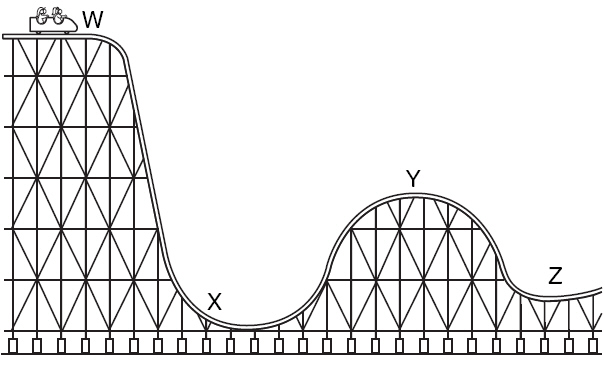
At which point is potential energy greatest?
a)
W
b)
X
c)
Y
d)
Z
30.

Can an atom of Hydrogen have 2 protons?
a)
Yes, because it can be an ion
b)
No, because protons identify the atom
c)
Yes, because it can be an isotope
d)
No, because only neutral atoms exist
31.

Can an atom of Helium have 3 electrons?
a)
Yes, because it can be an ion with a negative charge
b)
No, because protons identify the atom
c)
Yes, because all He atoms have 3 electrons
d)
No, because only neutral atoms exist
100 %

