wayground logo

Free Printable Worksheets

Font size

S
M
L
XL
Worksheets

Plate Tectonics, Magnetic Field, & Seismic Waves

Total questions: 51

Worksheet time: 39mins

Name
Class
Date
1.
This layer of Earth is solid Iron and Nickel
a)
Outer Core
b)
Mantle
c)
Inner Core
d)
Crust
2.

Which type of plate boundary would cause mountains to form?

a)

Transform

b)

Convergent

c)

Divergent

d)

Reform

3.
The Great Rift Valley in Africa and the Mid-Ocean Ridge were all created by this boundary
a)
Divergent
b)
Convergent
c)
Reform
d)
Transform
4.
This layer of Earth is the thickest part
a)
crust
b)
outer core
c)
mantle
d)
inner core
5.
What are the two types of crust
a)
continental and oceanic
b)
ocean and upper
c)
lower and upper
d)
pizza and subway
6.
Which layer has convection currents?
a)
Inner Core
b)
Outer Core
c)
Mantle
d)
Crust
7.
subduction zones in the ocean can create which features?
a)
islands
b)
volcanoes
c)
earthquakes
d)
all of the above
8.
Earthquakes and volcanoes are most likely found in which locations?
a)
At plate boundaries
b)
in oceans
c)
in the middle of continents
d)
in the middle of plates
9.
Transform boundaries are most likely to produce what phenomenon?
a)
volcanoes
b)
deep sea trenches
c)
underwater mountain ranges
d)
earthquakes
10.
When an oceanic plate and a continental plate collide, which one will subduct?
a)
oceanic
b)
continental
c)
neither
11.
Which of the following is NOT a tectonic boundary?
a)
Convergent
b)
Divergent
c)
Sedergent
d)
Transform
12.

Two tectonic plates collide at a _______ plate boundary.

a)

convergent

b)

divergent

c)

transform

13.
What is the name of the plate boundary that slides past each other?
a)
Divergent
b)
Convergent
c)
Transform
d)
Mr. C the Slide Man
14.
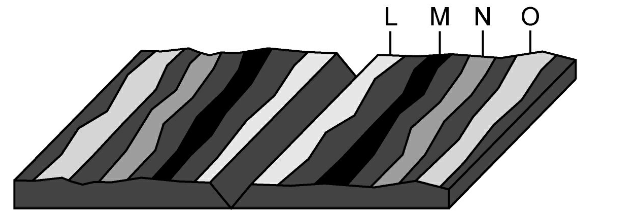
Where would the oldest rock be found?
a)
L
b)
M
c)
N
d)
O
15.

How is it possible for new crust to be formed without increasing the surface area of the Earth?

a)

Crust is destroyed in a subduction zone at the same time it is created along a mid-ocean ridge

b)

New crust is underwater where it sinks

c)

New crust breaks more easily than old crust

16.

The theory that says Earth's continents once made up an ancient supercontinent, and have been moving apart ever since, is called the theory of...

a)

Pangea

b)

Plate Tectonics

c)

Continental Drift

d)

Gravity

17.
Which of the following is NOT evidence to support the theory of plate tectonics?
a)
Fossils
b)
Mountains
c)
Glaciers
d)
Sand Erosion
18.

Which of the following is the name of the ancient supercontinent formed 280 Million Years ago.

a)

Pangea

b)

Gondwanda

c)

Laurasia

d)

Neverland

19.
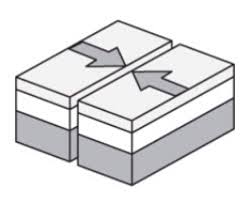
What type of plate boundary is this?
a)
Plate
b)
Divergent
c)
Convergent
d)
Transform
20.
Which of the following causes Earth's tectonic plates to move?
a)
Energy from the Sun
b)
Magnetic Pole Reversal
c)
Convection currents in the mantle
d)
Faults in Mountain Ranges
21.
Which of these layers is ALL solid iron and nickle?
a)
inner core
b)
outer core
c)
lithosphere
d)
mesosphere
22.
Which of the following occurs because of convection currents?
a)
Tectonic plates on the crust move.
b)
The mantle increases in size.
c)
Pressure in the crust increases.
d)
Pressure in the crust decreases.
23.
The mantle of Earth is made partly of magma. When magma rises and sinks, this is called ______________. 
a)
a conduction current
b)
a hot spot
c)
a volcanic eruption
d)
a convection current
24.
As you travel from the inner core to the crust, how would temperature, pressure and density of the material change?
a)
They would all increase
b)
They would all decrease.
c)
They would stay the same.  
d)
Temperature would decrease, but pressure and density would increase. 
25.
Where does the heat come from that drives this convection current in the mantle? 
a)
The sun
b)
The crust
c)
the mantle
d)
the core
26.
Which is true about hotter material in the mantle?
a)
more dense, sinks
b)
less dense, sinks
c)
less dense, rises
d)
more dense, rises
27.
During sea floor spreading, molten material rises up from the mantle...
a)
along the continents
b)
at the mid ocean ridges
c)
deep ocean trenches
d)
at north and south poles
28.
Geologists obtain evidence about Earth's interior by...
a)
measuring pressure at the surface
b)
studying seismic waves
c)
drilling through each layer
d)
estimation of temperature in the layers
29.
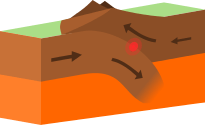
Name the boundary
a)
convergent boundary
b)
divergent boundary
c)
transform boundary
d)
sergent boundary
30.
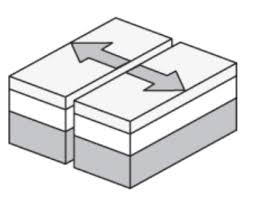
Name the boundary
a)
convergent boundary
b)
divergent boundary
c)
transform boundary
d)
sergent boundary
31.
What was the name given to all the continents when they were joined as one super continent? 
a)
Supreme Continent
b)
Eurasia
c)
Plate tectonics
d)
Pangea
32.

Earth is like a giant magnet due to....

a)

its liquid iron core

b)

the wind patterns of Coriolis Effect

c)

the alignment of the continents

d)

solar particles moving through the atmosphere

33.

What’s the most important function of Earth’s magnetic field?

a)

Earth's magnetic shield deflects asteroids and meteors

b)

Earth's magnetic shield keeps energy from escaping into space

c)

Earth's magnetic shield deflects most of the solar wind

d)

Earth's magnetic shield helps birds and other animals navigate

34.

Where is Earth's magnetic field strongest?

a)

Along the outside lines

b)

Along the inside lines on either side

c)

Where the lines are close together at the poles

d)

In the space outside of the lines

35.
The motion of liquid _______ in the Earth's core creates a magnetic field.
a)
Iron
b)
Magnesium
36.
Temperature _____________________ as you go deeper into the earth.
a)
increases
b)
decreases
c)
goes up and down depending on the layer
d)
stays the same
37.
Pressure ______________________ as you go deeper into the Earth
a)
increases
b)
decreases 
c)
goes up or down depending on the layer
d)
stays the same
38.

P waves travel faster than S waves

a)

True

b)

False

39.

Both P and S waves travel through solids.

a)

True

b)

False

40.

Only P waves travel through liquids.

a)

True

b)

False

41.

When S waves leave the Mantle and enter the outer core, they...

a)

speed up

b)

slow down

c)

get absorbed

42.

Which waves will reach a seismic station first?

a)

P waves

b)

S waves

c)

Both reach at the same time

43.

If the Earth did NOT have a liquid outer core, how would earthquake waves travel differently.

a)

P and S waves would both be absorbed.

b)

Only S waves would travel through the Earth's core.

c)

Shadow zones would not exist.

d)

S waves would travel faster than P waves.

44.

The diagram shows a

a)

S wave

b)

P wave

45.
Which body wave is pictured?
a)
P-Wave
b)
S-Wave
c)
Rayleigh Wave
d)
Love Wave
46.
We use this tool to measure seismic waves during earthquakes
a)
Seismographs
b)
magnitude
c)
actual magnitude
d)
sonograph
47.
This is the area beneath the Earth's surface where the earthquake begins
a)
epicenter
b)
focus
c)
fault line
d)
tectonic plate
48.
This is the area above ground where the earthquake starts
a)
focus
b)
epicenter
c)
p waves
d)
plate boundary
49.
What are the "waves" called that come from an earthquake?
a)
Thunder
b)
Seismic 
c)
Hang 10
d)
Lava
50.

According to the Ritcher Scale, the amount of energy between each magnitude (ex- magnitude 3 to mag. 4) increases by _______.

a)

10

b)

20

c)

30

d)

40

51.

A magnitude 4 earthquake is _____ times more powerful than a magnitude 1 earthquake.

a)

10

b)

20

c)

30

d)

40