
 Worksheets
End of the Year Bench Mark Review
Total questions: 136
Worksheet time: 1hrs 21mins
Name
Class
Date
1.
European imperialism of Africa, from 1880-World War I, is known as
a)
Spheres of Influence
b)
Scramble for Africa
c)
World War I
d)
French Revolution
2.
Which event resulted in India officially becoming a British colony?
a)
The Boxer Rebellion
b)
The Sepoy Rebellion
c)
The Meiji Rebellion
d)
The Taiping Rebellion
3.
Who fought against the Zulus in the 19th century for control of land in South Africa?
a)
The British
b)
Germany and Belgium
c)
Ethiopia and Italy
d)
India and Belgium
4.
Which colony was considered the "jewel of the crown"?
a)
China
b)
South Africa
c)
India
d)
Australia
5.
Which two regions of Africa remained free from European imperial control?
a)
Congo and South Africa
b)
Ethiopia and Liberia
c)
Egypt and Morocco
d)
Sudan and Chad
6.
Which European nation took control of the Congo?
a)
Britain
b)
Belgium
c)
Portugal
d)
France
7.
At what conference was Africa divided between European nations?
a)
Paris Peace Conference
b)
Vienna Conference
c)
Versailles Conference
d)
Berlin Conference
8.
Taking over land other than your own by force
a)
Imperialism
b)
Nationalism
c)
Industrialism
d)
Socialism
9.
One benefit of British rule in India was
a)
the building of the Suez Canal
b)
a thriving timber industry
c)
modernization and industrialization
d)
a better legal system
10.

The theme of this image is
a)
Industrialism
b)
Communism
c)
Capitalism
d)
Imperialism
11.
Which of the following were causes of imperialism?
a)
Industrial Revolution
b)
Nationalism
c)
Imperialism
d)
All of the Above
12.
Leader of Hawaii when the American businesses over threw the government by surrounding her throne at gunpoint.
a)
Sanford Dole
b)
Queen Liliokahlani
c)
Queen Kalakaua
d)
Jose Marti
13.
Imperialism is __________.
a)
when a powerful nation uses its resources to help a weaker nation
b)
when a weaker nation invites a powerful nation to help it industrialize
c)
when a powerful nation takes control of the economy and government of a weaker nation
d)
when weak nations join together to fight a strong nation
14.
Why did nations want to be imperialistic?
a)
They wanted prestige among other nations
b)
They needed more natural resources
c)
They needed more markets to sell industrial goods
d)
All of the Above
15.

Who did the U.S. buy Alaska from?
a)
Cuba
b)
Germany
c)
Russia
d)
Canada
16.

Why was building the Panama Canal so important to the United States?
a)
It allowed endangered animals to expand their territory
b)
It allowed U.S. families to stay connected with each other
c)
It increased Canada's military capability.
d)
It would be a major shipping canal connecting the Pacific & Atlantic Oceans
17.
In __, sugar planters staged a rebellion. It was annexed into the US in 1898.
a)
Japan
b)
Hawaii
c)
Panama
d)
China
18.
What did Japan do once it modernized?
a)
converted to Christianity
b)
imperialized other nations
c)
returned to isolationism
19.
The Meiji Restoration helped Japan become a ...
a)
traditional nation
b)
mighty world power
c)
island to itself
20.
What rebellion did NOT take place in China?
a)
Taiping
b)
Zulu
c)
Boxer
d)
Opium
21.
What product did Great Britain use the open up trade with China?
a)
Opium
b)
Gold
c)
Spices
d)
Silk
22.
Who defeated the Boxer Rebellion?
a)
Great Britain
b)
The United States
c)
many European Nations
d)
Koreans
23.
The goal of the Boxer Rebellion was to
a)
drive all foreign influences from China
b)
to defeat Japan and control Korea
c)
to stop buying Opium
d)
colonize Japan
24.
The policy that the United Sates put into effect that said China was open to all nations
a)
Meiji Restoration
b)
spheres of influence
c)
open door policy
d)
Opium Wars
25.
Who controlled India before the Sepoy Mutiny?
a)
Great Britain
b)
Britain East India Company
c)
China
d)
France
26.
The poem, The White Man's Burden, by Rudyard Kipling, represents the belief that European culture was _______.
a)
superior to other cultures
b)
misunderstood by Americans
c)
the oldest culture in the world
d)
a replica of Ancient Greek culture
27.
What is Spheres of Influence?
a)
Replacing local leaders with foreigners
b)
Putting local leaders in charge (with guidance from foreigners)
c)
Controlling a country through trade and economy
d)
Removing the government and having anarchy
28.
Where did the Sepoy Rebellion occur?
a)
Germany
b)
France
c)
India
d)
Britain
29.
Who were the Sepoys?
a)
British soldiers
b)
Indian soldiers
c)
French soldiers
d)
German soldiers
30.
What led to the Sepoy's rising up against the British?
a)
imbalance of society
b)
gun cartridges greased with beef and pork fat
c)
a social hiearchy where nobles reign
d)
the clergy controlling all aspects of society
31.
After the Sepoy Rebellion, what happened to India?
a)
gained independence
b)
Officially joined the British empire
c)
became an ally to France
32.
What was the cause of the conflict between Cuba and Spain?
a)
Cuba wanted to enslave Spain
b)
Spain wanted to convert the Cuban government to communism
c)
Spain wanted to turn Cuba into a sugar can colony
d)
Cuba wanted independence from Spain
33.
What was the United States warship called that exploded killing over 200 American sailors?
a)
U S Maine
b)
USS Maine
c)
USS Maybe
d)
US Maritime
34.
Yellow Journalism is....
a)
The Loudoun Sun Times
b)
Exaggerated News Reports
c)
Yellow Paper Reports
d)
Nonfiction News Reports
35.
What was a result of Yellow Journalism?
a)
Economic growth for the readers
b)
Public opinion for the war increased
c)
Public outcry against the war increased.
d)
US won the Spanish American War
36.

What does this political cartoon BEST represents ?
a)
Exploration
b)
Imperialism
c)
Diplomacy
d)
Big Stick Policy
37.
What is a policy to build a strong military to prepare for war?
a)
Militarism
b)
Alliances
c)
Imperialism
d)
Nationalism
38.
What is an agreement between two countries to protect one another?
a)
Militarism
b)
Alliances
c)
Imperialism
d)
Nationalism
39.
What is pride or loyalty in one's country?
a)
Militarism
b)
Alliances
c)
Imperialism
d)
Nationalism
40.
What was the SPARK that caused WWI?
a)
Assassination of Archduke Ferdinand
b)
Germany declares war on Bulgaria
c)
Great Britain conquered Ottoman territory
d)
German Kaiser Wilhelm was exiled to Siberia
41.
Which country was NOT an Allied Power?
a)
Great Britain
b)
Germany
c)
France
d)
Russia
42.
Which country was NOT a Central Power?
a)
Germany
b)
Austria Hungary
c)
Ottoman Empire
d)
Russia
43.
In what year did WWI start?
a)
1910
b)
1904
c)
1914
d)
1918
44.
What are the names of the two alliances during World War I?
a)
Allied vs Central Powers
b)
Union vs Confederacy
c)
Blue vs Red People
d)
NATO vs Warsaw
45.
What was a disadvantage for the Central Powers during WWI?
a)
They were surrounded by the Allied powers and fought on two fronts.
b)
They were inexperienced.
c)
They lacked transportation needed for war.
d)
They refused to participate in trench warfare.
46.
What type of fighting was used in WWI?
a)
Guerrilla Warfare
b)
Total Warfare
c)
Subwarfare
d)
Trench Warfare
47.
What was the stretch of land between the trenches?
a)
No mans land
b)
La La land
c)
Attack Trenches
d)
Switzerland
48.
What answer is NOT a reason why America joined WWI?
a)
Zimmerman Telegram
b)
Unrestricted Subwarfare
c)
Member of the allies
d)
Lusitania sinking
49.
Which 14 point did Wilson create to prevent future wars?
a)
League of Nations
b)
No secret alliances
c)
Removal of economic barriers
d)
Absolute freedom of seas
50.
What nation did not sign the Treaty of Versailles?
a)
France
b)
Great Britain
c)
United States
d)
Germany
51.
The term "Black Tuesday" refers to the
a)
U.S. invasion of Normandy.
b)
crash of the stock market.
c)
bombing of Pearl Harbor.
d)
end of the Great Depression.
52.
Roosevelt's plan to end the Great Depression was called the
a)
Economic Recovery Act of 1939.
b)
New Deal.
c)
Boom and Bust Cycle.
d)
Unemployment Act of 1941.
53.

Who were the Bolsheviks?
a)
Czar Nicholas' small group of supporters
b)
They protested the war and were essentially the Communist party.
c)
They supported the War and were later considered the Communist party.
d)
leninThey were Rasputin's friends.
54.

During what decade did the Great Depression mainly occur?
a)
1910's
b)
1920's
c)
1930's
d)
1940's
55.

Who rose to power to become dictator of Italy in 1922?
a)
Adolf Hitler
b)
Benito Mussolini
c)
Francisco Franco
d)
Josef Stalin
56.

What was the name of Mussolini's party member thugs / soldiers?
a)
Black Shirts
b)
Red Shirts
c)
Brown Shirts
d)
Pink Shirts
57.

In Fascism, what is most important?
a)
Religion
b)
The State
c)
Rights of Citizens
d)
Equality
58.

Who rose to power as a dictator in Germany in 1933?
a)
Paul von Hindenburg
b)
Otto von Bismarck
c)
Adolf Hitler
d)
Konrad Adenauer
59.

What was the name of Hitler's political party that came to dominate Germany?
a)
NAZI
b)
Soviet
c)
Fascist
d)
Democrat
60.

Which was NOT true of the Nuremberg Laws?
a)
Jews could not marry non-Jews
b)
Jews could not leave Germany
c)
Jews could not be published
d)
Jews could not be doctors of lawyers
61.

What event began the formal NAZI persecution of the Jews in Germany?
a)
Kristallnacht
b)
Nachtmusik
c)
Spassenacht
d)
Stille Nacht
62.

What was the name of Stalin's totalitarian party that ruled Russia?
a)
NAZI
b)
Soviet
c)
Fascist
d)
Nationalist
63.

Communism seeks a dictatorship by...
a)
the Wealthy, Educated Elite
b)
Religious Leaders
c)
the Poor, Working Class
d)
Emo Hipsters
64.
What did Stalin call his programs to increase production in the Soviet Union?
a)
5 Year Plans
b)
The Great Leap Forward
c)
The Khmer Rouge
d)
The Great Society
65.
. Which type of government believes that the country is more important than the individual?
a)
communism
b)
fascism
c)
democracy
d)
theocracy
66.
Who took over Russia after the death of Vladimir Lenin?
a)
Solzhenitsyn
b)
Tojo
c)
Stalin
d)
Trotsky
67.
Who was responsible for bringing Communism to Russia?
a)
Stalin
b)
Soviet
c)
Lenin
d)
Bolshevik
68.
What was a result of the harsh conditions placed on Germany by the Treaty of Versailles?
a)
the development of democracy
b)
economic and political instability
c)
a local uprising
d)
an increase in their military
69.
The provision (part) in the Treaty of Versailles that required Germany to take responsibility for the war was known as the
a)
War Guilt Clause
b)
We did it Clause
c)
Blame us Clause
70.
What caused the hyperinflation in Germany after World War I?
a)
Germany printed money
b)
Industrial growth used up natural resources
c)
people stopped buying expensive items
d)
the nation's unemployment was too high
71.

This graph shows the change in the global economy over time. What event caused the changes seen in this graph during the 1930s?
a)
Great Depression
b)
Industrial Revolution
c)
WWI
d)
WWII
72.
President Woodrow Wilson wanted peace, but the rest of the "Big Four" wanted to punish...
a)
Austria-Hungry
b)
Russia
c)
Germany
d)
The Ottoman Empire
73.
Payment for damages after a war is called...
a)
Demilitarization
b)
Self-determination
c)
Reparations
d)
Imperialism
74.
The policy of giving into the demands of an aggressive country in order to avoid war.
a)
Appeasement
b)
Indoctrination
c)
Embargo
d)
Negotiation
75.

What country attacked the navy base pictured on December 7, 1941?
a)
Soviet Union
b)
Germany
c)
Japan
d)
Italy
76.

The Invasion of which country by Germany was the reason for the beginning of War in Europe 1939?
a)
invasion of Austria
b)
invasion of Poland
c)
invasion of Hungary
d)
invasion of Czechoslovakia
77.
4. Who were the Allied Powers?
a)
Great Britain, Italy, France
b)
US, Great Britain, U.S.S.R.
c)
US, Japan, Italy
d)
Germany, Japan, Italy
78.
After WWI, the ____________________________ of the 1930s brought chaos and unemployment to Europe, which led to the rise of authoritarian dictators.
a)
Imperialism
b)
Treaty of Versailles
c)
Great Depression
d)
Invasion of Nanking
79.
Like Japan, Italy was militaristic, nationalistic, and had dreams of an empire. Mussolini used his modern military to conquer which previously independent country?
a)
Spain
b)
Ethiopia
c)
Liberia
d)
Manchuria
80.
From the perspective of Western leaders, Stalin's actions as leader of the Union of Soviet Socialist Republics reflected an emphasis on which of the following...
a)
individualism
b)
Liberty
c)
focus on human rights
d)
aggression
81.
The Allies were the first and have since been the only military forces to use an atomic bomb in war. They were dropped in Japan, please identify the location (city) of their detonation.
a)
Hiroshima and Nagasaki
b)
Tokyo and Mt. Fuji
c)
Jakarta and Barbarossa
d)
Chernobyl and Minsk
82.
The trials in which concentration camp leaders and guards were punished were referred to as the...
a)
Berlin Trials
b)
Nuremberg Trials
c)
Munich Agreement
d)
Stalin Papers
83.
Which of the following events during WWII brought the United States into the war?
a)
Germany's invasion of Poland
b)
D-Day invasion of Normandy
c)
Nazi Germany's treatment of the Jewish people
d)
Japan's bombing of Pearl Harbor
84.
After WWI, the League of Nations was created to help resolve international conflicts before they led to war. What did Japan's successful invasion of Manchuria in 1931 indicate about the ability of the League of Nations to prevent WWII?
a)
The League had little leadership or power to stop acts of aggression
b)
The League was concerned only with disputes in Europe
c)
The League's army was unprepared for modern warfare
d)
The League was led by countries with the weakest military forces
85.

The British air forces were called the...
a)
Royal Air Force (RAF)
b)
Army Air Corps
c)
British Air Force
d)
Luftwaffe
86.
Who won the battle at Stalingrad?
a)
Italy
b)
France
c)
Germany
d)
Soviet Union
87.
Why was the Battle of Stalingrad important to the Allies?
a)
Began the liberation of Europe
b)
Turning point of the war in Pacific
c)
Turning point of the war in Europe
d)
It was the last battle of the war
88.
Which of these was the turning point of the war in Pacific?
a)
Iwo Jima
b)
Pearl Harbor
c)
Midway
d)
Stalingrad
89.
June 6, 1944, Normany, Allied forces. What do all these have in common?
a)
Pearl Harbor
b)
Battle of Stalingrad
c)
D-Day
d)
Battle of Midway
90.
What is the term for Anti-Jewish feeling in Europe after WW1?
a)
Aryan Supremacy
b)
Anti-Fascism
c)
Anti-Semitism
91.
What is the term for mass murder of a group of people?
a)
Holocaust
b)
genocide
c)
group murder
92.
What strategy did the US use in the Pacific Theater?
a)
Blitzkrieg
b)
Island-Hopping
c)
Unrestricted submarine warfare
d)
dogfighting
93.
What is the term for mass murder of a group of people?
a)
Holocaust
b)
genocide
c)
group murder
94.
What is the movement that developed after WWII to give Jews a homeland in Israel?
a)
Intifada
b)
PLO
c)
Zionism
d)
Hammas
95.
What group's goal is to create a Palestinian state?
a)
PLO
b)
Zionists
c)
Balfours
d)
Nationalists
96.
What movement called for a Jewish homeland and encouraged Jews to move back to the land now called "Israel"?
a)
The Crusades
b)
Zionism
c)
The PLO
d)
Arab Nation
97.

What group was already living in Palestine before Israel was created in 1948?
a)
French
b)
Palestinian Arabs
c)
Americans
d)
Spanish
98.
The Balfour Declaration was issued by who?
a)
Israel
b)
Britain
c)
United Nations
d)
Palestine
99.
The Persian Gulf War started as a result from Iraq's invasion of which country?
a)
Iran
b)
Afghanistan
c)
Kuwait
d)
Saudi Arabia
100.
Why did the United States send troops to Saudi Arabia?
a)
To protect oil from Iraq
b)
To look for Saddham Hussein
c)
Saudi Arabia requested aid against Iraq
101.
______________ supports only Muslim-based practices in the Middle East and demand the removal of all Western ideas and influuence from the Middle East.
a)
Taliban
b)
ISIS
c)
Al Qaeda
d)
Iraq
102.
How many planes were hijacked during the 9/11 terrorist attack?
a)
1
b)
2
c)
3
d)
4
103.
How did President Bush react to the events of 9/11?
a)
Saddham Hussein was immediately captured
b)
He declared a global "war on terrorism"
c)
He issued the Oslo Peace Accords
d)
The US invaded Iran
104.

What type of economy did the Soviet Union have?
a)
socialist
b)
capitalist
c)
mercantile
d)
feudal
105.

What type of government did Churchill and Roosevelt represent?
a)
limited
b)
communist
c)
unlimited
d)
totalitarian
106.

What two nations were in competition with each other during the Cold War?
a)
Spain and Portugal
b)
England and France
c)
Germany and Italy
d)
United States and Soviet Union
107.

What was the term 'iron curtain' used to describe the division of?
a)
North and South Vietnam
b)
East and West Asia
c)
North and South Korea
d)
East and West Europr
108.

President Truman adopted a new foreign policy during the Cold War know as the Truman Doctrine. What was the main goal of the Truman Doctrine?
a)
To expand trade with Europe
b)
To limit the build up of nuclear weapons
c)
To stop the spread of communism
d)
to send financial aid to Europe
109.

The United States got involved in conflicts like Korea and Vietnam because they were afraid of the domino theory. What is the domino theory?
a)
If one country fell to democracy, others would follow
b)
If one country fell to communism, others would follow
110.

How did the Marshall plan try to stop the spread of communism in Western Europe after WWII?
a)
by providing government housing for refugees
b)
by providing military assistance to Vietnam
c)
by providing money to stop poverty
111.

Why was the United States involved in the Berlin Airlift?
a)
to airlift food to the people of West Berlin
b)
to bomb East Berlin
c)
to demolish the Berlin Wall
d)
to transport people out of East Berlin
112.

Why did the United States become involved in the Korean War?
a)
to contain communism
b)
to colonize Korea
c)
to spread communism
d)
to Christianize Koreans
113.

Where was Korea divided?
a)
18 parallel
b)
34 parallel
c)
38 parallel
d)
15 parallel
114.

In 1950, Korea fought a civil war over the spread of communism. Communists from the north tried to take over the south. What role did he US play in this war?
a)
The US and its allies went to Vietnam to fight Korean Communists.
b)
The US and its allies join the fight to keep communism from spreading.
c)
The US and its allies did not join the Korean War.
d)
The US and its allies fought to defend the North.
115.
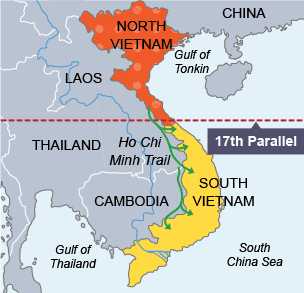
In the 1950s, the United States became involved in the Vietnam War. Why did the United States become involved in this war?
a)
to prevent the collapse of the government of North Vietnam
b)
to stop Vietnam from taking over Hong Kong
c)
to stop the spread of communism to South Vietnam
d)
to prevent attacks against United States shipping
116.

How did the US respond to finding out that the Soviets had missiles in Cuba?
a)
They sent the Air Force to bomb Cuba
b)
They began placing missiles in the Soviet Union.
c)
They placed a naval blockade around Cuba.
d)
They invaded Cuba and the Soviet Union.
117.

Who were the two participants in the Space Race?
a)
The US and Cuba
b)
China and US
c)
The USSR and US
d)
US and North Vietnam
118.

What was the name of the first satellite in space launched by the Soviet Union?
a)
Gagarin
b)
Apollo 11
c)
Sputnik
d)
Apollo 13
119.
Who was the first president of the Russian Federation that was directly elected by the people?
a)
Vladmir Putin
b)
Boris Yeltsin
c)
Mikhail Gorbachev
d)
Dmitry Medvedev
120.
What Soviet leader helped bring an end to the Cold War?
a)
Joseph Stalin
b)
Mikhail Gorbachev
c)
Ronald Reagan
d)
Pol Pot
121.
Which of Gorbachev's programs did he begin to allow Soviet citizens freedom of speech?
a)
Glasnost
b)
Perestroika
122.
Which of Gorbachev's programs did he begin to allow Soviet citizens some capitalism?
a)
Glasnost
b)
Perestroika
123.
What happened to East and West Germany after the Fall of the Berlin Wall?
a)
They kept the same political system
b)
They unified into one democratic country
c)
They unified into one communist country
d)
They rebuilt the wall.
124.
During the Cold War, which event happened last?
a)
Launching of SPUTNIK
b)
Cuban Missile Crisis
c)
Berlin Airlift
d)
Destruction of Berlin Wall
125.
What type of economic system was used in the USSR, China and North Korea?
a)
Capitalism
b)
Command Economy
c)
Mixed Economy
d)
Mercantilism
126.
How was the UN different from the League of Nations?
a)
The United States refused to join the UN
b)
The League of Nations focused on preventing wars
c)
The UN was given the ability to use military power
d)
The League of Nations created a Security Council
127.
What event prompted the Soviet Union to form the Warsaw Pact?
a)
the formation of NATO
b)
the Cuban Missile Crisis
c)
the Korean War
d)
the launch of Sputnik
128.

The countries to the east of the bold black line were all members of what group?
a)
the Warsaw Pact
b)
the North Atlantic Treaty Organization (NATO
c)
the Axis Powers
d)
the Southeast Asia Treaty Organization (SEATO
129.

What is shown in the two marked areas on this map?
a)
the North Atlantic Treaty Organization and the Warsaw Pact
b)
the World Trade Organization and the International Monetary Fund
c)
the Allied Powers and the Axis Powers
d)
the Protestants and the Catholics
130.
Who led the independence movement in India?
a)
Nelson Mandela
b)
Mahatma Gandhi
c)
Kwame Nkrumah
d)
Jomo Kenyatta
131.
What is NOT a strategy that Gandhi used to gain independence from England?
a)
violence
b)
civil disobedience
c)
fasting
d)
Salt March
132.
As a result of giving India its independence, what did the British do to the Indian Subcontinent?
a)
Split it into two countries
b)
Dropped a bomb on it
c)
Shut down all European trade
d)
Declared war
133.
As a result of giving India its independence, what did the British do to the Indian Subcontinent?
a)
Split it into two countries
b)
Dropped a bomb on it
c)
Shut down all European trade
d)
Declared war
134.
What Southeast Asian country gained its Independence from the United States?
a)
Portugal
b)
Puerto Rico
c)
The Philippines
d)
Ghana
135.
Who led Kenya to getting their Independence and who did they win it from?
a)
Jomo Kenyatta, British
b)
Nelson Mandela, British
c)
Kwame Nkrumah, France
d)
Jomo Kenyatta, France
136.
Who led South Africa to its Independence by using peaceful civil disobedience?
a)
Mahatma Gandhi
b)
Jomo Kenyatta
c)
Kwame Nkrumah
d)
Nelson Mandela
100 %

