
NEW
Font size
S
M
L
XL
 Worksheets
US History EOC Review
Total questions: 30
Worksheet time: 15mins
Name
Class
Date
1.

Was the promise of religious, social, and political freedom in America a push or pull factor for immigrants?
a)
Push
b)
Pull
2.

What was Ellis Island?
a)
An amusement park
b)
An immigration center in New Jersey
c)
An immigration center in New York
d)
The first capital of the United States
3.
I had a monopoly on the steel industry. I am ______________
a)
Thomas Edison
b)
John D. Rockefeller
c)
The Wright Brothers
d)
Andrew Carnegie
4.
This man invented the assembly line that he used to make his Model T.
a)
Henry Ford
b)
Thomas Edison
c)
Andrew Carnegie
d)
JP Morgan
5.
Captains of Industry or __________ ruthlessly took advantage of workers and destroyed competitors to get rich
a)
Political Bosses
b)
Freedman's Bureau
c)
Robber Barons
d)
Poor Immigrants
6.

In 1906 I Wrote The Jungle which exposed the conditions in the U.S. meat packing industry. (Helped pass the Pure Food and Drug Act)
a)
Upton Sinclair
b)
Lincoln Steffens
c)
Jacob Riis
d)
Frank Norris
7.
Social Darwinism promoted the idea that..
a)
people in lower classes were not capable of economic success
b)
immigration weakened national unity
c)
the government should take responsibility for the well-being of people
d)
poverty could be eradicated through increased economic regulation
8.

The U.S. declared war on Spain after
a)
the Maine exploded in Havana Harbor
b)
an attempted assasination of President Cleveland
c)
the Spanish invaded Puerto Rico
d)
the failed rebellion of José Martí
9.
Who was the President during the building of the Canal and was the 1st to leave America?
a)
Teddy Roosevelt
b)
William Howard Taft
c)
Woodrow Wilson
d)
Franklin Roosevelt
10.
Which statement is NOT true about the territories the U.S. gained after the war?
a)
The U.S. had control over the Philippines until they gained their independence in 1946
b)
The U.S. still controls Guam and Puerto Rico today
c)
Cuba became independent after The Treaty of Paris was signed in 1898
d)
The U.S. gained control over The Philippines, Cuba, Guam, and Puerto Rico
11.

The assassination of which leader was the spark that started WWI?
a)
Tsar Nicholas II of Russia
b)
Emperor Franz Josef of Austria-Hungary
c)
King George V of England
d)
Archduke Franz Ferdinand of Austria-Hungary
12.

What were the causes of World War I? (hint: MAIN)
a)
alliances, socialism,communism, realism
b)
imperialism, capitalism, mercantilism, fascism
c)
militarism, alliances, imperialism, nationalism
d)
communism, nazism, racism, militarism
13.
What happened to the British passenger ship, the "Lusitania?"
a)
It began the blockade on Germany.
b)
The Germans sank the ship by bombing it from its new airplanes.
c)
The Germans sank the ship with its submarines and killed over 100 Americans.
d)
The British accidentally sank the ship with their own submarine.
14.
During WWI, there was a "Great __________" of almost 500,000 African Americans who left the South to the cities of the North hoping to escape poverty,discrimination and find jobs.
a)
100,000 Man March
b)
Pandora's Box
c)
Migration
d)
Summit
15.
What effect did the Dust Bowl storms have on the Great Depression?
a)
Many farmers were forced to leave the Great Plains.
b)
Unemployment decreased gradually.
c)
Many homes along the Mississippi River were flooded.
d)
Hoover was re-elected as president.
16.
What were the major goals of the New Deal?
a)
no gold standard and free coinage of silver
b)
abolition and suffrage
c)
relief, recovery, and reform
d)
expanding the size and economic influence of the United States
17.
This president thought the federal government should not get involved in the economy. As a result, many Americans blamed him for the Great Depression. This caused him to lose the election in 1932.
a)
Franklin Delano Roosevelt
b)
Theodore Rooselvelt
c)
Herbert Hoover
d)
Calvin Coolidge
18.

Which of the following was NOT a cause of the Great Depression?
a)
an increase in productivity without an increase in wages
b)
trade imbalance with Europe
c)
strong automobile sales
d)
overproduction of farm products
19.

The successful Allied invasion of France was known as
a)
Battle of Midway
b)
Battle of the Bulge
c)
D-Day
d)
Battle of El Alamein
20.
Why is the Cold War considered a “cold” war, compared to WWII, a “hot” war?
a)
Most of the fighting took place in the cooler Northern Hemisphere
b)
The Soviet Union is located in a fairly cold area
c)
The Soviets and Americans never actually fought against one another with weapons
d)
The United States believed a nuclear war would end the seasons and it would be cold on Earth
21.
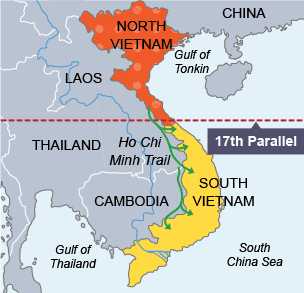
In the 1950s, the United States became involved in the Vietnam War. Why did the United States become involved in this war?
a)
to prevent the collapse of the government of North Vietnam
b)
to stop Vietnam from taking over Hong Kong
c)
to stop the spread of communism to South Vietnam
d)
to prevent attacks against United States shipping
22.
How did the Cuban Missile Crisis end?
a)
The Soviets and the U.S. entered into a nuclear war
b)
It never really ended, there are still tensions today
c)
Soviets backed down and pulled their missiles out of Cuba
d)
the Cubans forced the Soviets to leave because they didn't want war with the U.S.
23.

Senator Joseph McCarthy won national attention when he...
a)
Was convicted as a spy.
b)
Claimed hundreds of government employees were communists.
c)
Helped Eisenhower become president.
d)
Went to Korea and said atomic weapons should be used to break the stalemate.
24.
What did the Iron Curtain divide?
a)
North and South Korea
b)
Soviet Union and China
c)
Eastern and Western Europe
d)
America and Europe
25.

After Brown v. Board of Education, 9 AA students were admitted into a High School. The governor and state national guard stood in front of the doors stopping the admission. President Eisenhower sent federal troops to escort the students. Where did the event take place?
a)
Little Rock, Arkansas
b)
Montgomery, Alabama
c)
Washington DC
d)
Del Rio, Texas
26.

How did Martin Luther King, Jr.'s "I Have a Dream" speech impact the civil rights movement?
a)
It called for violent resistance, resulting in riots across the country.
b)
It inspired many people, giving strength and momentum to the movement.
c)
It was largely ignored by the movement, though regarded as a superbly written speech.
d)
It was considered controversial and fragmented the movement into small groups.
27.
The policy objectives of Reaganomics were based on the theory that —
a)
borrowing from foreign countries would help cover the costs of domestic programs
b)
significant increases in government spending would help reduce unemployment
c)
broad tax cuts and financial deregulation would promote economic expansion
d)
reducing trade barriers would result in a budget surplus
28.
Broad tax cuts, and financial deregulation, which would promote economic expansion, are examples of what policy's objective:
a)
Reaganomics
b)
Trade Imbalance
c)
Iran-Contra Affair
d)
Heritage Foundation
29.
How did the Watergate Scandal affect American politics?
a)
It had a negative impact because it caused distrust in the government.
b)
It had a positive impact because it brought the people together.
c)
It didn't impact anything.
30.

What did Iranian student activists do when the Shah of Iran was treated in an American hospital?
a)
they terrorized American travelers in Europe
b)
they forced an attack on Iraq
c)
they seized the American embassy and took hostages
d)
they staged an overthrow of the government
Reset

