
 Worksheets
2nd semester 8th grade modified
Total questions: 22
Worksheet time: 44mins
Name
Class
Date
1.
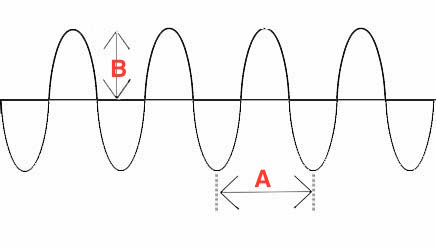
What property of this wave is represented by the letter "A"
a)
amplitude
b)
crest
c)
wavelength
2.

Which vocabulary term is used to identify the distance between points C & G?
a)
Wavelength
b)
Crest
c)
Frequency
3.
The highest point on a wave is:
a)
the crest
b)
the trough
c)
the top
4.
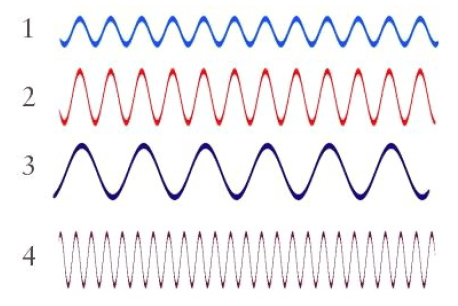
Which wave in the diagram has the greatest frequency?
a)
4
b)
3
c)
2
5.
The positive particles of an atom are
a)
electrons
b)
protons
c)
neutrons
6.
What is the mass number?
a)
the number of protons
b)
the number of protons and neutrons
c)
the number of neutrons
7.

"For every action, there is an equal and opposite reaction."
a)
Newton's 1st Law
b)
Newton's 2nd Law
c)
Newton's 3rd Law
8.

This is an example of a/an:
a)
Closed circuit
b)
Open circuit
9.

What happens when the area in which you live tilts away from the sun?
a)
It is summer.
b)
It is spring.
c)
It is winter.
10.
What is the longest day of the year?
a)
winter solstice
b)
summer solstice
c)
fall equinox
11.
Why do we experience the changing of the season on the earth?
a)
tilt of the earth's axis
b)
rotation of the earth
c)
change in solar output
12.

Why is the Equator warmest?
a)
Because it is closest to the sun.
b)
Because it receives the most direct sunlight
c)
Because no clouds form here.
13.
Object spinning on its axis.
a)
revolution
b)
rotation
14.
One rotation of Earth is equal to
a)
a day.
b)
a year.
15.
How long does it take the earth to revolve once around the sun?
a)
12 hours
b)
365.25 days
c)
30 days
16.

What does the earth's tilt cause?
a)
The seasons
b)
Day and Night
c)
Tsunamis
17.

For a solar eclipse to occur, what has to happen?
a)
The sun must be directly between Earth and the moon.
b)
The moon must be directly between Earth and the Sun.
c)
Earth must be directly between the Sun and the moon.
18.
How are electrons arranged in an atom?
a)
In groups of five
b)
In energy levels
c)
By color
d)
By shape
19.
What is an atom?
a)
giant object
b)
building block of matter
c)
molecule
d)
compound
20.

What are the 3 subatomic particles that make-up the atom?
a)
protons, neutrons, and isotopes
b)
neutrons, isotopes, and electrons
c)
positives, negatives, and electrons
d)
protons, neutrons, and electrons
21.
What does the nucleus consist of?
a)
Protons + Neutrons
b)
Neutrons + Electrons
c)
Atoms
22.

In summer, the axis of the earth is pointed away or toward the sun?
a)
towards
b)
up
c)
down
100 %

