
 Worksheets
Physical Science Final Exam Review Part 2
Total questions: 69
Worksheet time: 54mins
Name
Class
Date
1.

A battery converts what type of energy to another?
a)
sound to kinetic
b)
light to heat
c)
mechanical to electrical
d)
chemical to electrical
2.
Work is:
a)
A transfer of energy by a force to move and object
b)
Something you get paid for
c)
Something you take home
d)
Makes you sweat
3.
True or false: the energy an object has by virtue of its motion is called its kinetic energy.
a)
True
b)
False
4.
True or false: the rate at which work is done is called power.
a)
True
b)
False
5.
How much work is done on a 50 N rock that you lift 10 m straight up?
a)
500 J
b)
50 J
c)
10 J
d)
1 J
6.
A 5kg squirrel sits in a tree 20m from the ground. What is it's G.P.E.?
a)
980 J
b)
9800 J
c)
98000 J
d)
98 J
7.
What is the G.P.E. of a scoreboard located 25 m above the floor with a mass 5000kg?
a)
1960 J
b)
19600 J
c)
122,500 J
d)
1,225,000 J
8.
A 25kg race car driver drives a 250kg car down a drag strip with a speed of 100m/s. What is kinetic energy of the car and driver?
a)
1,250,000 J
b)
137,500 J
c)
1,375,000 J
d)
13,750,000 J
9.

This is an example of a _______ circuit
a)
open
b)
series
c)
parallel
d)
square
10.
In a parallel circuit, if one connection is broken, all of the connections stop working.
a)
True
b)
False
11.
A series circuit has ____ path(s) that the electric current can take.
a)
One
b)
Two
c)
Three
d)
Four
12.

The flow of electrical energy starts at the ___ side of the d-cell.
a)
negative
b)
positve
c)
complete circuit
d)
bulb
13.

What type of circuit is pictured?
a)
A. alternating
b)
B.overloaded
c)
C.parallel
d)
D. series
14.
A material in which electrons are not able to move easily
a)
Circuit
b)
Insulator
c)
Resistance
d)
Conductor
15.
When you are holding a book, energy is stored between the book and Earth; this type of energy is called ________ potential energy.
a)
Kinetic
b)
Potential
c)
Gravity
d)
Friction
16.
A material in which electrons are able to move easily
a)
Circuit
b)
Insulator
c)
Resistance
d)
Conductor
17.
Energy can be _____________ or changed from one type to another.
a)
destroyed
b)
transferred
c)
created
d)
ignored
18.

At which point is potential energy greatest
a)
W
b)
X
c)
Y
d)
Z
19.

As a pendulum swings from its highest to lowest position, what happens to its kinetic and potential energy?
a)
Both the potential energy and kinetic energy decrease
b)
The potential energy decreases while the kinetic energy increases
c)
The kinetic energy decreases while the potential energy increases
d)
Bothe the potential energy and kinetic energy increase
20.

What is the unit of Potential Energy?
a)
m, mass
b)
kg, kilogram
c)
J, Joules
d)
m/s, meters/second
21.

At which point is kinetic energy greatest
a)
W
b)
X
c)
Y
d)
Z
22.

What is the v in this equation? Choose the one with the CORRECT unit!
a)
volume (m3)
b)
velocity (m/s)
c)
velocity (m/s2)
d)
volume (v)
23.

What is the g? Choose the one with the correct unit!
a)
mass (kg)
b)
gravity (m/s)
c)
gravity (m/s2)
d)
grams (g)
24.

When a pendulum swings, at which point is kinetic energy highest:
a)
1
b)
2
c)
3
d)
4
25.

You drop a 5 kg ball from a height of 2 m. Just before it reaches the ground, what is the ball's velocity?
a)
6.32 m/s
b)
40 m/s
c)
4.47 m/s
d)
100 m/s
26.
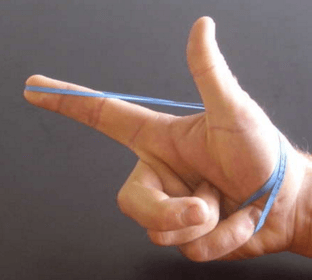
A stretched rubber band.
a)
Potential
b)
Kinetic
27.

A person climbing a ladder.
a)
Potential
b)
Kinetic
c)
Both
28.

A rock at the edge of a cliff.
a)
Potential
b)
Kinetic
29.
What does work do?
a)
Changes energy
b)
Moves the object
c)
Causes force
d)
Makes you sweat
30.
What is the unit for work and energy?
a)
N
b)
m
c)
J
d)
kgm/s
31.

"For every action, there is an equal and opposite reaction."
a)
Newton's 1st Law
b)
Newton's 2nd Law
c)
Newton's 3rd Law
d)
Newton's 4th Law
32.

Force = Mass x Acceleration
a)
Newton's 1st Law
b)
Newton's 2nd Law
c)
Newton's 3rd Law
d)
Newton's 4th Law
33.

"An object in motion (or at rest) will to stay in motion (or at rest) until an outside force acts upon it."
a)
Newton's 1st Law
b)
Newton's 2nd Law
c)
Newton's 3rd Law
d)
Newton's 4th Law
34.

The force that opposes motion between two surfaces in contact with each other.
a)
inertia
b)
friction
c)
momentum
d)
gravity
35.

The force of attraction between all matter.
a)
inertia
b)
friction
c)
net force
d)
gravity
36.

A force that opposes motion between a surface in contact with the atmosphere.
a)
air resistance
b)
gravity
c)
momentum
d)
terminal velocity
37.

When all the forces on an object are equal and opposite, & the net force is zero, that's...
a)
balanced forces
b)
unbalanced forces
c)
terminal velocity
d)
reaction forces
38.

The combination of all the forces acting on an object is the...
a)
net force
b)
action force
c)
reaction force
d)
balance force
39.

The net force on a ball thrown on Earth is... (you are no longer touching the ball)
a)
there is none
b)
forward
c)
down and backward
d)
forward and down
40.

In the picture, the vehicle will move because of...
a)
Newton's 1st Law
b)
Newton's 2nd Law
c)
Newton's 3rd Law
d)
Newton's 9th Law
41.
An exploratory robot was sent to the planet Mars. The gravity on Mars is weaker than the gravity on Earth. Compared to the mass and weight of the robot on Earth, the robot on Mars has...
a)
less mass and weight.
b)
less mass but equal weight.
c)
equal mass and weight.
d)
equal mass but less weight.
42.
According to Newton's First Law, an object's velocity will not change unless _____ acts upon it.
a)
a balanced force
b)
an unbalanced force
c)
zero force
43.
A crumpled piece of paper hits the ground before a flat sheet of paper because
a)
the acceleration of gravity is greater on the crumpled paper.
b)
there is more air resistance against the flat paper.
c)
the crumpled paper is more massive
d)
the crumpled paper is less massive.
44.
A greater applied force is required to move an object with a greater mass than one with a smaller mass.
a)
True
b)
False
45.
If a baseball and a cannonball are dropped from the same height at the same time, which ball will hit the ground first?
a)
the cannonball
b)
the baseball
c)
The balls land at the same time.
d)
the ball with the larger volume
46.

Will the light bulb light?
a)
Yes
b)
No
47.

Will the ight bulb Light?
a)
Yes
b)
No
48.

Will the light bulb light?
a)
Yes
b)
No
49.
Waves move ___ through vibrations
a)
Energy
b)
Matter
c)
Mass
d)
Weight
50.
Longitudinal waves are ______.
a)
Parallel
b)
Perpendicular
c)
Crazy
51.
Transverse waves are ___.
a)
Parallel
b)
Perpendicular
c)
Weird
52.
What is the wavelength?
a)
Length
b)
Height
c)
# of waves
53.
What is the amplitude?
a)
length
b)
height
c)
# of waves
54.

Which is the wavelength?
a)
1
b)
2
c)
3
d)
4
55.
The pitch of the sound depends on
a)
frequency
b)
amplitude
c)
wavelength
56.
The loudness of the sound depends on
a)
wavelength
b)
amplitude
c)
frequency
57.

Which EM wave has the longest wavelength?
a)
light
b)
radio
c)
ultraviolet
d)
red
58.
Is refracting light bending or bouncing?
a)
bending
b)
bouncing
59.
A blue tshirt looks blue because of ___.
a)
reflection
b)
refraction
c)
diffraction
60.

Which color has the highest frequency?
a)
blue
b)
yellow
c)
orange
d)
violet
61.
The highest point on a wave is:
a)
the crest
b)
the trough
c)
the top
d)
the coast
62.
The lowest point on a wave is the:
a)
Amplitude
b)
Crest
c)
Trough
d)
Wavelength
63.
The type of waves that require medium to pass:
a)
Mechanical Waves
b)
Electromagnetic Waves
64.
The number of wavelengths that pass a point each per second is:
a)
frequency
b)
period
c)
longitudinal
d)
transverse wave
65.
When the frequency of a wave increases, what happens to the wavelength?
a)
The wavelength is not directly affected by the frequency of a wave.
b)
The wavelength increases.
c)
The wavelength decreases.
d)
More specific information is needed to form a conclusion about the wavelength.
66.

Which wave in the diagram has the greatest wavelength?
a)
1
b)
2
c)
3
d)
4
67.
regular disturbances that carry energy through matter or space
a)
crest
b)
energy
c)
wave
d)
trough
68.
When a wave strikes and object and bounces off. (example echo)
a)
medium
b)
refraction
c)
reflection
d)
interference
69.
which material does sound travel the fastest?
a)
solid
b)
liquid
c)
gases
100 %

