wayground logo

Free Printable Worksheets

NEW

Font size

S
M
L
XL
Worksheets

Korean War & Vietnam War-50's & 60's & early 70's culture

Total questions: 58

Worksheet time: 1hrs 13mins

Name
Class
Date
1.
Which one is an accurate portrayal of how the Korean War ended?
a)
In a stalemate, the 38th parallel remains the dividing line
b)
The North Koreans won, all of Korea is communist
c)
The U.N. withdrew and South Korea won the war.
2.
What did the 38th parallel separate?
a)
Korea
b)
Vietnam
c)
Berlin
d)
Hungary
3.
The Truman Doctrine's main goal was to:
a)
Contain communism
b)
Provide weapons to democratic countries
c)
Help north Korea
d)
Provide collective security
4.
What caused McCarthyism?
a)
President Truman making atomic bombs.
b)
Japanese spies.
c)
Bombing China.
d)
Increased fear of communism.
5.
Launched a televised Red Scare during the 1950s
a)
Nixon
b)
Robinson
c)
McCarthy
d)
Douglas
6.
The United States was involved in the Korean War and the Vietnam War because...
a)
The countries wanted to show support for Germany.
b)
The U.S owed them money from previous wars. 
c)
The U.S did not want a communist takeover in these countries. 
d)
The U.S did not want a democratic takeover in these countries. 
7.
All of the following are true of advertising in the 1950s EXCEPT:
a)
TV commercials were purely informational
b)
Advertisers focused their commercials for a certain audience
c)
Commercials often used flashy images, were mixed with music, and sometimes used celebrities
d)
Advertising executives were highly paid professionals
8.
Rock and Roll gave the young people of the 1950s
a)
a way to conform with their parents’ expectations
b)
the values they needed to live through the depression and war
c)
a stable and secure cultural role
d)
a new style of music they could call their own
9.
How did the US economy respond in the 1950s following WWII?
a)
It was prosperous 
b)
It went into a Depression
c)
It went into a recession
d)
Nothing happened
10.
What was the impact of the GI Bill
a)
Soldiers were paid for their time in the war
b)
Soldiers were forced to sell their property
c)
Soldiers received help for college, businesses, and loans
d)
Soldiers were thrown in jail for their high debts accrued during the war
11.
Where did people start to move to in the 1950s?
a)
Inner cities
b)
Farms
c)
Suburbs
d)
Canada
12.
What was the "Baby Boom?"
a)
Soaring birthrate following WW2
b)
Decline in babies following WW2
c)
Babies becoming smarter
d)
Babies working in factories 
13.
What was an impact of the "Baby Boom?"
a)
Decline in births
b)
Babies ate less food
c)
Babies were able to buy goods
d)
The largest generation in America's history
14.
Separation of races in public places
a)
Black Codes
b)
Segregation
c)
10% Plan 
d)
Carpetbaggers
15.
Belief that one race or group of people is superior to another
a)
Segregation
b)
Carpetbaggers
c)
Scalawags
d)
Racism
16.
Favoring one group or person over another
a)
Racism
b)
Black Codes
c)
Segregation
d)
Discrimination
17.
Laws that kept blacks and whites seperate
a)
Black Codes
b)
Segregation
c)
Literacy test
d)
Jim Crow Laws
18.
Supreme Court decision that stated "separate but equal" was Constitutional (1896)
a)
Wade-Davis Bill
b)
Compromise of 1877
c)
Brown v Board of Education
d)
Plessy v Ferguson
19.
Why did Southern Democrats pass Jim Crow laws?
a)
to assure equal education for all
b)
to separate African Americans and whites in public life
c)
to encourage Southerners to move to the North
20.
How would a free market economy be described?
a)
An economy in which decisions are made by the government.
b)
The international exchange of goods.
c)
An economy based on supply and demand with little or no government control
d)
An economy that is communist
21.
What is Capitalism?
a)
A system where the government controls business
b)
Capitalism is an economic system where the means of production are privately owned and operated for profit! 
c)
A economic system in which the people have limited rights
d)
An economic system in which most property and resources, such as factories or farms, are publicly owned or controlled.
22.

Mr. Hartz & Mr. Linde are in charge of running a car mechanic shop that is owned by the government. They do not receive any of the profit and they make the same amount as everyone else that works for them.

a)

Capitalism

b)

Socialism

c)

Communism

d)

Democracy

23.
An economic system in which the means of production is owned by the government and private ownership doesn't exist.
a)
Capitalism
b)
Imperialism 
c)
Socialism
d)
Communism 
24.
Which of the following is not true about McCarthyism?
a)
It was the hunting down of suspected Communist in America
b)
named after  Joseph McCarthy
c)
The House Un-American Activities Committe (HUAC) participated
d)
If Communist were discovered they were immediately executed
25.
The 1957 launch of Sputnik by the Soviet Union embarrassed the United States because it
a)
allowed the Soviets to place missiles in Turkey
b)
revealed that the Soviets had nuclear weapons
c)
appeared that the United States had failed to keep up in scientific achievement
d)
confirmed the United States use of U-2 spy planes
26.
Which characteristic of American life in the 1950s is illustrated in this cartoon?
a)
 growth of the elderly population
b)
effects of suburbanization
c)
 decreasing use of automobiles
d)
declining importance of the media
27.
Who is the "king" of rock and roll?
a)
Adam Levine
b)
Usher
c)
Blake Shelton
d)
Elvis
28.
This is a system of society where all things are owned and controlled by the government
a)
Communism
b)
Democracy
c)
Monarchy
d)
Direct Democracy
29.
Napalm is...
a)
a flamable liquid used in warfare.
b)
an essential oil used in first aid. 
c)
a juice used to quench thirst.
d)
a granade. 
30.
After the Civil Rights Act of 1964 was passed, it was no longer legal to
a)
let African Americans ride the bus.
b)
deny someone of a job because of their race.
c)
fire someone for not doing their job.
d)
kick someone out of the military.
31.
Which event is MLK, Jr. most known for?
a)
being President during the Civil Rights Movement.
b)
not giving up his seat to a white man.
c)
creating Jim Crow laws.
d)
March on Washington
32.
What did the court case Brown vs Board of Ed establish?
a)
Public buses could not discriminate.
b)
Segregation is not legal in theaters and hotels.
c)
Public schools could not segregate.
d)
All-black schools must be equal to all-white schools.
33.
Rosa Parks is most associated with
a)
March on Washington
b)
militant movements.
c)
Montgomery Bus Boycott
d)
Brown v. Board of Education
34.

Which communist nation is most closely associated with the leadership of Ho Chi Minh and the surrender of Saigon?

a)

North Korea

b)

Vietnam

c)

Soviet Union

d)

Russia

35.

Who was the communist leader of Vietnam and the surrender of Saigon?

a)

Josef Stalin

b)

Ho Chi Mihn

c)

Mikhail Gorbachev

d)

Adolf Hitler

36.
The Vietcong fought against
a)
North Vietnam
b)
United States
c)
France
d)
Japan
37.
What does the word “escalation” mean with respect to President Johnson’s policy toward Vietnam between 1965 and 1968?
a)
slow withdrawal
b)
increased involvement
c)
frequent surprise attacks
d)
full disclosure of information
38.
During the Vietnam War, hawks and doves disagreed mainly over whether
a)
funding domestic programs was more important than winning the Cold War
b)
U.S. forces should use a nuclear bomb to force the Vietcong to surrender
c)
the United States should have a draft
d)
protesting the war was unpatriotic
39.

What did President Nixon do on April 30, 1970 to infuriate many Americans?

a)

He began slowly withdrawing U.S. troops from Vietnam without the knowledge of Congress or the people.

b)

He announced that he had sent U.S. troops into Cambodia, expanding the war he had promised to end.

c)

He authorized the use of force by National Guard troops against students on college campuses.

d)

He did nothing; making things worse.

40.
What kind of government did Ho Chi Minh want?
a)
Communist
b)
Democratic
c)
Socialist
d)
Monarchy
41.
What was the chemical used to kill the vegetation in Vietnam?
a)
Agent Orange
b)
Agent Yellow
c)
Agent Napalm
d)
Agent Magenta
42.
Networks of jungle paths used by N. Vietnam to transport supplies to the Vietcong?
a)
Saigon Route
b)
Bataan Death March
c)
Trail of Tears
d)
Ho Chi Minh Trail
43.
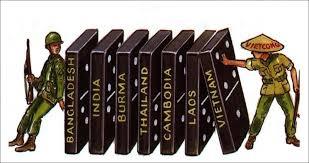
The idea that if South Vietnam fell to communism, other nations would soon follow...
a)
Vietnamization 
b)
Communism
c)
Domino Theory
d)
Imperialism
44.
Allowed the public to be negatively influenced concerning the  Vietnam war?
a)
Television and media bias
b)
Radio 
c)
Telegraph
d)
Internet
45.
In Vietnam the fighters used an irregular warfare tactic that made it difficult for our soldiers to be successful...it was called?
a)
Vietnamese Warfare tactics
b)
Cheetah Warfare
c)
Hidden Warfare
d)
Guerrilla warfare
46.
What were the problems of fighting in Vietnam?
a)
Identifying the enemy 
b)
Jungle/Location provided cover and a place to transport enemy supplies
c)
Weather and climate
d)
all of these
47.
This limits the power of the President during a time of conflict.
a)
Voting Rights Act
b)
Economic Opportunity Act
c)
Gulf of Tonkin Resolution
d)
War Powers Act
48.
In what year did the U.S. and North Vietnam agree to stop fighting in the Vietnam War?
a)
1945
b)
1965
c)
1973
d)
1991
49.

This Act requires the president to get congressional approval before committing U.S. troops to an armed struggle...

a)

24th Amendment

b)

Limited Test Ban Treaty

c)

War Powers Act

d)

Act of Aggression

50.
Look at the map: where is Vietnam?
a)
#4
b)
#8
c)
#5
d)
#3
51.
In the Vietnam War era, people outside the cultural norm were part of the...
a)
        Conservatives
b)
       Counterculture
c)
            In-Crowd
d)
            Liberals
52.
This 1969 Arts and Music Festival was a celebration of Peace during the Vietnam War...
a)
        Mile of Music
b)
National Folk Festival
c)
         Woodstock
d)
Essence Music Festival
53.
What style of warfare did the Vietcong use?
a)
Guerilla
b)
Trench
c)
Aerial
d)
Traditional
54.

What is one way in which the United States was affected after the Vietnam War ended?

a)

North Vietnam took control of the United States.

b)

More than 58,000 soldiers dies & more than 150,000 were wounded.

c)

The United States gained a tremendous amount of natural resources, making the War a huge success.

d)

It threw the United States into an economic downward spiral; causing bankruptcy.

55.
What are Civil Rights?
a)
Rights that only some citizens get
b)
Rights that all citizens get
c)
 Rights that are civil
d)
Rights that are controlled by the president
56.
How did newspapers and media play a role in the Civil Rights Movement?
a)
They showed how great Jim Crow laws were
b)
They showed how unfair Jim Crow laws were and helped convince people to join the Civil Rights Movement
c)
 They made a lot of money following Martin Luther King Jr. 
d)
All of the above
57.
Why did the United States begin to send advisers and troops to Vietnam in the 1950s?
a)
to prepare for the United States invasion of Laos
b)
to defend American bases in the Gulf of Tonkin
c)
to help the South Vietnamese revolt against the French
d)
to prevent the spread of communism into South Vietnam
58.
Chose the best an explanation of how the Civil Rights Act was a "second emancipation." 
a)
a.  Civil Rights Act helped people.
b)
b.  After the Civil War, slavery was abolished.  Nonetheless, many states used poll taxes, ect. to keep residents from voting.  The Civil Rights Act was like a "second emancipation" because it ended segregation and banned unfair practices by the states based on nationally and race.
c)
c.  The Civil Rights Act included the "Jim Crow" law.
d)
d.  The Civil Rights Act made states treat people equally.