
 Worksheets
PLTW Technology II Final Exam Review
Total questions: 101
Worksheet time: 1hrs 3mins
Name
Class
Date
1.
What does STEM stand for?
a)
systems, technology, engineering, math
b)
science, technology, engineering, math
c)
science, technology, energy, modeling
2.
Leah was asked to build Thomas a table for his room. The table needs to cost less than $100 total and should be large enough for Thomas to put a plate on top with a drink and needs to be made of wood. Also, the table should be painted purple.
which of the following is a constraint?
which of the following is a constraint?
a)
the table should be large enough to hold a drink
b)
the table must cost less than $100
c)
The table should be purple
d)
all of the above
3.
What should you measure the length of a pencil with?
a)
caliper
b)
yard stick
c)
ruler
4.
Calipers are precision measuring devices that measure to the ______________ of an inch
a)
thousandths
b)
hundredths
c)
tenths
5.
If you were to measure an object to be 7 ½ inches long, what system of measurement have you used?
a)
the Forsberg System
b)
The metric system
c)
the Standard system
d)
the mana system
6.
Which of these measurements is the largest?
a)
1 yard
b)
1 meter
c)
1 centimeter
d)
1 inch
7.
The majority of the worlds population uses inches, feet and miles as their main unit of measurement.
a)
true
b)
false
8.
Which step of the Engineering Design Process includes detailed sketches?
a)
Define Problem
b)
Generate Concepts
c)
Develop a Soultion
d)
Construct Prototype
9.
Which is not a unit of measure in the US customary system?
a)
Inch
b)
Foot
c)
Yard
d)
Meter
10.
Which step of the Engineering Design Process comes after brainstorming?
a)
Define Problem
b)
Generate Concepts
c)
Develop a Soultion
d)
Construct Prototype
11.
How many centimeters in a meter
a)
10
b)
100
c)
1,000
d)
100,000
12.
How many feet in a mile?
a)
5,280
b)
5,000
c)
5,820
d)
5,200
13.
Which step of the Engineering Design Process includes brainstorming?
a)
Define Problem
b)
Generate Concepts
c)
Develop a Soultion
d)
Construct Prototype
14.

What is the depth of the wall?
a)
2 m
b)
.23 m
c)
2 m * 2 m
d)
.23 m* .23 m
15.

This is an example of what kind of sketch?
a)
Isometric
b)
Full
c)
Dimensioned
d)
Multiview
16.

What is the correct measurement for is block?
a)
2 1/4 cm
b)
2 2/8 in
c)
2 1/4 in
d)
2 1/4 ft
17.

What is the correct measurement for this block?
a)
2.294 in
b)
2.194 in
c)
2.194 cm
d)
2.294 cm
18.

What is the area?
a)
10 cm
b)
10 cm squared
c)
10 in
d)
10 in squared
19.

What is the area?
a)
I am so done!
b)
4 cubed meters
c)
4 square meters
d)
It's a wall, who cares?!
20.

What is the volume?
a)
30 square feet
b)
30 cubed feet
c)
36 cubed feet
d)
36 square feet
21.

What is the measurement?
a)
4 cm 5 mm
b)
4.5 cm
c)
blue
d)
green
22.

What type of sketch?
a)
Color
b)
Multiview
c)
Dimensioned Multiview
d)
Isometric
23.

How many whole cm?
a)
0
b)
1
c)
2
d)
3
24.

a)
0.670 in
b)
0.670 cm
c)
0.600 in
d)
0.700 in
25.

a)
4.44 in
b)
4.044 in
c)
4.004 in
d)
3.944
26.

What is the formula to solve this?
a)
volume = b * h
b)
volume = (a * h)/3
c)
volume = a * h
d)
volume = (b * h)/3
27.

How would you find the area of this sign?
a)
length * width
b)
length * width * height
c)
Add the lengths of all 4 sides
d)
Is this close to being over?
28.

What is the measurement?
a)
13 cm
b)
12 cm 9 mm
c)
12.9 cm
d)
green
29.

How many mm?
a)
2
b)
2.0
c)
20
d)
200
30.
By using various combinations of light & shadow, you can create a sense of depth.
a)
TRUE
b)
FALSE
31.
By incorporating the use of space in your design, you can enlarge or reduce the visual space.
a)
TRUE
b)
FALSE
32.
RED gives a sense of __________________.
a)
Warmth
b)
Formal
c)
Attention
d)
Mystery
33.
BLUE gives a sense of __________________.
a)
Warmth
b)
Cool or Formal
c)
Attention
d)
Mystery
34.
GREEN gives a sense of __________________.
a)
Less tension
b)
Cool or Formal
c)
Attention
d)
Mystery
35.
YELLOW gives a sense of __________________.
a)
Less tension
b)
Cool or Formal
c)
Attention
d)
Mystery
36.
PURPLE gives a sense of __________________.
a)
Less tension
b)
Warmth
c)
Attention
d)
Mystery
37.
A limit to the design process. It may be such things as appearance, funding, space, materials, and human capabilities.
a)
Aesthetics
b)
Consumer
c)
Criteria
d)
Constraints
38.
Pleasing in appearance.
a)
Aesthetics
b)
Consumer
c)
Criteria
d)
Constraints
39.
Desired specifications (elements or features) of a product or system.
a)
Aesthetics
b)
Consumer
c)
Criteria
d)
Constraints
40.
A person or household that purchases goods or services.
a)
Aesthetics
b)
Consumer
c)
Criteria
d)
Constraints
41.
A method of shared problem solving in which all members of a group spontaneously, and in an unrestrained discussion, generate ideas.
a)
Aesthetics
b)
Brainstorming
c)
Criteria
d)
Constraints
42.
A person who is trained in and uses technological and scientific knowledge to solve practical problems.
a)
Engineer
b)
Design Process
c)
Ergonomics
d)
Design Elements
43.
The study of workplace equipment design or how to arrange and design devices, machines, or workspace so that people and things interact safely and most efficiently.
a)
Engineer
b)
Design Process
c)
Ergonomics
d)
Design Elements
44.
A systematic problem-solving strategy, with criteria and constraints, used to develop many possible solutions to a problem or to satisfy human needs and wants and winnow (narrow) down the possible solutions to one final choice.
a)
Engineer
b)
Design Process
c)
Ergonomics
d)
Design Elements
45.
The factors (e.g., line, color, light, shadow, space, texture) that define a product and take into account the aesthetics and function of the product.
a)
Engineer
b)
Design Process
c)
Ergonomics
d)
Design Elements
46.
A full-scale working model used to test a design concept by making actual observations and necessary adjustments.
a)
Prototype
b)
Model
c)
Research
d)
Problem Solving
47.
A visual, mathematical, or three-dimensional representation in detail of an object or design, often smaller than the original.
a)
Prototype
b)
Model
c)
Research
d)
Problem Solving
48.
The feel, appearance, or consistency of a surface, substance, or fabric.
a)
Prototype
b)
Model
c)
Texture
d)
Problem Solving
49.
A curved line gives a sense of ________________________.
a)
Graceful Flow
b)
Increases length
c)
Increases height
d)
shows a transition
50.
A vertical line gives a sense of ________________________.
a)
Graceful Flow
b)
Increases length
c)
Increases height
d)
shows a transition
51.
A horizontal line gives a sense of ________________________.
a)
Graceful Flow
b)
Increases length
c)
Increases height
d)
shows a transition
52.
What is a 3-dimensional square?
a)
Square
b)
Cube
c)
Circle
d)
Sphere
53.
What is a 2-dimensional sphere?
a)
Square
b)
Cube
c)
Circle
d)
Sphere
54.
Which is not a Design Element?
a)
Line
b)
Light and Shadow
c)
Space
d)
Size
55.
Which is not a Design Element?
a)
Shapes and Form
b)
Texture
c)
Color
d)
Brainstorming
56.
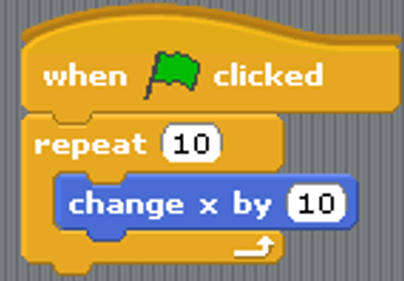
a)
Go Up
b)
Go Down
c)
Go Left
d)
Go Right
57.

a)
Draw random colors
b)
Draw random shapes
c)
Noting, code is broken
d)
Draw random colours in random spots
58.
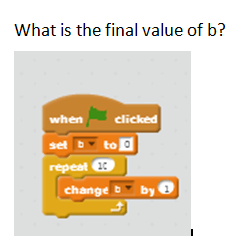
a)
0
b)
9
c)
10
d)
11
59.

The Sprite will move...
a)
Up
b)
Down
c)
Left
d)
Right
60.

The Sprite will move...
a)
Up
b)
Down
c)
Left
d)
Right
61.

What element of design is it to make a game in platform perspective?
a)
Space
b)
Mechanics
c)
Components
62.

What element of design when the game screen wraps around?
a)
Space
b)
Mechanics
c)
Components
63.

What element of design is it when there are multiple screens, either horizontal or vertical, in the game space?
a)
Space
b)
Mechanics
c)
Components
64.

What element of design is it to have the game space closed on the sides?
a)
Space
b)
Mechanics
c)
Components
65.

What element of design is it to have your avatar leave or fall off of the screen?
a)
Space
b)
Mechanics
c)
Components
66.

What element of design is it to have a top-down perspective?
a)
Space
b)
Mechanics
c)
Components
67.

What element of design is it to set your avatar's speed?
a)
Space
b)
Mechanics
c)
Components
68.

What element of design is it to have an avatar solve puzzles?
a)
Space
b)
Mechanics
c)
Components
69.

What element of design is it to have an avatar collect points?
a)
Space
b)
Mechanics
c)
Components
70.

What element of design is it to have a jumping avatar?
a)
Space
b)
Mechanics
c)
Components
71.

What element of design is having an avatar that can blast?
a)
Space
b)
Mechanics
c)
Components
72.

What element of design is a frag counter?
a)
Space
b)
Mechanics
c)
Component
73.

What element of design is a score keeper?
a)
Space
b)
Mechanics
c)
Component
74.

What element of design is an avatar?
a)
Space
b)
Mechanics
c)
Component
75.

What element of design is a timer?
a)
Space
b)
Mechanics
c)
Component
76.

What element of design is a point?
a)
Space
b)
Mechanics
c)
Component
77.

What element of design is a key?
a)
Space
b)
Mechanics
c)
Component
78.

What element of design is an enemy?
a)
Space
b)
Mechanics
c)
Component
79.

What element of design is a damage block?
a)
Space
b)
Mechanics
c)
Component
80.

What element of design is a Goal Block?
a)
Space
b)
Mechanics
c)
Components
81.
Goals of the Gamestar Mechanic Unit is for student's to accomplish all of the following except:
a)
Utilize computer programing skills to create video games.
b)
Develop planning and design skills
c)
To teach you the guiding principles of game design
d)
Develop systems thinking in a highly engaging and creative environment.
82.
Which of the following is the most important Design element listed
a)
Rules
b)
Goals
c)
Components
d)
All are important
83.
Avatars that collect or pick up points need this.
a)
The Net option
b)
Collecting Mechanic
c)
Snag Frag Feature
d)
Blasting Mechanic
84.

What is the name of this tool?
a)
Pan tool
b)
Compass tool
c)
Move tool
d)
Expand tool
85.

What is the name of this tool?
a)
Pencil tool
b)
Line tool
c)
Eraser tool
d)
Color tool
86.

What is the name of this tool?
a)
Stanley tool box
b)
Eraser tool
c)
Draw tool
d)
Tape Measure tool
87.

What is the name of this tool?
a)
Trash tool
b)
Pour tool
c)
Paint Bucket tool
d)
Follow Me tool
88.

What action does the Zoom tool perform?
a)
Allows you to push and pull shapes or faces in to, or out of your model.
b)
Allows you to move your model quickly.
c)
Allows you to zoom in and out of the design.
d)
Can be used to duplicate the profile of a face along a path.
89.

What is the name of this tool?
a)
Box tool
b)
Rectangle tool
c)
Push/Pull tool
d)
View tool
90.

What is the name of this tool?
a)
Circle tool
b)
Button tool
c)
Hole tool
d)
Round tool
91.

What action does the Pan tool perform?
a)
Allows you to move your view up, down, left and right, without changing the angle of your view.
b)
Allows you to copy a component as many times as you wish.
c)
Allows you to move your view around the design at any angle.
d)
Allows you to make pan shaped holes in your model.
92.

What action does the Push/Pull tool perform?
a)
It allows you to move around your design
b)
It allows you to create a 3D object
c)
It moves your model upwards
d)
It allows you to add dimensions to your design
93.
Which tool allows you do delete a line or edge?
a)
Follow Me tool
b)
Eraser tool
c)
Paint Bucket tool
d)
Line tool
94.

Calculate the Volume
a)
410 cm3
b)
420 cm3
c)
402 cm3
d)
401 cm3
95.
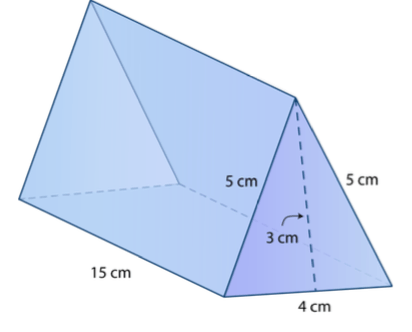
Calculate the volume.
a)
90 cm³
b)
150 cm³
c)
180 cm³
96.

Find the volume
a)
1120 ft2
b)
2011 ft2
c)
120 ft3
d)
1120 ft3
97.
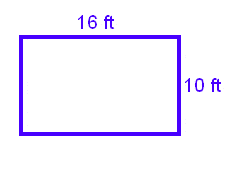
Find the AREA of this figure.
a)
160 square feet
b)
160 feet
c)
160
d)
1600 feet
98.
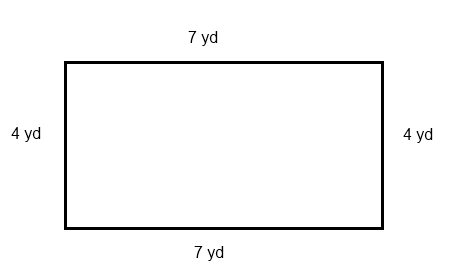
What is the PERIMETER of this rectangle?
a)
22 sq. yd.
b)
22
c)
22 cm
d)
22 yd.
99.
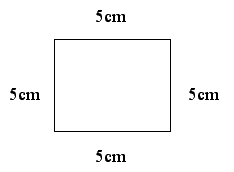
Find the PERIMETER of this figure.
a)
20 square feet
b)
20 cm
c)
25 square feet
d)
20 cm sq.
100.

Cooper used his ruler to measure the side of a square, as shown.
What is the area of the square?
What is the area of the square?
a)
4 sq. in.
b)
8 sq. in.
8 sq. in.
8 sq. in.
c)
12 sq. in.
d)
16 sq. in.
101.

What is the perimeter of this rectangle?
a)
21 units
b)
12 units
c)
3 units
d)
None of the above.
100 %

