wayground logo

Free Printable Worksheets

Font size

S
M
L
XL
Worksheets

Civil Rights & Vietnam War

Total questions: 38

Worksheet time: 1hrs 27mins

Name
Class
Date
1.
Napalm is...
a)
a flamable liquid used in warfare.
b)
an essential oil used in first aid. 
c)
a juice used to quench thirst.
d)
a granade. 
2.
After the Civil Rights Act of 1964 was passed, it was no longer legal to
a)
let African Americans ride the bus.
b)
deny someone of a job because of their race.
c)
fire someone for not doing their job.
d)
kick someone out of the military.
3.
Which event is MLK, Jr. most known for?
a)
being President during the Civil Rights Movement.
b)
not giving up his seat to a white man.
c)
creating Jim Crow laws.
d)
March on Washington
4.
What did the court case Brown vs Board of Ed establish?
a)
Public buses could not discriminate.
b)
Segregation is not legal in theaters and hotels.
c)
Public schools could not segregate.
d)
All-black schools must be equal to all-white schools.
5.
Rosa Parks is most associated with
a)
March on Washington
b)
militant movements.
c)
Montgomery Bus Boycott
d)
Brown v. Board of Education
6.

Which communist nation is most closely associated with the leadership of Ho Chi Minh and the surrender of Saigon?

a)

North Korea

b)

Vietnam

c)

Soviet Union

d)

Russia

7.

Who was the communist leader of Vietnam and the surrender of Saigon?

a)

Josef Stalin

b)

Ho Chi Mihn

c)

Mikhail Gorbachev

d)

Adolf Hitler

8.
Who was the leader of the Soviet Union?
a)
Joseph Stalin 
b)
John Fitzgerald Kennedy
c)
Mikhail Gorbachev
d)
Nikita Khrushchev
9.
What conflict did the Cuban Missile Crisis occur in?
a)
WW2
b)
Cold War
c)
WW1
d)
Vietnam War
10.
When was the Cuban Missil Crisis?
a)
October 14, 1962 to October 28, 1962
b)
October 14, 1961 to October 28, 1961
c)
1947 to 1991
d)
January 26, 1962 to February 5, 1962
11.
The Vietcong fought against
a)
North Vietnam
b)
United States
c)
France
d)
Japan
12.
What does the word “escalation” mean with respect to President Johnson’s policy toward Vietnam between 1965 and 1968?
a)
slow withdrawal
b)
increased involvement
c)
frequent surprise attacks
d)
full disclosure of information
13.
During the Vietnam War, hawks and doves disagreed mainly over whether
a)
funding domestic programs was more important than winning the Cold War
b)
U.S. forces should use a nuclear bomb to force the Vietcong to surrender
c)
the United States should have a draft
d)
protesting the war was unpatriotic
14.

What did President Nixon do on April 30, 1970 to infuriate many Americans?

a)

He began slowly withdrawing U.S. troops from Vietnam without the knowledge of Congress or the people.

b)

He announced that he had sent U.S. troops into Cambodia, expanding the war he had promised to end.

c)

He authorized the use of force by National Guard troops against students on college campuses.

d)

He did nothing; making things worse.

15.

one of the first people to walk on the moon

a)

William Westmoreland

b)

Yuri Gagarin

c)

Neil Armstrong

d)

Will Smith

16.
What kind of government did Ho Chi Minh want?
a)
Communist
b)
Democratic
c)
Socialist
d)
Monarchy
17.
What was the chemical used to kill the vegetation in Vietnam?
a)
Agent Orange
b)
Agent Yellow
c)
Agent Napalm
d)
Agent Magenta
18.
Networks of jungle paths used by N. Vietnam to transport supplies to the Vietcong?
a)
Saigon Route
b)
Bataan Death March
c)
Trail of Tears
d)
Ho Chi Minh Trail
19.
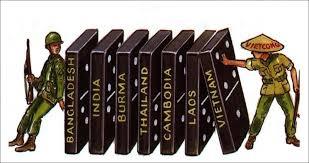
The idea that if South Vietnam fell to communism, other nations would soon follow...
a)
Vietnamization 
b)
Communism
c)
Domino Theory
d)
Imperialism
20.
Allowed the public to be negatively influenced concerning the  Vietnam war?
a)
Television and media bias
b)
Radio 
c)
Telegraph
d)
Internet
21.
In Vietnam the fighters used an irregular warfare tactic that made it difficult for our soldiers to be successful...it was called?
a)
Vietnamese Warfare tactics
b)
Cheetah Warfare
c)
Hidden Warfare
d)
Guerrilla warfare
22.
What were the problems of fighting in Vietnam?
a)
Identifying the enemy 
b)
Jungle/Location provided cover and a place to transport enemy supplies
c)
Weather and climate
d)
all of these
23.
This limits the power of the President during a time of conflict.
a)
Voting Rights Act
b)
Economic Opportunity Act
c)
Gulf of Tonkin Resolution
d)
War Powers Act
24.
In what year did the U.S. and North Vietnam agree to stop fighting in the Vietnam War?
a)
1945
b)
1965
c)
1973
d)
1991
25.
What did President Kennedy intend  to do by establishing the Peace Corps?
a)
bring a nonviolent end to racial segregation in the United States
b)
design a treaty that would end the conflict with Cuba
c)
provide young people with a chance to express their views
d)
help developing countries with tasks such as building schools and digging wells
26.

This Act requires the president to get congressional approval before committing U.S. troops to an armed struggle...

a)

24th Amendment

b)

Limited Test Ban Treaty

c)

War Powers Act

d)

Act of Aggression

27.
Look at the map: where is Vietnam?
a)
#4
b)
#8
c)
#5
d)
#3
28.
In the Vietnam War era, people outside the cultural norm were part of the...
a)
        Conservatives
b)
       Counterculture
c)
            In-Crowd
d)
            Liberals
29.
This 1969 Arts and Music Festival was a celebration of Peace during the Vietnam War...
a)
        Mile of Music
b)
National Folk Festival
c)
         Woodstock
d)
Essence Music Festival
30.
What style of warfare did the Vietcong use?
a)
Guerilla
b)
Trench
c)
Aerial
d)
Traditional
31.

What is one way in which the United States was affected after the Vietnam War ended?

a)

North Vietnam took control of the United States.

b)

More than 58,000 soldiers dies & more than 150,000 were wounded.

c)

The United States gained a tremendous amount of natural resources, making the War a huge success.

d)

It threw the United States into an economic downward spiral; causing bankruptcy.

32.
 An African American women who was asked to give up her seat on the bus to a white man in Montgomery, Alabama was
a)
Harriet B. Stowe
b)
Rosa Parks
c)
Michelle Obama
d)
Coretta King
33.
What are Civil Rights?
a)
Rights that only some citizens get
b)
Rights that all citizens get
c)
 Rights that are civil
d)
Rights that are controlled by the president
34.
This U.S. president was president during the Cuban Missile Crisis and supported the Civil Rights Movement. He was also assassinated for his support. 
a)
John F. Kennedy
b)
Robert F. Kennedy
c)
MLK
d)
FDR
35.
How did newspapers and media play a role in the Civil Rights Movement?
a)
They showed how great Jim Crow laws were
b)
They showed how unfair Jim Crow laws were and helped convince people to join the Civil Rights Movement
c)
 They made a lot of money following Martin Luther King Jr. 
d)
All of the above
36.
Why did the United States begin to send advisers and troops to Vietnam in the 1950s?
a)
to prepare for the United States invasion of Laos
b)
to defend American bases in the Gulf of Tonkin
c)
to help the South Vietnamese revolt against the French
d)
to prevent the spread of communism into South Vietnam
37.
Read these sentences from the text:
"Following the Civil War (1861-1865), a trio of constitutional amendments abolished slavery, made the former slaves citizens and gave all men the right to vote regardless of race.  Nonetheless, many states-particularly in the South-used poll taxes, literacy tests and other similar measures to keep their African-American residents essentially disenfranchised.  They also enforced strict segregation though "Jim Crow" laws and condoned violence from white supremacist groups like the ku klux klan."
Based on evidence in the text, why might the Civil Rights Act have been necessary?

a)
a.  because resistance in many states still prevented African Americans from exercising their rights as citizens
b)
b.  because poll taxes, literacy test, and other similar measures were not yet standardized
c)
c.  because women were still being discriminated against with regards to employment
d)
d.  because individual liberties and states' rights did not yet have power over federal law
38.
Chose the best an explanation of how the Civil Rights Act was a "second emancipation." 
a)
a.  Civil Rights Act helped people.
b)
b.  After the Civil War, slavery was abolished.  Nonetheless, many states used poll taxes, ect. to keep residents from voting.  The Civil Rights Act was like a "second emancipation" because it ended segregation and banned unfair practices by the states based on nationally and race.
c)
c.  The Civil Rights Act included the "Jim Crow" law.
d)
d.  The Civil Rights Act made states treat people equally.