
 Worksheets
AMS Second Semester Review
Total questions: 115
Worksheet time: 2hrs 32mins
Name
Class
Date
1.

What two nations were in competition with each other during the Cold War?
a)
Spain and Portugal
b)
England and France
c)
Germany and Italy
d)
United States and Soviet Union
2.

President Truman adopted a new foreign policy during the Cold War know as the Truman Doctrine. What was the main goal of the Truman Doctrine?
a)
To expand trade with Europe
b)
To limit the build up of nuclear weapons
c)
To stop the spread of communism
d)
to send financial aid to Europe
3.

The United States got involved in conflicts like Korea and Vietnam because they were afraid of the domino theory. What is the domino theory?
a)
If one country fell to democracy, others would follow
b)
If one country fell to communism, others would follow
4.

Why did the United States become involved in the Korean War?
a)
to contain communism
b)
to colonize Korea
c)
to spread communism
d)
to Christianize Koreans
5.

Where was Korea divided?
a)
18 parallel
b)
34 parallel
c)
38 parallel
d)
15 parallel
6.

In 1950, Korea fought a civil war over the spread of communism. Communists from the north tried to take over the south. What role did he US play in this war?
a)
The US and its allies went to Vietnam to fight Korean Communists.
b)
The US and its allies join the fight to keep communism from spreading.
c)
The US and its allies did not join the Korean War.
d)
The US and its allies fought to defend the North.
7.
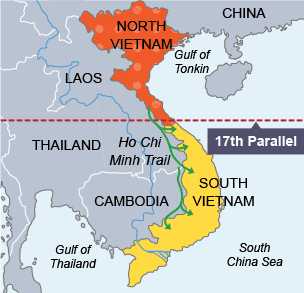
In the 1950s, the United States became involved in the Vietnam War. Why did the United States become involved in this war?
a)
to prevent the collapse of the government of North Vietnam
b)
to stop Vietnam from taking over Hong Kong
c)
to stop the spread of communism to South Vietnam
d)
to prevent attacks against United States shipping
8.

Where was Vietnam divided?
a)
17th Parellel
b)
20thParellel
c)
38th Parellel
d)
34th Parellel
9.

How did the US respond to finding out that the Soviets had missiles in Cuba?
a)
They sent the Air Force to bomb Cuba
b)
They began placing missiles in the Soviet Union.
c)
They placed a naval blockade around Cuba.
d)
They invaded Cuba and the Soviet Union.
10.

Who were the two participants in the Space Race?
a)
The US and Cuba
b)
China and US
c)
The USSR and US
d)
US and North Vietnam
11.

What was the name of the first satellite in space launched by the Soviet Union?
a)
Gagarin
b)
Apollo 11
c)
Sputnik
d)
Apollo 13
12.

What is being depicted in the above picture in Cold War terms?
a)
Deterrent
b)
Space Race
c)
Domino Theory
d)
Superpowers
13.

The graph above shows the amount of nuclear weapons the U.S. and Soviet Union possessed during the Cold War. Which vocabulary word is this graph best illustrating?
a)
Berlin Airlift
b)
NATO
c)
Arms Race
d)
Communism
14.
No competition, government involvement in economics, and lack of incentive to work hard
.
These characteristics above relate to what kind of economy?
.
These characteristics above relate to what kind of economy?
a)
Market Economy
b)
Traditional Economy
c)
Mixed Economy
d)
Command Economy
15.
The United States’ experience in the Vietnam War supports the idea that the outcome of a war...
a)
is determined mainly by technological superiority
b)
is dependent on using the greatest number of soldiers
c)
is determined based on if your country is democratic
d)
can be strongly affected by public opinion
16.
What action does President Kennedy decide to take during the Cuban Missile Crisis?
a)
Invasion of Cuba
b)
Blockade/Quarantine of Cuba
c)
Nuclear attack on Cuba
d)
Nothing
17.
How did the Vietnamese fight against the U.S. Army?
a)
They used conventional warfare such as tanks and planes
b)
They used nuclear weapons on the U.S.
c)
They used guerrilla warfare such as hit and run tactics
d)
They used Soviet soldiers to fight for them
18.
Which of the following best describes the outcome of the Korean War?
a)
the South Koreans won the war and controlled all of Korea
b)
the North Koreans won the war and controlled all of Korea
c)
neither side won the war and Korea remains divided today
d)
the U.S. and Soviet Union took over the area
19.
“…An iron curtain has descended across the Continent. Behind that line lie all the capitals of the ancient states of Central and Eastern Europe… and the populations around them lie in what I must call the Soviet sphere…” - Winston Churchill
.
Winston Churchill’s remark above on the “iron curtain” in Europe is describing what?
.
Winston Churchill’s remark above on the “iron curtain” in Europe is describing what?
a)
the division in Europe during the Cold War
b)
the destruction of Europe during the Cold War
c)
the diversity in Europe during the Cold War
d)
the depression in Europe during the Cold War
20.
A competition of space exploration between the United States and Soviet Union.
a)
Space Race
b)
Star Wars
c)
Surveillance
d)
McCarthyism
21.
State of tension and mistrust between the United States and the Soviet Union after World War II
a)
Cold War
b)
Vietnam War
c)
Korean War
22.

During what event did U.S. airplanes drop food and supplies to the people in West Berlin?
a)
Berlin Airlift
b)
World War II
c)
British Air Raid
d)
Soviet Food Drive
23.

Why was the Cuban Missile Crisis one of the MOST important events of John Kennedy’s presidency?
a)
The US almost started a war with Cuba.
b)
The US and the USSR almost started a nuclear war.
c)
The US landed a person on the moon.
d)
The USSR broke apart into nation-states.
24.

Who built the Berlin Wall?
a)
Soviet Union
b)
NATO
c)
The UN
d)
China
25.
What is Communism?
a)
people taking a chance to start a new business
b)
the government having complete control of businesses and property
c)
free enterprise and economic growth encouraged by the government
d)
a democratic government with personal freedoms and economic opportunities
26.

Students practiced nuclear safety drills in school known as?
a)
Bert the Turtle
b)
Duck and Cover
c)
Stop, Drop, and Roll
d)
Operation Alert
27.
How were the Korean War and Vietnam War similar?
a)
both were fought in Eastern Europe
b)
Both were fought to stop the Soviet Union from taking over
c)
Both were fought to stop the spread of communism
d)
Both were fought between the east and the west
28.
Which country did the U.S. send military aid to during the Korean War?
a)
North Korea
b)
South Korea
c)
Germany
d)
Japan
29.

Why is the Cold War called a "cold" war?
a)
The areas affected were in the polar regions of the world
b)
The war was fought during winter months only
c)
Leaders of the superpowers were sick with coughs and fevers
d)
There was never direct fighting between the two superpowers
30.
What military alliance included Poland, East Germany, Czechoslovakia, Bulgaria, Romania, and Albania?
a)
NATO
b)
Warsaw Pact
c)
United Nations
d)
European Union
31.
What is the 1949 military alliance formed with the United States, Canada, and ten other western European nations?
a)
United Nations
b)
European Union
c)
Warsaw Pact
d)
NATO
32.
Why was the Cold War named such?
a)
It was only fought during winter.
b)
The soldiers did not have warm clothing.
c)
This war was fought using ideas and propaganda instead of guns.
d)
It was primarily fought in the north and south poles.
33.
This word means pride in one's country; it was a cause of WWI.
a)
Militarism
b)
Alliances
c)
Nationalism
d)
Imperialism
34.
This word means strengthening a country's military; it's a cause of World War I.
a)
Nationalism
b)
Militarism
c)
Alliances
d)
Imperialism
35.
This word means seeking other colonies; it was a cause of World War I.
a)
Militarism
b)
Imperialism
c)
Alliances
d)
Nationalism
36.
This word means support for different sides during war; there were the Allied and Central powers during WWI.
a)
Nationalism
b)
Imperialism
c)
Alliances
d)
Militarism
37.
Germany used their U-boats to sink ships of the Allied powers; this British passenger liner was destroyed in 1915.
a)
Lusitania
b)
USS Maine
38.
The United States entered WWI in what year?
a)
1914
b)
1915
c)
1916
d)
1917
39.
What was signed in 1919 to end WWI?
a)
Treaty of Versailles
b)
Treaty of Paris
c)
Treaty of World Wars
40.
Which did NOT contribute to the tensions in Europe before the war?
a)
militarism
b)
nationalism
c)
neutrality
d)
alliances
41.
Which country was NOT part of the Allied force?
a)
France
b)
Russia
c)
Britain
d)
Germany
42.
Nations formed two alliances in WWI: the Allied Powers and the Central Powers. The Central Powers included all of the following except
a)
Germany
b)
the Ottoman Empire
c)
France
d)
Austria-Hungary
43.
On November 11, 1918 the fighting stopped and Germany signed and armistice, or __________.
a)
peace treaty
b)
cease-fire
c)
reparations
d)
acknowledgement of guilt
44.

What were the causes of World War I?
a)
alliances, socialism,communism, realism
b)
imperialism, capitalism, mercantilism, fascism
c)
militarism, alliances, imperialism, nationalism
d)
communism, nazism, racism, militarism
45.
A short term cause of WWI was
a)
The assassination of President Wilson
b)
MAIN
c)
The assassination of Archduke of Austria-Hungary
d)
the Sinking of the Maine
46.
Germany sent the Zimmermann Telegrarm to what nation that they were trying to make an alliance with?
a)
China
b)
Japan
c)
Spain
d)
Mexico
47.
What Allied Power dropped out of World War I after a Revolution in 1917?
a)
Great Britain
b)
Italy
c)
United States
d)
Russia
48.

During World War I, what nation put a warning in the newspaper warning nations including cruise ships to stay out of the water?
a)
Germany
b)
France
c)
Great Britain
d)
Austria-Hungary
49.

Why did Republicans in the Senate oppose the Treaty of Versailles?
a)
They felt with the League of Nations America would be pulled into future wars
b)
The did not want to shrink the military
c)
They thought the treaty should punish France
d)
They supported the Treaty of Versailles
50.
At the end of World War I, what nation did not join the League of Nations?
a)
France
b)
United States
c)
Italy
d)
Great Britain
51.

During World War I an old fighting style was used on the farm fields of Europe where the military dug large ditches in the ground. Why is this type of warfare called?
a)
Trench Warfare
b)
Unrestricted Warfare
c)
Cyber Warfare
d)
Guerrilla Warfare
52.

Which countries made up the Triple Alliance?
a)
Germany, Italy, Japan
b)
Russia, Germany, France
c)
United States, Belgium, Romania
d)
Germany, Austria-Hungary, Italy
53.

Which country switched sides in 1915?
a)
Mexico
b)
Switzerland
c)
Italy
d)
Albania
54.

Who was the President of the United States during WWI?
a)
Woodrow Wilson
b)
Grover Cleveland
c)
Teddy Roosevelt
d)
Franklin D. Roosevelt
55.
Germany had to pay war debt, give up land, and lose colonies according to which document?
a)
The Armistice Treaty
b)
The Veterans Day Treaty
c)
The Treaty of Versaillies
d)
The Peace Treaty at Warsaw
56.

Which countries made up the Triple Entente?
a)
Great Britain, China, India
b)
France, Spain,United States
c)
Russia, Norway, Finland
d)
Great Britain, France, Russia
57.
President Woodrow Wilson wanted to create a "general association of nations" -- called the ___________.
a)
League of Nations
b)
United Nations
c)
Allies
d)
Central Powers
58.
The spark that started WWI was the assassination of the __________Archduke, Franz Ferdinand.
a)
Austrian
b)
German
c)
Russian
d)
Serbian
59.
The assassin who killed Franz Ferdinand and his wife Sophie was Gavrilo Princip, a member of the ______ nationalist group The Black Hand.
a)
German
b)
Serbian
c)
Russian
d)
American
60.
The Schlieffen Plan was Germany's military strategy to achieve what goal?
a)
avoid a two-front war with France and Russia
b)
gain an alliance with Britain and France
c)
knock Italy out of the war
d)
Keep the United States out of the war
61.
Imperialism caused
a)
increased efforts to solve problems between countries
b)
decreased competition between countries
c)
increased competition between countries
d)
decreased tension between countries
62.
What was the purpose of the League of Nations?
a)
to govern Germany after the war
b)
to help secure capitalism in Europe
c)
to prevent future conflicts through negotiations and settlements
d)
to insure US trading rights
63.
The Western Front was the battleground between Germany and _______, while the Eastern Front was the battleground between Germany and _________.
a)
Russia and France
b)
France and Italy
c)
France and Russia
d)
Italy and France
64.
In 1914, fighting increased rapidly from a local conflict in Europe to a world war because
a)
Several nations had colonies in northern Europe
b)
Religious differences led to open warfare
c)
Alliances dragged numerous countries into the conflict
d)
The League of Nations failed in its peace efforts
65.

What is NOT an effect of the Treaty of Versailles?
a)
The U.S. joined the League of Nations.
b)
The League of Nations was created.
c)
Germany was required to pay high fines and disarm their military.
d)
Germany and other Central Powers had to accept responsibility for causing all loss and damage.
66.
During WWI, most battles were fought on the Western Front. Near what country was it located?
a)
England
b)
France
c)
Italy
d)
Russia
67.

When a country is neutral it:
a)
makes an official alliance with another country
b)
sends troops to battle when a war begins
c)
does not take either side in a war and stays out of it
d)
declares war and joins the fight
68.
By the end of 1915, the fighting in the west had reached the point of
a)
Victory at sea but not on land
b)
Victory everywhere
c)
Stalemate
d)
Enjoyment
69.
Which form of government puts the country and government above the rights of the individual people?
a)
republicanism
b)
democracy
c)
fascism
d)
theocracy
70.

Who is this man?
a)
Joseph Stalin
b)
Hideki Tojo
c)
Adolph Hitler
d)
Benito Mussolini
71.

What country attacked the navy base pictured on December 7, 1941?
a)
Soviet Union
b)
Germany
c)
Japan
d)
Italy
72.

The two sides that fought in World War II were the
a)
Allied & Central Powers
b)
Allied & Axis Powers
c)
Central & Axis Powers
d)
Allied & Associated Powers
73.
What were the two U.S. Presidents during World War II?
a)
Eisenhower and Truman
b)
FDR and Eisenhower
c)
Trump and Washington
d)
FDR and Truman
74.
What were the two U.S. Presidents during World War II?
a)
Eisenhower and Truman
b)
FDR and Eisenhower
c)
Trump and Washington
d)
FDR and Truman
75.
This is the name remembered for the Allied attack on France on June 6, 1944.
a)
Operation Dumbo Drop
b)
Operation Torch
c)
D-Day
d)
Omaha
76.
Which two Japanese cities were destroyed by atom bombs?
a)
Hiroshima and Nagasaki
b)
Kyoto and Tokyo
c)
Nagasaki and Kyoto
d)
Tokyo and Hiroshima
77.
What was NOT one of the three punishments placed on Germany after World War I?
a)
forced to pay reparations
b)
had to give their military to the Soviet Union
c)
Military was weakened
d)
Territories were taken away
78.
What position of power politically did Adolf Hitler rise to in Germany?
a)
President
b)
Emperor
c)
King
d)
Chancellor
79.
What does the word “Nazi” stand for?
a)
National Socialist Party
b)
National Workers Party
c)
National Socialist German Workers Party
d)
United Socialist Republic
80.
What was a way in which the Jews were NOT discriminated against by the Nazis?
a)
forced to wear yellow stars
b)
Jewish books were burned
c)
Jewish businesses were vandalized
d)
citizens were encouraged to support Jewish owned businesses
81.
What was the Manhattan Project?
a)
Testing and creation of the Atomic Bomb
b)
preparing the borough of Manhattan for nuclear safety
c)
secret plan to create spies in the war effort
d)
Operation to create secret airplanes for the war effort
82.
Which President gave the order to drop the Atomic Bomb?
a)
Herbert Hoover
b)
Harry S. Truman
c)
Dwight D. Eisenhower
d)
Ronald Reagan
83.
What was the first of the two cities on which the atomic bomb was dropped?
a)
Nagasaki
b)
Tokyo
c)
Roswell
d)
Hiroshima
84.
What was the end date of World War II?
a)
June 6, 1944
b)
Sept 2, 1945
c)
Sept 1, 1939
d)
Sept 2, 1941
85.
What finally brought an end to World War II?
a)
a massive Soviet invasion of the Japanese islands
b)
the appeasement of Germany
c)
a U.S. naval blockade of Japan
d)
the dropping of atomic bombs on Hiroshima and Nagasaki
86.
What was the "Final Solution"?
a)
The Plan to end the war for the Allied Powerd.
b)
The plan to end the war for the Axis Powers
c)
The plan to kill the entire Jewish population
d)
The plan to save the entire Jewish population.
87.
Dictators often used __________ to get their citizens on board with their policies/ideas.
a)
Negotiations
b)
Radio Shows
c)
Propaganda
d)
Violence
88.
______________ was the dictator in Italy during the war.
a)
Roosevelt
b)
Mussolini
c)
Hitler
d)
Stalin
89.
_______________ was the dictator of the Soviet Union during the war.
a)
Hitler
b)
Mussolini
c)
Stalin
d)
Lenin
90.
Giving into someone's demands to maintain the peace is known as what? (I.e. Neville Chamberlain to Hitler)
a)
strategy
b)
encroachment
c)
deceit
d)
appeasement
91.
President Harry Truman’s decision to use atomic bombs against Japan was primarily based on his belief that
a)
an invasion of Japan would result in excessive casualties
b)
Germany would refuse to surrender in Europe
c)
an alliance was developing between Japan and the Soviet Union
d)
Japan was threatening to use an atomic bomb on the U.S.
92.
Which of the following is NOT a characteristic of a totalitarian government?
a)
secret police
b)
censorship of the press
c)
democratic elections
d)
propaganda
93.
Which of the following events sparked U.S. involvement in World War II?
a)
Japan attacked Pearl Harbor
b)
Germany used a poisonous gas attack in France
c)
Germany invaded Poland
d)
Archduke Franz Ferdinand was assassinated
94.
Which of the following events sparked England and France to enter World War II?
a)
Germany used a poisonous gas attack in France
b)
Germany invaded Poland
c)
Archduke Franz Ferdinand was assassinated
d)
Japan attacked Pearl Harbor
95.

Which political philosophy gave rise to dictators with total power, who denied other individuals freedoms?
a)
Communism
b)
Anarchism
c)
Socialism
d)
Facism
96.
Which of the following was NOT an Axis Power?
a)
Italy
b)
Soviet Union
c)
Germany
d)
Japan
97.
Which of the following was NOT an Allied Power during WWII?
a)
United States
b)
Great Britain
c)
France
d)
Italy
98.
How did the use of atomic bombs impact the outcome of WWII?
a)
Germany was forced to surrender.
b)
Italy was forced to surrender.
c)
The Soviet Union was forced to surrender.
d)
Japan was forced to surrender.
99.
What effect did the Treaty of Versailles have on the start of World War II?
a)
it rewarded the Italians with additional land and resources
b)
it allowed the Russians to receive financial aid and build their army.
it allowed the Russians to receive financial aid and build their army.
c)
it led to an aggressive military dictatorship in France
d)
it punished Germany by making them pay reparations and led the Germans to seek revenge
it punished Germany by making them pay reparations and led the Germans to seek revenge
100.

What political term does the political cartoon above describe?
a)
Assimilation
b)
Appeasement
c)
Blitzkrieg
d)
Blitzkrieg
101.
European imperialism of Africa, from 1880-World War I, is known as
a)
Spheres of Influence
b)
Scramble for Africa
c)
World War I
d)
French Revolution
102.
Where did the Industrial Revolution begin?
a)
Germany
b)
France
c)
Great Britain
d)
United States
103.
Using military force to expand current boundaries is an example of
a)
Industrialism
b)
Militarism
c)
Nationalism
d)
Imperialism
104.
Why was Great Britain the first country to industrialize?
a)
The king demanded it
b)
No other country wanted to industrialize
c)
They had all the necessary factors of production
d)
They had a political revolution
105.
How did the Industrial Revolution affect the cities?
a)
Made the crime rate decrease
b)
Led to an increase in farm workers
c)
Make the cities cleaner and safer
d)
Led to an increase in population in the cities
106.
The main reason industrialized nations wanted to imperialize non-industrialized nations was
a)
to gain raw materials
b)
to spread Christianity
c)
To show national pride
d)
To build factories there
107.
At the beginning of the Industrial Revolution, European nations wanted
a)
Raw materials
b)
Land
c)
Wealth
d)
All of the Above
108.
Which of the following were causes of imperialism?
a)
Industrial Revolution
b)
Nationalism
c)
Industrialization
d)
All of the Above
109.
What was the Industrial Revolution?
a)
Changes and advancements in government
b)
Changes and advancements in militarism
c)
Changes and advancements in religion
d)
Changes and advancements in the production of goods
110.
The poem, The White Man's Burden, by Rudyard Kipling, represents the belief that European culture was _______.
a)
superior to other cultures
b)
misunderstood by Americans
c)
the oldest culture in the world
d)
a replica of Ancient Greek culture
111.
Economic motives for imperialism include _________.
a)
a desire to spread Christianity
b)
a need for military bases around the world
c)
a need for raw materials to be used in factories
d)
a desire to gain glory
112.
Nationalism in European nations led to imperialism because
a)
the nations wanted fueling stations for their naval ships.
b)
the people of Africa and Asia were poor and in need of help.
c)
the countries of Europe were competing to become the strongest in power.
d)
because the Europeans wanted a market for goods made in factories
113.
What two European countries had the most colonies in Africa?
a)
Great Britain and France
b)
Germany and Italy
c)
France and Italy
d)
Germany and Great Britain
114.
European imperialism was beneficial (helpful) because
a)
the natives of the imperialized countries were given equal rights with the Europeans.
b)
the imperial countries thought they were superior to the colonies.
c)
the imperial countries built schools and hospitals and developed new industries.
d)
the natives of the colonized regions could not hold high government jobs
115.
Imperialism often caused hardships to the imperialized region such as:
a)
Transportation systems remained poor.
b)
Schools and hospitals were destroyed.
c)
Natives shared in the policies of the new governments.
d)
Local industries were destroyed by the cheap European goods.
100 %

