
 Worksheets
ROCK CYCLE
Total questions: 25
Worksheet time: 32mins
Name
Class
Date
1.
What type of rock results directly from cooled magma?
a)
Igneous
b)
Metamorphic
c)
Sedimentary
2.
Which type of rock forms from extreme heat and pressure?
a)
Igneous
b)
Sedimentary
c)
Organic
d)
Metamorphic
3.
The process by which water, wind, ice, and changes in temperature break down rock into fragments called sediments.
a)
Deposition
b)
Melting/Cooling
c)
Weathering/Erosion
d)
Compaction/Cementation
4.
The process by which sediments are transformed into sedimentary rock.
a)
Deposition
b)
Melting/Cooling
c)
Weathering/Erosion
d)
Compaction/Cementation
5.
The process by which igneous rocks are formed...
a)
heat and pressure
b)
melting and cooling
c)
compaction and cementation
6.

These rocks were broken apart from the expansion of water within rock during cooler temps (night). This is an example of:
a)
frost wedging
b)
acid rain
c)
permeability
d)
abrasion
7.
What factor commonly triggers mass movements?
a)
earthquakes
b)
saturation of surface materials with water
c)
removal of vegetation
d)
all are correct
8.
Which of the following weathering processes involves the constant freezing and thawing of water?
a)
exfoliation
b)
unloading
c)
frost wedging
d)
spheroidal weathering
9.
Which term describes the max amount of material a stream can hold.
a)
competence
b)
capacity
c)
discharge
d)
load
10.
The dropping off of sediment in a body of water.
a)
Weathering
b)
Erosion
c)
Deposition
11.
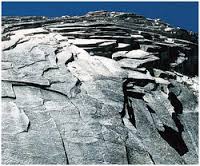
What is mechanical weathering?
a)
Process through which rocks are physically broken into smaller pieces.
b)
Rocks are broken down through chemical changes.
c)
Rocks are worn away from acid in plant roots.
d)
Rocks broken down by machinery.
12.
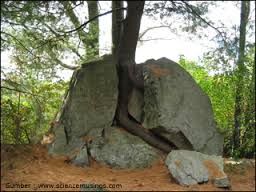
How do plants weather rocks?
a)
During photosynthesis
b)
When roots grow into cracks of rocks and expand the rock breaks.
c)
When the plant moves water from the roots to the leaves, the rock breaks.
d)
Plants don't weather rocks.
13.

How is a stream's load sorted?
a)
by color
b)
by dimension
c)
by mass
d)
by chemistry
14.
Which sediments are deposited LAST?
a)
the lightest
b)
average weight
c)
the heaviest
15.
How does freezing water cause the weathering of rocks? The freezing water—
a)
keeps the rocks in place
b)
makes the rocks last longer
c)
expands cracks and breaks rocks
d)
causes rocks to fall in landslides
16.

In order for rain to have weathered this statue, it must have contained carbon dioxide to form carbonic acid. This is an example of:
a)
Oxidation
b)
Root wedging
c)
Frost wedging
d)
Solution weathering
17.

Oxidation is a reaction that takes place when oxygen reacts with another element. Oxygen is very strongly chemically reactive. The most familiar type of oxidation is when iron reacts with oxygen to create rust. What type of reaction is this?
a)
Chemical
b)
Biological
c)
Mechanical
18.

How do plants weather rocks?
a)
during photosynthesis
b)
when roots grow into cracks of rocks and expand the rock
c)
when the plant moves water from the roots to the leaves
19.
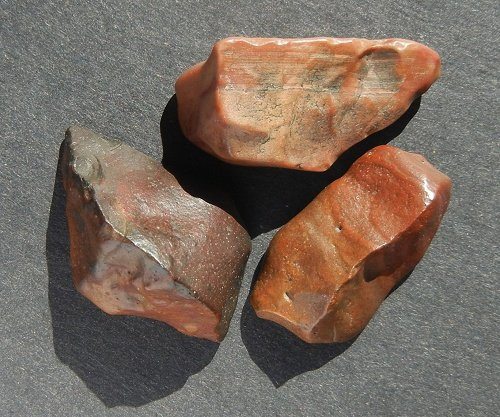
These rocks were made smooth by wind blowing smaller rock particles across their surface. This is an example of:
a)
ice wedging
b)
chemical weathering
c)
acid rain
d)
abrasion
20.
Abrasion is what type of weathering?
a)
Chemical
b)
Mechanical
c)
Biological
21.
Potholes forming in the road after a cold winter is an example of:
a)
mechanical weathering
b)
chemical weathering
c)
biological weathering
22.
How does freezing water cause the weathering of rocks? The freezing water—
a)
keeps the rocks in place
b)
makes the rocks last longer
c)
expands cracks and breaks rocks
d)
causes rocks to fall in landslides
23.
Weeds growing into the cracks in a sidewalk and the sidewalk begins to crumble is an example of:
a)
mechanical weathering
b)
chemical weathering
24.

What kind of weathering causes changes to the rock at a molecular level?
a)
mechanical weathering
b)
permeable weathering
c)
chemical weathering
d)
physical weathering
25.
What type of weathering only happens on exposed rock surfaces?
a)
Mechanical weathering
b)
Chemical weathering
c)
Wind erosion
d)
Water erosion
100 %

