
 Worksheets
Gas questions
Total questions: 24
Worksheet time: 19mins
Name
Class
Date
1.
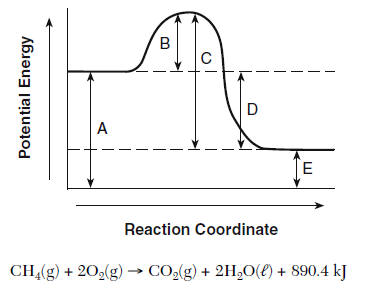
Which interval represents the heat of reaction for the reaction?
a)
A
b)
B
c)
D
d)
E
2.
What phase change brings an increase in entropy?
a)
g->s
b)
l->s
c)
l->g
d)
g->l
3.
According to boyles law, what happens when volume increases?
a)
Temperature increases
b)
Pressure decreases
c)
Moles increase
d)
Nothing
4.
2SO2(g)+O2(g)⇌2SO3(g)
Adding O2(g) will
Adding O2(g) will
a)
shift equilibrium right
b)
shift equilibrium left
c)
decrease pressure
d)
have no change
5.
A ________ speeds up a reaction by lowering the activation energy.
a)
Inhibitor
b)
Catalyst
c)
particle size
d)
salt
6.
A gas has a pressure of 1.50 atm at a temperature of 273 K. What will be the pressure at 410 K?
a)
.99 atm
b)
2.25 atm
c)
.75 atm
d)
2.5 atm
7.
I have 130 Liters of gas in a piston at a temperature of 250 * C. If I cool the gas until the volume decreases to 85 Liters, what will the temperature of the gas be?
a)
799 *C
b)
527 K
c)
335 K
d)
69 *C
8.
How are Pressure and Temperature related?
a)
Inversely
b)
Directly
c)
Indirectly
d)
Constants
9.
In order to solve gas law calculations, temperature must be measured in:
a)
Fahrenheit
b)
Celsius
c)
Kelvin
d)
It doesn't matter
10.
Mr. Avagadro said that one mole of a gas at STP occupies what volume?
a)
.0821 L
b)
62.4 L
c)
22.4 L
d)
6.02 X 10²³ L
11.
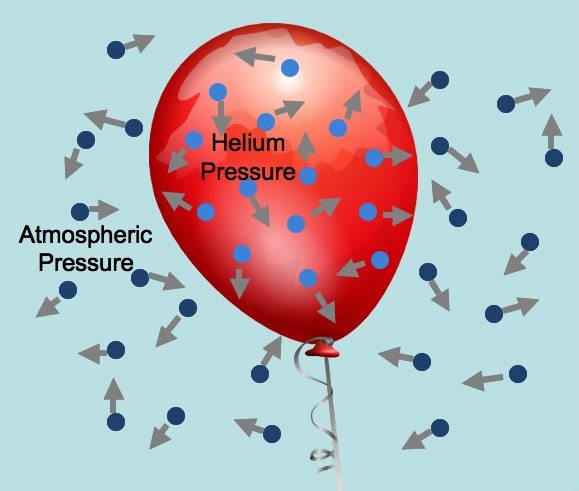
What causes pressure?
a)
The walls of the container
b)
The vacuum in the container
c)
The collisions of the particles
d)
Atmospheric pressure acting on the outside walls
12.
What is the molecular reason that explains the relationship between pressure and volume?
a)
When you decrease the volume it gives the molecules less space to move, so they bounce on the container more
b)
When you decrease the volume it gives the molecules more space to move, so they bounce on the container more
c)
When you decrease the volume it gives the molecules more energy to move faster
d)
When you increase the volume it gives the molecules more space and so the molecules move slower
13.
What is the molecular reason that explains the relationship between pressure and temperature?
a)
heat makes molecule move faster and bounce on the side of the inflexible container
b)
heat makes molecule move faster and bounce on the side of the flexible
c)
heat makes molecule move slower and bounce on the side of the inflexible
d)
pressure is completely unrelated to temperature
14.
What is the equation for Boyles Law?
a)
P1V2=P2V1
b)
P1V1=P2V2
c)
V1T1=V2T2
d)
V1T2=V2T1
15.
What is the equation for Charles Law?
a)
P1V2=P2V1
b)
P1V1=P2V2
c)
V1T1=V2T2
d)
V1T2=V2T1
16.
What two factors govern whether a collision between reacting particles will be effective?
a)
orientation and potential energy
b)
kinetic energy and temperature
c)
kinetic energy and orientation
d)
potential energy and kinetic energy
17.
Under the collision theory, the particles must collide ____ and ____ for a reaction to occur.
a)
sufficient rate and sufficient energy
b)
sufficient surface area and correct orientation
c)
sufficient catalyst and sufficient energy
d)
sufficent energy and correct orientation
18.
Which interval represents the heat of reaction for the reaction?
a)
A
b)
B
c)
D
d)
E
19.
Heat is measured in
a)
joules
b)
grams
c)
degrees celcius
20.
If the rate of melting equals the rate of freezing...
a)
there is more liquid
b)
there is more solid
c)
the system is in equilibrium
d)
the system is working towards equilibrium
21.
When the atmospheric pressure equals the equilibrium vapor pressure ___ occurs.
a)
freezing
b)
melting
c)
boiling
d)
sublimation
22.
During a phase change, the temperature
a)
increases
b)
decreases
c)
fluctuates
d)
stays the same
23.
What is the boiling point of water
a)
0 C
b)
100 F
c)
50 C
d)
100 C
24.
What is water's melting point?
a)
32 C
b)
0 C
c)
32 F
d)
0 F
100 %

