
 Worksheets
Guillen MS Classification
Total questions: 128
Worksheet time: 2hrs 42mins
Name
Class
Date
1.

Which domain is capable of living in extreme environments like hot springs, geysers, or very salty waters?
a)
Bacteria
b)
Archaea
c)
Eukarya
2.

Which domain includes all animals and plants?
a)
Archaea
b)
Eukarya
c)
Bacteria
3.

Almost all bacteria are...
a)
Unicellular
b)
Multicellular
4.

Which two kingdoms are entirely multicellular?
a)
Animalia and Plantae
b)
Animalia and Protista
c)
Protista and Plantae
5.
To say that an organism is heterotrophic means...
a)
it cannot reproduce asexually
b)
it cannot make its own food
c)
it cannot breathe oxygen gas
6.
Which kingdoms have some organisms that can make their own food (autotrophic)?
a)
Plantae and Animalia
b)
Fungi and Plantae
c)
Protista and Plantae
7.
Organisms whose cells have NO nucleus are classified as...
a)
Eukaryotic
b)
Prokaryotic
c)
Dead
8.
True or False: All cells have DNA.
a)
True
b)
False
9.
True or False: All living things are made of one or more cells.
a)
True
b)
False
10.

Moss belongs in the kingdom...
a)
Fungi
b)
Plantae
11.

Algae and Kelp belong to the Kingdom...
a)
Plantae
b)
Protista
c)
Fungi
d)
Eubacteria
12.

Fungi are a type of...
a)
decomposer
b)
producer
13.

Mold, yeast, and mushrooms all belong to the Kingdom _______.
a)
Archaebacteria
b)
Fungi
c)
Eubacteria
d)
Protista
14.
Which kingdom contains members who are prokaryotic?
a)
Archaebacteria and Eubacteria
b)
Archaebacteria and Protista
c)
Eubacteria and Animalia
d)
Eubacteria and Fungi
15.
Members of this kingdom never have a cell wall
a)
Animalia
b)
Plantae
c)
Archaebacteria
d)
Protista
16.
Members of this kingdom have cell walls made of cellulose
a)
Eubacteria
b)
Protista
c)
Plantae
d)
Fungi
17.
When using a dichotomous key to identify organisms, what do we look at?
a)
physical features
b)
weather patterns
c)
environment
d)
diet
18.

What type of cells do the domain classification of Bacteria contain?
a)
Eukaryotic
b)
Exkaryotic
c)
Prokaryotic
d)
Semikaryotic
19.
The science of identifying, classifying, and naming organisms
a)
Classification
b)
Taxonomy
c)
Plantae
d)
Sorting
20.
Animals must eat other organisms for food, so they are classified as--
a)
heterotrophs
b)
autotrophs
c)
eukaryotic
d)
prokaryotic
21.
When DNA is contained in a nucleus, the cell is
a)
eukaryotic
b)
prokaryotic
c)
unicellular
d)
multicellular
22.
All organisms that do not fit into plant, fungi, and animal kingdoms but have a nucleus are:
a)
archaebacteria
b)
eubacteria
c)
protists
d)
fungus
23.
This kingdom is unicellular and prokaryotic.
a)
Bacteria
b)
Protista
c)
Fungi
d)
Animalia
24.
Tigers, Jellyfish, Gorillas and Sponges are all part of kingdom _______.
a)
Animalia
b)
Plantae
c)
Fungi
d)
Bacteria
25.
Eubacteria...
a)
are eukaryotic
b)
live in normal conditions
c)
are non-living
d)
are multicellular
26.
What kingdom is always multicellular, heterotrophic and has NO cell wall?
a)
Protista
b)
Fungi
c)
Plantae
d)
Animalia
27.
All of the following have a nucleus except...
a)
Bacteria
b)
Animalia
c)
Plantae
d)
Protista
28.
Which kingdom is autotrophic AND has a cell wall?
a)
Bacteria
b)
Fungi
c)
Plantae
d)
Protista
29.
What is the difference between Archaebacteria and Eubacteria?
a)
Bacteria is eukaryotic
b)
Archaebacteria is multicellular
c)
Archaebacteria can live in extreme environments
d)
They are the same
30.
In which kingdom do I belong if I am unicellular, autotrophic, and eukaryotic?
a)
Archaebacteria
b)
Protista
c)
Animalia
d)
Plantae
31.

You would find mushrooms in which kingdom?
a)
Plantae
b)
Protists
c)
Fungi
d)
Animalia
32.
Which kingdom is a part of the domain Bacteria?
a)
Archaebacteria
b)
Animalia
c)
Eubacteria
d)
Protista
33.
This kingdom contains heterotrophic organisms that can be unicellular or multicellular. Organisms from this kingdom can sometimes cause athlete's foot or ringworm.
a)
Fungi
b)
Animalia
c)
Protista
d)
Archaebacteria
34.

This domain is characterized by ancient bacteria that can live in extreme environments, such as hot springs.
a)
Archaea
b)
Bacteria
c)
Eukarya
d)
Prokarya
35.

Which kingdom would this organism belong to?
a)
Plantae
b)
Archaebacteria
c)
Protista
d)
Animalia
36.

Which kingdom do humans belong to?
a)
Plantae
b)
Fungi
c)
Animalia
d)
Protista
37.
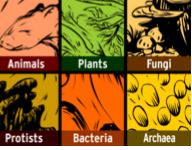
Which kingdoms are prokaryotic?
a)
Archaebacteria and Animalia
b)
Eubacteria and Archaebacteria
c)
Fungi and Protista
d)
Plantae and Eubacteria
38.
Which kingdom is part of the domain Archaea?
a)
Animalia
b)
Archaebacteria
c)
Eubacteria
d)
Plantae
39.

This organism is found in a normal environment. What kingdom does it belong to?
a)
Eubacteria
b)
Protista
c)
Archaebacteria
d)
Fungi
40.
What are the three domains?
a)
Archaea, Bacteria, and Eubacteria
b)
Archaea, Protista, and Eubacteria
c)
Archaea, Bacteria, and Eukarya
d)
Archaea, Fungi, Animalia
41.
This domain contains organisms that have a true nucleus in each of their cells. This domain breaks down into four kingdoms.
a)
Animalia
b)
Archaea
c)
Bacteria
d)
Eukarya
42.
This kingdom contains organisms that are unicellular, prokaryotic, and often live in water. Amoeba, euglena, and paramecium are a part of this kingdom.
a)
Animalia
b)
Eubacteria
c)
Fungi
d)
Protista
43.
Organisms that are classified as unicellular are --
a)
seen with the naked eye
b)
many celled organisms
c)
single celled organisms
d)
able to make their own food
44.
Which domain contains organisms that are unicellular, prokaryotic, and can cause strep throat or e. coli infections?
a)
Eukarya
b)
Archaea
c)
Fungi
d)
Bacteria
45.

This kingdom contains organisms such as trees, plants and shrubs.
a)
Fungi
b)
Plantae
c)
Animalia
d)
Protista
46.
Sexual Reproduction requires ______ parents
a)
0
b)
1
c)
2
d)
3
47.

What kingdom would this organism be classified as? (Click text to reveal picture)
a)
Protista
b)
Eubacteria
c)
Archaebacteria
d)
Fungi
48.

Which word best describes the cell in the picture? (Click text to reveal picture)
a)
Multicelluar
b)
Prokaryotic
c)
Eukaryotic
d)
Abiotic
49.

What type of organism makes its own food internally?
a)
heterotroph
b)
autotroph
c)
carnivore
d)
omnivore
50.
How do scientists organize living things?
a)
by looks
b)
by shared characteristics
c)
by size
d)
by differences
51.
What is the science of organizing, classifying and naming living things.
a)
taxonomy
b)
taxadermy
c)
taxicab
d)
toxicology
52.
This domain is characterized by ancient bacteria that can live in extreme environments, such as volcanoes.
a)
Archaea
b)
Bacteria
c)
Eukarya
d)
Prokarya
53.
Organisms that are classified as autotrophic are able to-
a)
be seen with the human eye
b)
move
c)
reproduce
d)
make their own food
54.
The broadest or most general taxonomic classification of living organisms is organized by --
a)
Kingdom
b)
Domain
c)
Species
d)
Organisms
55.
Organisms in the Kingdom Animalia are mostly unicellular Eukaryotes.
a)
True
b)
False
56.
What are the three domains?
a)
Archaea, Bacteria, and Eubacteria
b)
Archaea, Protists, and Eubacteria
c)
Archaea, Bacteria, and Eukarya
d)
Archaea, Fungi, Animalia
57.
How many kingdoms are there?
a)
3
b)
4
c)
6
d)
9
58.
I am made of many cells. My cells have an organized nucleus. I mostly have two parents, but sometimes one. I make my own food.
a)
Fungi
b)
Bacteria
c)
Plantae
d)
Animalia
59.

Is fungi autotrophic or heterotrophic?
a)
Autotrophic, they make their own food
b)
Hetertrophic, they get food from other organisms
60.

A pine tree is a member of the kingdom
a)
Animalia
b)
Protista
c)
Fungi
d)
Plantae
61.
Mushrooms are members of the kingdom
a)
Protista
b)
Animalia
c)
Plantae
d)
Fungi
62.
What would scientists do if they discovered organisms that could not fit into any of the four kingdoms of the domain Eukarya?
a)
destroy the newly discovered organisms
b)
change the newly discovered organisms so they fit one of the four kingdoms
c)
create new kingdoms
d)
leave the newly discovered organisms alone
63.
The simple, single-celled organisms that live in your intestines are classified in the kingdom
a)
Eukarya
b)
Archaea
c)
Protista
d)
Eubacteria
64.
Animalia, Protista, Fungi, and Archaea are the
a)
scientists who organized taxonomy
b)
names of kingdoms
c)
levels of classification
d)
scientific names of different organisms
65.
This kingdom includes complex, multicellular organisms that are usually green, have cell walls, and make sugar by photosynthesis
a)
fungi
b)
bacteria
c)
plantae
d)
archaea
66.
This kingdom includes mostly single-celled or simple multicellular organisms.
a)
Protista
b)
Eubacteria
c)
Archaebacteria
d)
Fungi
67.
This kingdom includes nongreen, nonmoving eukaryotic organisms that break down substances outside their bodies and absorb the nutrients.
a)
Archaea
b)
Plantae
c)
Bacteria
d)
Fungi
68.
This kingdom includes unicellular organisms, they reproduce quickly by binary fission (asexual), have a flagella, and are make up most of the common bacteria.
a)
Archaebacteria
b)
Fungi
c)
Eubacteria
d)
Protists
69.
In this kingdom, you can find all the organisms are prokaryotes, unicellular, some may have a cell wall, their methanogens, halophiles, thermaphiles, and they are found in extreme environments.
a)
Eubacteria
b)
Archaebacteria
c)
Protists
d)
Fungi
70.
Which of the following is an example of a heterotroph?
a)
Sunflower
b)
Tree
c)
Mushroom
d)
Carrot
71.
In these kingdoms, they are eukaroytes, mostly multicellular, and mostly reproduce sexually.
a)
Archaebacteria, Eubacteria, and Protists
b)
Protists, Fungi, and Plants
c)
Fungi, Animals, and Plants
d)
Animals, Plants and Protists
72.
How many cells do eubacteria have?
a)
1
b)
2
c)
3
d)
millions
73.
Organisms that are classified as autotrophic are able to-
a)
be seen with the human eye
b)
move
c)
reproduce
d)
make their own food
74.
Which kingdom is autotrophic AND has a cell wall?
a)
Bacteria
b)
Fungi
c)
Plantae
d)
Protista
75.
All of the following have a nucleus except...
a)
Bacteria
b)
Animalia
c)
Plantae
d)
Protista
76.
Which of the following is NOT a reason why scientists classify organisms?
a)
To help them communicate
b)
To organize information
c)
Because they are bored
77.
Which word means to organize into groups?
a)
sample
b)
vertebrate
c)
classify
d)
organism
78.
The scientific process of placing organism into groups based on their similarities is called ____________________.
a)
Categorizing
b)
Grouping
c)
Classifying
d)
Declassifying
79.
What is the tool used for classifying organisms?
a)
Microscope
b)
Taxonomic Key
c)
Experiment
d)
Telescope
80.
What is the classification level directly below domain?
a)
Phylum
b)
Genus
c)
Species
d)
Kingdom
81.
What word means change over time?
a)
classification
b)
revolution
c)
changification
d)
evolution
82.
What is the broadest (highest) level of classification?
a)
Domain
b)
Kingdom
c)
Genus
d)
Class
83.
Cells that include a membrane-bound organelles, nucleus with spiral DNA, and that generally make up a complex organism
a)
archaea
b)
prokarya
c)
eukarya
d)
bacteria
84.
Cells that have free-floating DNA, no nucleus, and no membrane-bound organelles
a)
eukarya
b)
prokarya
c)
archaea
d)
order
85.
Cells that do not have a true nucleus are called....
a)
eukaryote
b)
prokaryote
c)
unicellular
d)
multicellular
86.
Organisms are placed into this classification based on the number of cells in their body and their ability to make food.
a)
Kingdom
b)
Phylum
c)
Class
d)
Order
87.
Means they cannot make their own food and must get energy by consuming other plants or animals
a)
heterotroph
b)
autotroph
88.
eu
a)
change
b)
true
c)
inside
d)
false
89.
multi
a)
change
b)
outside
c)
after
d)
many
90.
archae
a)
bugs
b)
many
c)
ancient
d)
not
91.
bi
a)
names
b)
two
c)
word
d)
many
92.
Organisms that are unicellular, plant-like or animal-like or fungus-like, live in damp or wet places like ponds, rivers, or streams.
a)
Kingdom Fungi
b)
Kingdom Plantae
c)
Kingdom Animalia
d)
Kingdom Protista
93.
Organisms that live in deep thermal vents, acidic environments, salty places, or places without oxygen belong to
a)
Eubacteria
b)
Archaebacteria
c)
Monera
d)
Prokarya
94.
Organisms that are eukaryotes, multicellular, heterotrophs, reproduce asexually or sexually belong to this Kingdom:
a)
Fungi
b)
Protista
c)
Animalia
d)
Plantae
95.

A kingdom of mostly one-celled eukaryotic organisms that are different from plants, animals, bacteria, and fungi
a)
Eubacteria
b)
Protista
c)
Animalia
96.

An organism whose cell contains nuclei
a)
Prokaryote
b)
Eukaryote
97.

Unicellular organism lacking a nucleus
a)
Prokaryote
b)
Eukaryote
98.

Classified in the Kingdom Animalia
a)
human
b)
mushroom
c)
oak tree
d)
amobea
99.

Classified in the Kingdom Fungi
a)
humans
b)
mushrooms
c)
amoeba
d)
rose bush
100.

the process of grouping items based on their similarities
a)
classification
b)
dichotomous key
c)
scientific name
d)
taxonomy
101.

the process of grouping items based on their similarities
a)
classification
b)
dichotomous key
c)
scientific name
d)
taxonomy
102.

the level of classification made up of the largest group of organisms
a)
species
b)
family
c)
class
d)
kingdom
103.

The classification kingdom containing complex, multicellular organisms that lack cell walls, are usually able to move around, and possess specialized sense organs that help them quickly respond to their environment
a)
Eubacteria
b)
Protista
c)
Animalia
d)
Plantae
104.
Single celled, lives in extreme environments
a)
Archeabacteria
b)
Eubacteria
c)
Protista
d)
Plantae
105.
Single celled, can be found in dairy products
a)
Archeabacteria
b)
Eubacteria
c)
Protista
d)
Plantae
106.
Multi-cellular, absorbs nutrients
a)
Archeabacteria
b)
Protista
c)
Fungi
d)
Plantae
107.
Multi-celled, most can move on their own
a)
Archeabacteria
b)
Plantae
c)
Protista
d)
Animalia
108.

What kingdom do viruses belong to?
a)
None (not a living thing)
b)
Protista
c)
Archea
d)
Eubacteria
109.

Which list of characteristics best describes the Bacteria Domain?
a)
Prokaryotes, Eubacteria, no nuclear membrane
b)
Prokaryotes, Archaebacteria, no nuclear membrane
c)
Eukaryotic, nuclear membrane, Protists
d)
Prokaryotes, Archaebacteria, nuclear membrane
110.

Which of these kingdoms is not part of the Eukarya Domain?
a)
Bacteria
b)
Plantae
c)
Fungi
d)
Protists
111.

Cells that have a nucleus are called _______________.
a)
Eukaryotes
b)
Heterotrophs
c)
Prokaryotes
d)
Autotrophs
112.

In the Kingdom Plantae organisms that make their own food are called_____________.
a)
Eukaryotes
b)
Heterotrophs
c)
Prokaryotes
d)
Autotrophs
113.

Organisms in the Kingdom Animalia that consume other organisms are called_____________.
a)
Eukaryotes
b)
Heterotrophs
c)
Prokaryotes
d)
Autotrophs
114.

In which Kingdom and Domain is man classified?
a)
Animalia/Archaea
b)
Eubacteria/Eukarya
c)
Animalia/Eukarya
d)
Homo/Sapien
115.
Protist:
a)
Live in dark areas
b)
Live in Direct Sun Light
c)
Live in Dry Areas
d)
Live in Water Sources
116.
An organism made up of more than one cell is
a)
unicellular
b)
multicellular
c)
eukaryotic
d)
prokaryotic
117.
An organism made up of only one cell is called
a)
Multicelluar
b)
Eukaryotic
c)
Unicellular
d)
Prokaryotic
118.
Animals need to eat other organisms for food this classifies them as:
a)
Heterotroph
b)
Autotroph
c)
Eukaryotic
d)
Prokaryotic
119.
A worm only requires one parent to reproduce. This is an example of:
a)
Sexual Reprodution
b)
Asexual Reproduction
120.
This plantlike organism lacks chlorophyll and cannot make it's own food. It needs to search for its food that is found in dead or decaying organisms.
a)
Bacteria
b)
Virus
c)
Fungus
d)
Protist
121.
When DNA is contained in a nucleus the cell is
a)
Eukaryotic
b)
Prokaryotic
c)
Unicellular
d)
Multicellular
122.
A cell that does not contain genetic material in the nucleus is a
a)
Multicelular
b)
Prokaryotic
c)
Eukaryotic
d)
Unicellular
123.
In order to reproduce a ________ must invade a living cell.
a)
Fungus
b)
Protist
c)
Virus
d)
Bacteria
124.
Bacteria Reproduce:
a)
Asexually
b)
Sexually
125.
Which organism does not break down dead or decaying material?
a)
Animal
b)
Fungi
c)
Protists
d)
Archaebacteria
126.
Which organism is unicellular?
a)
Fungi
b)
Plant
c)
Animal
d)
Eubacteria
127.
Which organism is unicellular?
a)
Fungi
b)
Plant
c)
Animal
d)
Eubacteria
128.
This organism is found in very extreme climates, such as the arctic or deserts
a)
Fungi
b)
Plants
c)
Archaebacteria
d)
Protists
100 %