
 Worksheets
Types of Chemical Reactions
Total questions: 24
Worksheet time: 36mins
Name
Class
Date
1.
A molecule is________
a)
a glob of gelatinous goo
b)
smaller than an atom
c)
filled with raisons
d)
more than one atom bonded together
2.
What is the left part of a chemical equation called?
H2 + O → H2O
H2 + O → H2O
a)
Reactants
b)
Products
c)
Yields
d)
Chemical Equation
3.
What is the right part of a chemical equation called?
H2 + O → H2O
H2 + O → H2O
a)
Reactants
b)
Products
c)
Yields
d)
Chemical Equation
4.

What are the PRODUCTS of the chemical reaction pictured?
a)
CH4 and CO2
b)
CH4 and O2
c)
CO2 and H2O
d)
O2 and H2O
5.
CH4 + 2 O2 → CO2 + 2H2O
In this equation, CH4 is a
In this equation, CH4 is a
a)
product
b)
reactant
c)
displacement
6.
CaCO3 represents a chemical
a)
Symbol
b)
Formula
c)
Subscript
d)
Reaction
7.
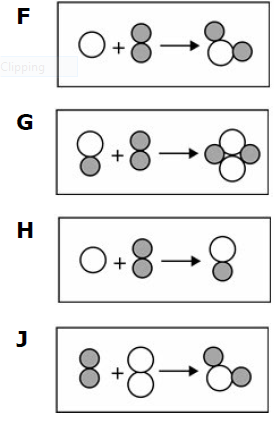
Which of the following models best demonstrates a balanced chemical equation?
a)
F
b)
G
c)
H
d)
J
8.

What is the mass of H2O in the reaction above?
a)
70.01
b)
24.11
c)
21.44
d)
48.22
9.
Si + S8 →Si2S4
a)
Synthesis (combination)
b)
Decomposition
c)
Single replacement
d)
Double replacement
10.
Ca + AlCl3→ CaCl2 + Al
a)
Synthesis (combination)
b)
Decomposition
c)
Single replacement
d)
Double replacement
11.
KOH + H3PO4 → K3PO4 + H2O
a)
Synthesis (combination)
b)
Decomposition
c)
Single replacement
d)
Double replacement
12.
Pb(NO3)2 →PbO + NO2 + O2
a)
Synthesis (combination)
b)
Decomposition
c)
Single replacement
d)
Combustion
13.
Mg + N2 →Mg3N2
a)
Synthesis (combination)
b)
Decomposition
c)
Single replacement
d)
Combustion
14.
NO2 →N2 + O2
a)
Synthesis (combination)
b)
Decomposition
c)
Single replacement
d)
Combustion
15.
AB + CD →AD + CB
a)
Double Replacement
b)
Single Replacement
c)
Synthesis
d)
Decomposition
16.
A + BC →B + AC
a)
Single Replacement
b)
Decomposition
c)
Double Replacement
d)
Synthesis
17.
AB →A + B
a)
Decomposition
b)
Single Replacement
c)
Double Replacement
d)
Synthesis
18.
Cu + 2Ag(NO3) → 2Ag + Cu(NO3)
a)
Synthesis Reaction
b)
Decomposition Reaction
c)
Single Displacement Reaction
d)
Double Displacement Reaction
19.
2NaCl →2Na +Cl2
a)
Synthesis Reaction
b)
Decomposition Reaction
c)
Single Displacement Reaction
d)
Double Displacement Reaction
20.
C + O2 → CO2
a)
Synthesis Reaction
b)
Decomposition Reaction
c)
Single Displacement Reaction
d)
Double Displacement Reaction
21.
Ca3(PO4)2 + 3 H2SO4 + 3 CaSO4 + 2 H3(PO4)
a)
Synthesis Reaction
b)
Decomposition Reaction
c)
Single Displacement Reaction
d)
Double Displacement Reaction
22.
During an endothermic reaction, what happens to energy in relation to the surroundings?
a)
released to
b)
absorbed from
c)
mixed with
23.
During an exothermic reaction, what happens to energy in relation to the surroundings?
a)
released to
b)
absorbed from
c)
mixed with
24.
In a cold pack, which type of reaction draws heat from the surroundings?
a)
exothermic
b)
endothermic
c)
exergonic
100 %

