
 Worksheets
Chemistry Review
Total questions: 35
Worksheet time: 22mins
Name
Class
Date
1.
_______ are the ROWS on the periodic table.
a)
Families
b)
Groups
c)
Periods
d)
Elements
2.
Atoms with similar chemical properties are most likely located...
a)
in the same period.
b)
in the same group.
c)
in different periods.
d)
to the right and left of each other.
3.
If an atom had the same properties as fluorine (F), it would probably be located in
a)
period 1.
b)
period 2.
c)
group 2.
d)
group 7.
4.
As you move from left to right across the periodic table, the atomic number increases.
a)
True
b)
False
5.
Each element is unique based on its number of protons, also known as the...
a)
atomic mass
b)
valence number
c)
atomic symbol
d)
atomic number
6.
In an exothermic reaction, heat is ...
a)
taken in
b)
given out
7.
If a chemical reaction is EXOTHERMIC, the temperature would....
a)
Stay the same
b)
Increase
c)
Decrease
8.
Do reactants in an endothermic reaction have a higher or lower energy than the products?
a)
Higher
b)
Lower
9.
During an endothermic reaction in a beaker if we are part of the surroundings and touched the beaker, it would feel _______.
a)
Warm
b)
Cold
10.
When iron nails get rusty, heat is released. What process is this?
a)
Exothermic
b)
Endothermic
11.
How many times can carbon share valence electrons in a covalent bond?
a)
2
b)
1
c)
4
d)
3
12.

Formed when 2 atoms share electrons
a)
Ionic
b)
Covalent
13.
Covalent bonds are formed by sharing an electron from a _______ to a ________.
a)
Metal to a metalloid
b)
Metalloid to a nonmetal
c)
Nonmetal to a nonmetal
d)
Metal to a nonmetal
14.
Ionic bonds are formed by transferring an electron from a _______ to a ________.
a)
Metal to a metalloid
b)
Metalloid to a nonmetal
c)
Nonmetal to a nonmetal
d)
Metal to a nonmetal
15.
What is an atom or group of atoms that has an electric charge?
a)
ion
b)
metal
c)
nonmetal
d)
ionic compound
16.
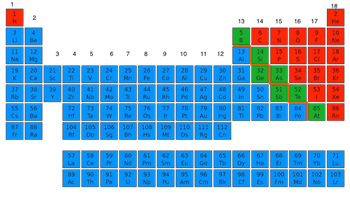
Where are the nonmetals located on the periodic table?
a)
Blue
b)
Red
c)
Green
17.

Where are the metalloids located on the periodic table?
a)
Blue
b)
Red
c)
Green
18.
How are ionic bonds formed?
a)
Transfer of electrons
b)
Sharing of electrons
19.

Is this ionic bond drawn correctly?
a)
Yes
b)
No
20.
What is a valence electron?
a)
The sum of neutrons and protons.
b)
The # of electrons in the last shell.
c)
A type of bond.
d)
A popular compound.
21.
NaCl
a)
Ionic Bond
b)
Covalent Bond
c)
Both bonds
d)
Neither bond
22.
The innermost energy level of any atom can hold up to _____ electrons
a)
two
b)
eight
c)
ten
23.
Elements in the same column of the periodic table always have the same # of _______ as one another.
a)
Protons
b)
Neutrons
c)
Electrons
d)
Valence Electrons
24.

How many electrons are in the outer shell of Chlorine (Cl)?
a)
1
b)
3
c)
6
d)
7
25.

?
a)
Helium
b)
Hydrogen
c)
Argon
d)
Silver
26.
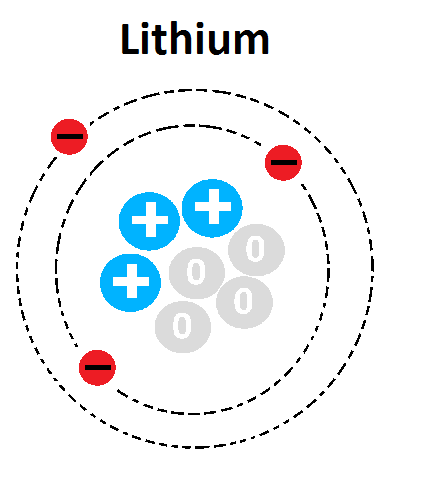
What is the mass number of this atom?
a)
1
b)
3
c)
4
d)
7
27.

?
a)
Lithium
b)
Boron
c)
Carbon
d)
Neon
28.

What element is represented in this Bohr Model?
a)
Carbon
b)
Hydrogen
c)
Aluminum
d)
Lithium
29.
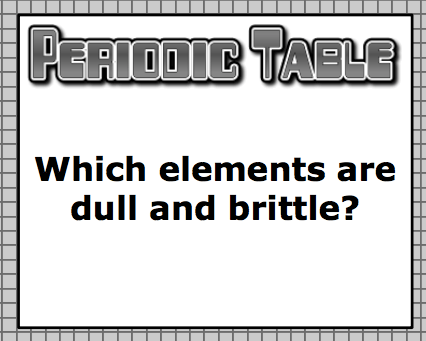
a)
Metals
b)
Nonmetals
c)
Metalloids
30.
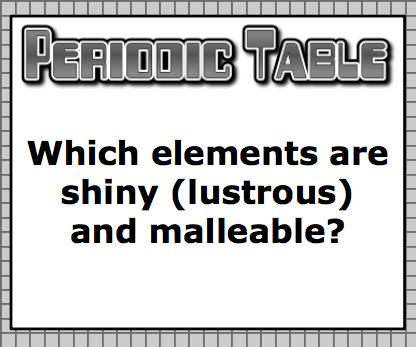
a)
Metals
b)
Nonmetals
c)
Metalloids
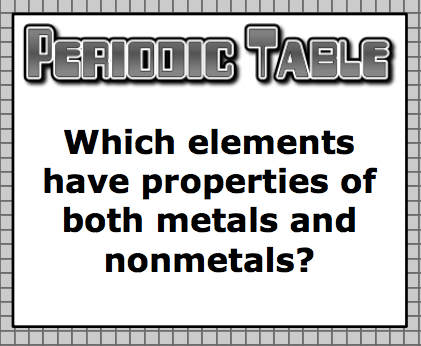
31.
a)
Metals
b)
Nonmetals
c)
Metalloids
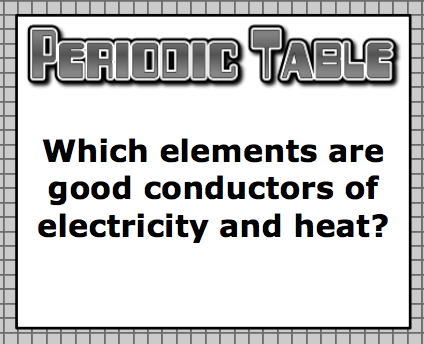
32.
a)
Metals
b)
Nonmetals
c)
Metalloids
33.
An electron has a _____ charge.
a)
negative
b)
positive
c)
neutral
34.
Which particles make up the nucleus of an atom?
a)
protons and neutrons
b)
electrons and protons
c)
electrons, protons, and neutrons
d)
electrons and neutrons
35.

What is the number of neutrons that the element in this image contain?
a)
14
b)
7
c)
15
d)
18
100 %

