
NEW
Font size
S
M
L
XL
 Worksheets
Final Review
Total questions: 65
Worksheet time: 2hrs 49mins
Name
Class
Date
1.
An object moving at a constant speed of 25 meters per second possesses 450 joules of kinetic energy. What is the object’s mass?
a)
0.72 kg
b)
1.4 kg
c)
18 kg
d)
36 kg
2.
A constant force of 1900 newtons is required to keep an automobile having a mass of 1.0 × 10³ kilograms moving at a constant speed of 20. meters per second. The work done in moving the automobile a distance of 2.0 × 10³ meters is
a)
2.0 × 10⁴ J
b)
3.8 × 10⁴ J
c)
2.0 × 10⁶ J
d)
3.8 × 10⁶ J
3.
A catapult with a spring constant of 1.0 × 10⁴ newtons per meter is required to launch an airplane from the deck of an aircraft carrier. The plane is released when it has been displaced 0.50 meter from its equilibrium position by the catapult. The energy acquired by the airplane from the catapult during takeoff is approximately
a)
1.3 × 10³ J
b)
2.0 × 10⁴ J
c)
2.5 × 10³ J
d)
1.0 × 10⁴ J
4.
What is the total electrical energy used by a 1500-watt hair dryer operating for 6.0 minutes?
a)
4.2 J
b)
250 J
c)
9.0 × 10³ J
d)
5.4 × 10⁵ J
5.
A spring scale reads 20. newtons as it pulls a 5.0-kilogram mass across a table. What is the magnitude of the force exerted by the mass on the spring scale?
a)
49 N
b)
20. N
c)
5.0 N
d)
4.0 N
6.
The amount of work done against friction to slide a box in a straight line across a uniform, horizontal floor depends most on the
a)
time taken to move the box
b)
distance the box is moved
c)
speed of the box
d)
direction of the box’s motion
7.
An object weighing 15 newtons is lifted from the ground to a height of 0.22 meter. The increase in the object’s gravitational potential energy is approximately
a)
310 J
b)
32 J
c)
3.3 J
d)
0.34 J
8.
As an object falls freely, the kinetic energy of the object
a)
decreases
b)
increases
c)
remains the same
9.
A 1-kilogram rock is dropped from a cliff 90 meters high. After falling 20 meters, the kinetic energy of the rock is approximately
a)
20 J
b)
200 J
c)
700 J
d)
900 J
10.
A 5-newton force causes a spring to stretch 0.2 meter. What is the potential energy stored in the stretched spring?
a)
1 J
b)
0.5 J
c)
0.2 J
d)
0.1 J
11.
A 40.-kilogram student runs up a staircase to a floor that is 5.0 meters higher than her starting point in 7.0 seconds. The student’s power output is
a)
29 W
b)
280 W
c)
1.4 × 10³ W
d)
1.4 × 10⁴ W
12.
What is the gravitational potential energy with respect to the surface of the water of a 75.0- kilogram diver located 3.00 meters above the water?
a)
2.17 × 10⁴ J
b)
2.21 × 10³ J
c)
2.25 × 10² J
d)
2.29 × 101 J
13.
A 60.0-kilogram runner has 1920 joules of kinetic energy. At what speed is she running?
a)
5.66 m/s
b)
8.00 m/s
c)
32.0 m/s
d)
64.0 m/s
14.
A motor used 120. watts of power to raise a 15-newton object in 5.0 seconds. Through what vertical distance was the object raised?
a)
1.6 m
b)
8.0 m
c)
40. m
d)
360 m
15.
Through what vertical distance is a 50.-newton object moved if 250 joules of work is done against the gravitational field of Earth?
a)
2.5 m
b)
5.0 m
c)
9.8 m
d)
25 m
16.
When a mass is placed on a spring with a spring constant of 15 newtons per meter, the spring is compressed 0.25 meter. How much elastic potential energy is stored in the spring?
a)
0.47 J
b)
0.94 J
c)
1.9 J
d)
3.8 J
17.
Two students of equal weight go from the first floor to the second floor. The first student uses an elevator and the second student walks up a flight of stairs. Compared to the gravitational potential energy gained by the first student, the gravitational potential energy gained by the second student is
a)
less
b)
greater
c)
the same
18.
A 55.0-kilogram diver falls freely from a diving platform that is 3.00 meters above the surface of the water in a pool. When she is 1.00 meter above the water, what are her gravitational potential energy and kinetic energy with respect to the water’s surface?
a)
PE = 1620 J and KE = 0 J
b)
PE = 1080 J and KE = 540 J
c)
PE = 810 J and KE = 810 J
d)
PE = 540 J and KE = 1080 J
19.
A truck weighing 3.0 × 10⁴ newtons was driven up a hill that is 1.6 × 10³ meters long to a level area that is 8.0 × 10² meters above the starting point. If the trip took 480 seconds, what was the minimum power required?
a)
5.0 × 10⁴ W
b)
1.0 × 10⁵ W
c)
1.2 × 10¹⁰ W
d)
2.3 × 10¹⁰ W
20.

An object dropped from the top of a cliff takes 2.85 s to hit the water in the lake below:What is the cliff's height above the water?
a)
3.98 m
b)
398 m
c)
39.8 m
d)
3.98 km
21.

Which graph represents zero acceleration (constant velocity)?
a)
A
b)
B
c)
C
d)
D
22.
The SI unit for frequency is ________.
a)
m
b)
m/s
c)
hertz
d)
s
23.

The image is of a ______________ circuit.
a)
series
b)
parallel
24.

The image is of a ______________ circuit.
a)
series
b)
parallel
25.
Resistance is measured in ...
a)
amps
b)
watts
c)
volts
d)
ohms
26.
You apply a force of 18 N to a dresser and move it 3.0 m. How much work did you do on the dresser?
a)
54 N
b)
6.0 J
c)
54 J
d)
27 J
27.
If you do 40 joules of work lifting a 10N box, how high is the shelf you move it to.
a)
400m
b)
4m
c)
50m
d)
40m
28.
You apply a force of ? to a wheelbarrow and moved it 6 m resulting in 48 J of work. How much force did you do on the dresser?
a)
8 N
b)
8 J
c)
288 J
d)
288 N
29.
Which of the following is NOT a transverse wave?
a)
sound
b)
light
c)
radio
d)
all of these
30.
A roller coaster car is poised at the top of the first hill on its track. What type of energy is the car's total energy stored as?
a)
Kinetic
b)
Thermal
c)
Potential
d)
Mechanical
31.
That same roller coaster car moves down the hill. Assuming that the track is frictionless, which option represents the transfer of energy?
a)
Potential to Kinetic
b)
Kinetic to Potential
c)
Mechanical to Thermal
d)
Mechanical to Potential
32.
If the roller coaster track is not frictionless, which option best represents the transfer of energy?
a)
Thermal to Kinetic and Potential
b)
Kinetic to Thermal and Potential
c)
Potential to Kinetic and Thermal
33.
A box with a mass of 20 kg is moving with a velocity of 3 m/s to the right. How much kinetic energy does it have?
a)
60 J
b)
75 J
c)
90 J
d)
180 J
34.
A spring with a spring constant of 3 N/m is compressed by 4 cm. How much potential energy is stored in the spring?
a)
0.0024 J
b)
0.024 J
c)
2.4 J
d)
24 J
35.
A 1 kg mass is placed against that same spring. When released, the spring imparts all of its energy to the mass. If the surface on which the mass rests is frictionless, what is the speed that the mass will move with?
a)
6.9 cm/s
b)
7.2 cm/s
c)
12.1 cm/s
d)
1.3 m/s
36.
True/False: Sound can travel through solids, liquids, gases, and even a vacuum.
a)
True
b)
False
37.
The law of reflection says that...
a)
all waves incident on a mirror are reflected
b)
waves incident on a mirror are partially reflected
c)
the angle a ray is reflected is random
d)
the angle of reflection equals the angle of incidence
38.
On a graph showing distance versus time, a horizontal line represents an object that is
a)
moving at constant speed
b)
decreasing its speed
c)
increasing its speed
d)
not moving
39.
If you exert a force of 20 N to push a desk 10 M, how much work did you do to the desk?
a)
20 N
b)
200 N
c)
200 J
d)
2 J
40.
An object is shot from the ground (at 25 m/s) at 25 degrees and 65 degrees. Which one rises to a higher height? (assume no air resistance)
a)
25 degrees
b)
65 degrees
c)
same for both
41.
An object is shot from the ground (at 25 m/s) at 25 degrees and 65 degrees. Which is in the air for longer? (assume no air resistance)
a)
25 degrees
b)
65 degrees
c)
same for both
42.
The Richmond County sheriff is trying to determine the speed of a car that slid off a 5 m bridge on a rainy night and landed in a ditch. The tire tracks show that the car landed 12.0 m horizontally from the bridge. How fast was the car going when it left the road?
a)
11.9 m/s
b)
65.7 m/s
c)
43.2 m/s
d)
9. 53 m/s
43.

The voltage drop across the 180 ohm resistor is
a)
9 V
b)
6 V
c)
2 V
d)
12 V
44.

Which diagram shows two bulbs in a series?
a)
1
b)
2
c)
3
d)
4
45.

If the current through the battery was 10A in this diagram. What would the current through each bulb be?
a)
10A
b)
5A
c)
20A
d)
0A
46.

Which statement is true?
a)
The light bulb will light up because the circuit is complete.
b)
The light bulb will light up because the circuit is broken.
c)
The light bulb will not light up because the circuit is complete.
d)
The light bulb will not light up because the circuit is broken.
47.
In a series circuit the current
a)
Is the sum of all currents going through a resistor
b)
Increases the more amount of resistors added
c)
The same throughout the circuit
d)
Goes back and forth
48.

What is happening between 3 seconds and 4 seconds?
a)
The object is moving in a negative direction.
b)
The object is returning to its starting position.
c)
The object is slowing to a stop.
d)
The object is changing direction.
49.

What is happening between 2 and 3 seconds?
a)
The object is not moving.
b)
The object is not accelerating.
c)
The object is slowing down.
d)
The object is speeding up.
50.

A car travels 14 meters in 7 seconds. How fast was the car going?
a)
v = 0.5 m/s
b)
v = 14.7 m/s
c)
v = 21 m/s
d)
v = 2 m/s
51.

A car is traveling at 21.0 m/s. It slows to a stop at a constant rate over 5.00 s. How far does the car travel during those 5.00 seconds before it stops?
a)
4.20 m
b)
52.5 m
c)
105 m
d)
158 m
52.
A vector is a quantity that had
a)
magnitude and time
b)
time and direction
c)
magnitude and direction
d)
direction and rhythm
53.
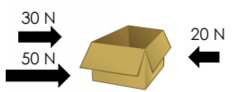
Calculate the Net Force.
a)
60N, Left
b)
40N, Right
c)
0N
d)
60N, Right
54.
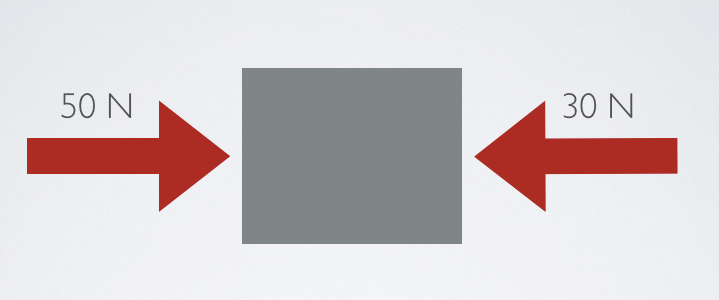
How will this object move?
a)
It won't move.
b)
It will move to the right.
c)
It will move to the left.
d)
It will move up.
55.
The _______ of two or more vectors is the sum of the vectors.
a)
components
b)
scalar
c)
resultant
d)
magnitude
56.

The equivalent resistance in this circuit is
a)
100 ohms
b)
450 ohms
c)
400 ohms
d)
30 ohms
57.

What is the unit of electric charge?
a)
Volts
b)
Amps
c)
Coulombs
d)
Ohms
58.

Consider the conduction charging shown.
a)
Electrons move from the insulating stand into the sphere.
b)
Protons move from the bar into the sphere.
c)
Electrons move from the charged metal bar into the sphere.
d)
Protons move from the sphere into the negatively charged bar.
59.

At which point is the electric field the strongest
a)
A
b)
B
c)
C
d)
D
60.

Consider the electric field lines shown in the diagram below. From the diagram, it is apparent that object A is ____ and object B is ____.
a)
+,+
b)
+,-
c)
-,+
d)
-,-
61.

Most of an Atom is empty space
a)
True
b)
False
62.
The units for momentum are
a)
kg
b)
m/s
c)
kg-m/s
d)
kg/m/s
63.
The units for Impulse are
a)
N/s
b)
N-s
c)
N
d)
m/s
64.

You drop a 5 kg ball from a height of 2 m. Just before it reaches the ground, what type of energy does it have?
a)
Potential Energy
b)
Kinetic Energy
c)
Nuclear Energy
d)
Chemical Energy
65.
The total momentum before a collision is _________ the total momentum after a collision.
a)
equal to
b)
less than
c)
more than
d)
It depends on the type of collision
Reset

