Wayground logo

Free Printable Worksheets

Font size

S
M
L
XL
Worksheets

Natural Selection & Evolution

Total questions: 23

Worksheet time: 21mins

Name
Class
Date
1.
A bird that can easily outcompete other birds for food and that can produce many eggs has a high
a)
sexuality
b)
mutation rate
c)
fitness
d)
adaptability
2.
What is suggested by the similarity of early embryos of different species of vertebrates?
a)
no evolutionary relationships between the groups
b)
common ancestry
c)
similar environments in the past
d)
genetic drift
3.
Some organisms that share a common ancestor have features that have different functions, but similar structures.  These are known as
a)
vestigial structures
b)
analogous structures
c)
homologous structures
d)
homologous chromosomes
4.
Two organisms that are closely related would have
a)
a very similar DNA sequence
b)
exactly the same DNA sequences
c)
no proteins in common
d)
completely different DNA sequence
5.
The diagram above shows an embryo of different vertebrates at different stages of development. Which field of study would support the similarities in development as evidence for evolution?
a)
comparative biochemistry
b)
paleontology
c)
comparative biogeography
d)
comparative embryology
6.
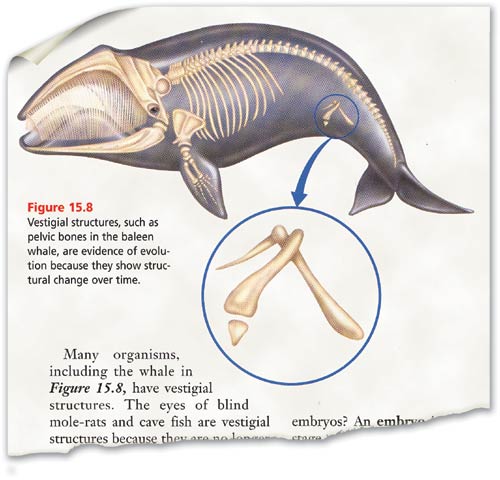
Which of the following is an example of a vestigial structure?
a)

the wings of a red-tailed hawk

b)

the hind limbs of a house cat

c)

the fins of sharks

d)

the appendix of a human

7.
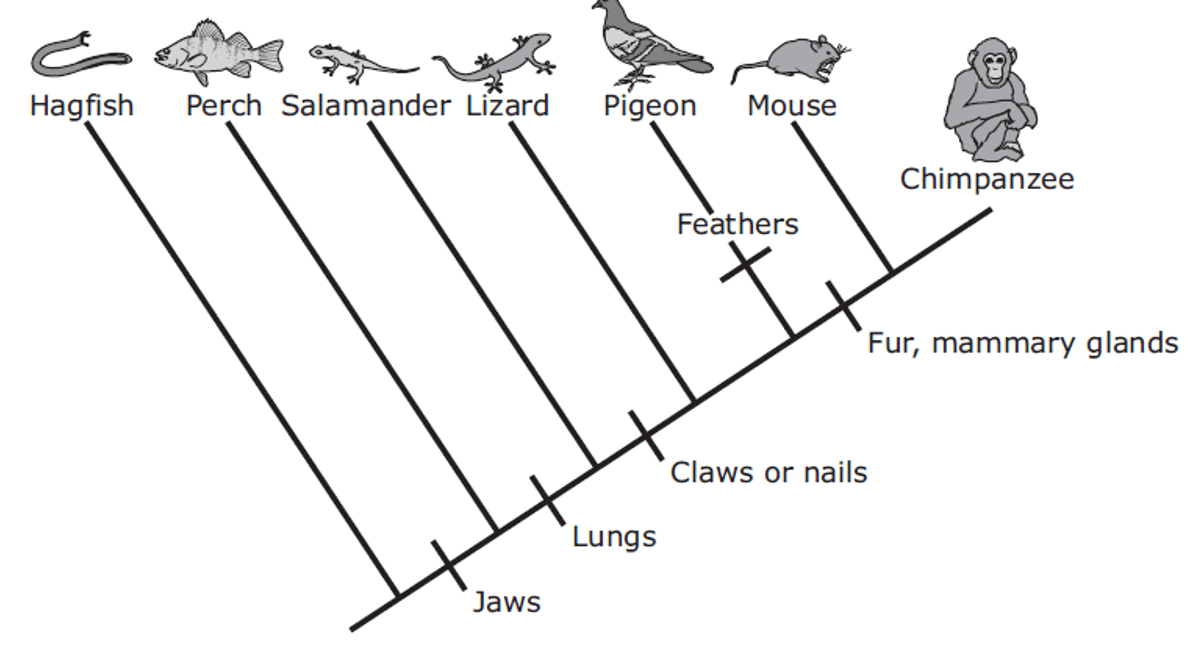
All the animals to the right of the hagfish would have the derived characteristic--
a)

Fur

b)

Claws or nails

c)

Lungs

d)

Jaws

8.
According to this cladogram, birds are LEAST related to 
a)
Amphibians
b)
Sharks
c)
Ray Finned Fish
d)
Crocodiles
9.
Individuals that are well adapted to their environment will survive and produce
a)
fewer mutations
b)
stronger genes
c)
more offspring
d)
better traits
10.
Which derived characteristic is only found in humans?
a)
jaws
b)
mammary glands & hair
c)
terrestrial during all life stages
d)
opposable thumbs
11.
According to the cladogram, which organism is most distantly related to the human?
a)
crayfish
b)
rat
c)
perch
d)
frog
12.
This picture illustrates one species of butterfly and describes which component of natural selection?
a)
homologous structures
b)
variation
c)
vestigial structures
d)
DNA studies
13.
Sea turtles usually lay 120-150 eggs, however, only a few of them hatch to produce young turtle hatchlings.  Which principle of Darwin's Theory of Natural Selection is this example?
a)
variation
b)
overproduction
c)
descent with modification
d)
struggle for existence
14.
Giant tortoises on the Galapagos Islands possess variation in their neck length and carapace (shell) shape that make them well adapted for eating different plants and vegetation.  In which environment would this long necked tortoise with a saddle-shaped carapace have the greatest fitness?
a)
Island with low grasses
b)
Island with shrubs and higher vegetation
15.
The study of the past and present distribution of species and the patterns that emerge from such analysis is 
a)
common ancestry
b)
biogeography
c)
stasis
d)
comparative biochemistry
16.
If two organisms can no longer interbreed and produce fertile offspring, they are considered to be 
a)
different animals
b)
different species
c)
mutated
d)
the same species
17.
If a student is looking at the early stages of duck and fish development, then they are considering:
a)
Biochemical molecules
b)
Fossils
c)
Artificial Selection
d)
Embryology
18.
You look at two species and see very similar DNA. What does this likely tell you?
a)
These are the same animal.
b)
These animals have a common ancestor.
c)
These animals are not likely related.
d)
These animals are likely becoming one species.
19.
Which two organisms are the most closely related according to their DNA sequence?
Critter A--> ATG CTT AAC CCG TTA
Critter B--> ATC GTT TTC CCG TCT
Critter C--> ATG CTA TAG GCG TAA
a)
Critter A and B
b)
Critter A and C
c)
Critter B and C
d)
They are all equally related
20.
Antibiotics are frequently given to humans that have strep throat. Why might this practice be considered a problem?
a)

Antibiotics cause mutations in the bacteria which could change to something deadly.

b)

The human body can metabolize the antibiotic too quickly, not allowing the antibiotic to reach the bacteria.

c)

Bacteria with a resistant gene survive and reproduce and can exchange plasmids with other bacteria.

d)

Nothing will happen. It takes thousands of years for bacteria to evolve and become antibiotic resistant.

21.
Populations of insecticide resistant insects (they are not harmed by insecticides) are the result of ______.
a)
temporal isolation
b)
genetic drift
c)
natural selection
d)
artificial selection
22.

Structures that are reduced in size and have no apparent function in an organism are ___________.

a)

homologous structures

b)

vestigial structures

c)

analogous structures

d)

embryological structures

23.

Two species of squirrel that look similar evolved from a single species. A river carved out a canyon and separated the squirrels and over time, due to natural selection they evolved into different species. This is an example of _____.

a)

temporal isolation

b)

behavioral isolation

c)

geographic isolation

d)

habitat isolation