
 Worksheets
SOL Science review
Total questions: 35
Worksheet time: 15mins
Name
Class
Date
1.
What kind of energy is in a moving skateboard?
a)
Potential
b)
Kinetic
2.

At which point is potential energy greatest?
a)
W
b)
X
c)
Y
d)
Z
3.
The formula for work is:
a)
d = r x t
b)
p = m x v
c)
f = m x a
d)
w = d x f
4.
An electron has a _____ charge.
a)
negative
b)
positive
c)
neutral
5.

Which image represent an element?
a)
X
b)
Y
c)
Z
d)
W
6.

Which rays on the electromagnetic spectrum has the highest frequency?
a)
Radio waves
b)
Gamma-Rays
c)
X-Rays
d)
UV waves
7.
Which atomic particle has negative electrical charge?
a)
Electron
b)
Proton
c)
Neutron
8.

The atomic mass of Carbon is
a)
12.011
b)
6
c)
18.011
9.
What is velocity?
a)
speed and time
b)
speed and direction
c)
direction and time
d)
time and mass
10.
What does Newton's 1st Law tell us?
a)
All objects stop moving eventually.
b)
Without an outside force, an object in motion will travel forever.
c)
For every action, there is an equal reaction.
11.

a)
Convex lens
b)
Concave lens
12.
Of the following, which one requires a direction?
a)
speed
b)
distance
c)
velocity
d)
time
13.
A ___________ is an arrangement of elements in columns
a)
columns
b)
rows
c)
periodic table
d)
electron shell
14.
The atomic number tells you what?
a)
number of electrons
b)
number of protons
c)
number of neutrons
d)
both electrons and protons in an atom.
15.
Which particle has a positive charge?
a)
electron
b)
orbital
c)
proton
d)
neutron
16.
Which particles make up the nucleus of an atom?
a)
protons and neutrons
b)
electrons and protons
c)
electrons, protons, and neutrons
d)
electrons and neutrons
17.
What charge does the nucleus have and why?
a)
positive - the neutrons do not have a charge
b)
positive - the neutrons and protons are positively charged particles
c)
neutral - the neutral charge dominates the positive charge
d)
neutral - electrons cancel out the positive charge of the atom
18.
A combination of substances that are not chemically combined is called a(n)____________.
a)
mixture
b)
compound
c)
physical
d)
Element
19.

What is a change in the size, shape, or state of matter that does not change it into a new kind of matter?
a)
energy
b)
physical change
c)
chemical change
d)
energy transformation
20.
Bending of a wave when it changes mediums
a)
reflection
b)
refraction
c)
diffraction
d)
convection
21.
Which of the following would be an insulator
a)
copper
b)
steel
c)
plastic
d)
graphite
22.

The shortest wavelength in visible light is______.
a)
violet
b)
red
c)
blue
d)
yellow
23.
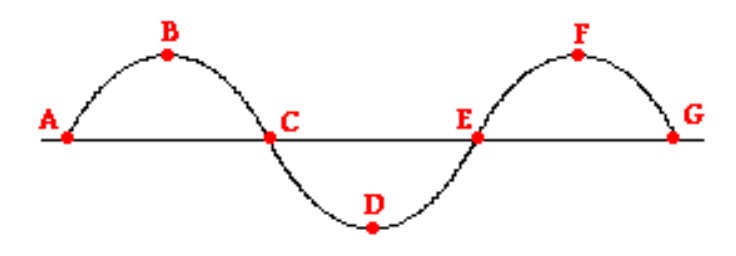
Which letter(s) represent the trough of the wave?
a)
A
b)
B & D
c)
D
d)
C & G
24.
Every action has an equal and opposite reaction
a)
Newton's 1st
b)
Newton's 2nd
c)
Newton's 3rd
d)
Law of Gravity
25.

a)
Convex lens
b)
Concave lens
26.

a)
Amplitude
b)
Trough
c)
Crest
d)
Rarefaction
27.
A pH less than seven is considered to be a(n) ---
a)
Base
b)
Acid
28.
The variable that changes in an experiment--
a)
Dependent variable
b)
Independent variable
29.
What is the Law of Conservation of mass?
a)
Mass is created in a chemical reaction
b)
Mass is created in a physical change
c)
New chemicals formed from a chemical reaction have a larger overall mass than the original reactants
d)
Mass is never created or destroyed
30.

Whose atomic model is this
a)
Bohr
b)
Democritus
c)
Rutherford
d)
Thomson
31.

Whose atomic model is this
a)
Bohr
b)
Democritus
c)
Rutherford
d)
Thomson
32.
The scientist responsible for "discovering" the nucleus is:
a)
Bohr
b)
Rutherford
c)
Schroedinger
d)
Einstein
33.

Whose model of the atom?
a)
Dalton
b)
Rutherford
c)
Newton
d)
Thompson
34.

In the current atomic theory, where are electrons likely to be found?
a)
Specific Orbits, like planets around a star
b)
In the nucleus
c)
In the electron cloud
d)
electrons are not part of the current atomic theory
35.

Which is the correct sequence of the scientists who made major changes in the model of the atom?
1-JJ Thomson
2-Erwin Schrodinger
3-John Dalton
4-Niels Bohr
5-Ernest Rutherford
1-JJ Thomson
2-Erwin Schrodinger
3-John Dalton
4-Niels Bohr
5-Ernest Rutherford
a)
2, 1, 4, 3, 5
b)
3, 1, 5, 4, 2
c)
5, 3, 2, 1, 4
d)
4, 3, 2, 1, 5
100 %

