
 Worksheets
6th grade Unit 3 (PfISD)
Total questions: 41
Worksheet time: 23mins
Name
Class
Date
1.
What is a physical model?
a)
A structure that allows for physical activity
b)
A structure scientists develop in their minds.
c)
A model based on the scientific method.
d)
A model scientists build to represent something else.
2.
What is a conceptual model?
a)
A structure that scientists develop in their minds.
b)
A model that scientists build to represent something else.
c)
A model based on the scientific method.
d)
A structure that allows for variables to be tested.
3.
Which of the following is not an example of a physical model?
a)
stuffed animal
b)
toy car
c)
skeleton
d)
atom
4.

What type of model represents this picture of an atom?
a)
Conceptual Model
b)
Physical Model
5.
Which of the following is not an example of a conceptual model?
a)
Atom
b)
DNA
c)
Layers of Earth
d)
House
6.

This model of the Earth represents which type of model?
a)
Conceptual Model
b)
Physical Model
7.

What is the volume of the rock? The water level is displaced from 20 mL to 23 mL with the rock.
a)
3 mL
b)
23 mL
c)
20 mL
d)
43 mL
8.

The graduated cylinder has a volume of 50 mL. You drop a tennis ball in the cylinder. The volume rises to 88 ml. What is the volume of the tennis ball?
a)
50 mL
b)
138 mL
c)
38 mL
d)
88 mL
9.
The ability for a solid to be hammered without shattering
a)
Density
b)
Conductivity
c)
Malleability
d)
Viscosity
10.
The ability of matter to conduct heat
a)
Viscosity
b)
Conductivity
c)
Density
d)
Melting/Boiling Point
11.
Which is an example of a physical property?
a)
rusting
b)
boiling point
c)
combustion
d)
reactivity with water
12.
The ability of matter to conduct electric current or heat
a)
Solubility
b)
Mass
c)
Weight
d)
Conductivity
13.
An attractive force for some metals.
a)
Conductivity
b)
Solubility
c)
Magnetism
d)
Mass
14.
A description of objects that can be measured and observed.
a)
gas
b)
mustangs
c)
physical properties
d)
melting point
15.
A substance's ability to be pulled into thin wires is.....
a)
Conductivity
b)
Malleability
c)
Ductility
d)
Hardness
16.

Water in this picture is in which state of matter?
a)
solid
b)
liquid
c)
gas
d)
mixture
17.
Mrs. Cowan picks up a box. She says the box is heavy. Which property is Mrs. Cowan referring to?
a)
texture
b)
mass
c)
color
d)
temperature
18.
The measure of how long something is from one side to another
a)
volume
b)
area
c)
length
d)
mass
19.

Which item is not made of matter?
a)
air
b)
water
c)
a pencil
d)
a shadow
20.

Using the image, which conclusion can be drawn from this information?
a)
Substance W has the greatest density.
b)
Substance Z is denser than substance Y and less dense than substance W.
c)
Substance X is denser than substance Z and less dense than substance Y.
d)
Substance Y has the least density
21.
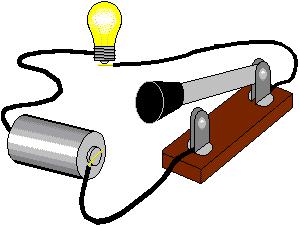
Using these tools, which physical property could someone find out more about?
a)
Thermal Conductivity
b)
Electrical Conductivity
c)
Relative Density
d)
Solubility
22.

Some students tested 3 substances and recorded their findings about physical properties in the chart. Which substance is magnetic, a conductor and has a volume between 8 cubic centimeters and 10 cubic centimeters?
a)
Substance A
b)
Substance B
c)
Substance C
d)
no way to tell
23.
To change a solid to a liquid, what do you do?
a)
add heat
b)
remove heat
c)
add cold
d)
mass
24.
What is mass?
a)
A solid
b)
The amount of space something takes up
c)
The amount of matter something has
d)
Anything that has mass and takes up space
25.
Changing gas to a liquid is called
a)
evaporation
b)
condensation
c)
melting
d)
freezing
26.
Which unit is used to measure volume?
a)
milliliters
b)
centimeters
c)
inches
d)
pounds
27.
What is matter?
a)
Volume of an object
b)
Anything that has mass and takes up space
c)
Mass of an object
d)
Space of an object
28.
This is how easy it is to hammer or roll a material into flat sheets or other shapes.
a)
Malleablity
b)
Ductile
c)
Luster
d)
Metal
29.
If an object is easily shattered when hit with an object like a hammer, the object is ___________.
a)
Luster
b)
Conductive
c)
Brittle
d)
Ductile
30.
the process in which matter changes from a liquid to a gas
a)
Evaporation
b)
Condensation
c)
Precipitation
31.
Something that prevents electricity or heat from passing through is a
a)
Insulator
b)
Conductor
32.
How much matter something has for its size
a)
Mass
b)
Matter
c)
Density
d)
Volume
33.
Whether something is a solid, liquid, or gas
a)
matter
b)
volume
c)
state of matter
d)
density
34.
Density is
a)
matter/solids
b)
volume/mass
c)
gas/liquid
d)
mass/volume
35.
A teacher mixes a white powder into a beaker of water. The white powder cannot be seen in the water. When it is heated and the water evaporates, the powder can be seen again. What property is this?
a)
density
b)
conductivity
c)
solubility
d)
mass
36.
Objects that shine have
a)
mass
b)
solubility
c)
malleability
d)
luster
37.
In the directions for a lab, you see, "record your measurement in grams." What tool would you use to take this measurement?
a)
Balance
b)
Graduated Cylinder
c)
Ruler
d)
Slide Rule
38.
In your partner's lab notebook, you see the measurement, "25 mL." What measurement is this?
a)
Volume
b)
Mass
c)
Length
d)
Density
39.
Your lab partner is reading a graduated cylinder by holding it up in the air in front of their face. Is this the correct way to read this piece of equipment?
a)
No - it needs to be on a flat surface
b)
Yes - as long as they read it at eye level
c)
No - it needs to be tilted up
d)
No - it should be put on a balance scale first
40.
Which object is not matter?
a)
air
b)
balloon
c)
sound
d)
moon
41.

What measurement is taken with this instrument?
a)
weight
b)
mass
c)
volume
d)
distance
100 %

