
 Worksheets
Cardiac Dysrhythmias!
Total questions: 11
Worksheet time: 9mins
Name
Class
Date
1.
A 55-year-old man presents after a syncopal event. He states he just started a new blood pressure medication. His heart rate is 41 beats/minute and his blood pressure is 95/60 mm Hg. Electrocardiogram shows sinus bradycardia. Which of the following medications should be administered?
a)
Adenosine
b)
Atropine
c)
Diltiazem
d)
Procainamide
2.
An 83-year-old is being evaluated in the emergency department after an episode of syncope. The woman was preparing dinner when she felt her heart start to race. The next thing she remembers is waking up on the floor. She experienced a similar episode about three weeks ago. She has never had anything like this before. Her past medical history is remarkable for hypertension, hyperlipidemia and hypothyroidism. Her medications include lisinopril, atorvastatin and levothyroxine. On physical exam her blood pressure is 142/83, heart rate 76/min, and respiration rate 13/min. Cardiac auscultation reveals no murmur. The remainder of her physical exam is normal. Electrocardiogram reveals normal sinus rhythm with left axis deviation. No cardiac rhythm abnormalities are detected. What is the most likely etiology of this patient’s syncope?
a)
Aortic Stenosis
b)
Cardiac dysrhythmia
c)
Orthostatic hypotension
d)
Vasovagal episode
3.

A 59-year-old man presents complaining of a severe headache for three days that came on gradually, and is diffuse in nature. His blood pressure is 205/105 mm Hg. All other vital signs are normal. His physical exam and basic laboratory workup are negative. His electrocardiogram is shown above. Which of the following antihypertensives is contraindicated in this patient?
a)
Atenolol
b)
Enalapril
c)
Hydralazine
d)
HCTZ
4.
A 35-year-old woman with alcohol abuse presents to clinic complaining of “skipped heart beats.” Her examination is normal. An in-office ECG is also normal. Laboratory testing is nonspecific. Which of the following is the next most appropriate test?
a)
Echocardiogram
b)
Electromyography
c)
Holter monitor
d)
Sestamibi scan
5.
An 81-year-old man with 10 years of coronary artery disease presents with chest pain and altered mental status. His ECG shows consecutive, large and wide QRS complexes. P waves cannot be appreciated. His pulse is 188 bpm. Which of the following is the most likely diagnosis?
a)
Atrial Fibrillation
b)
Atrial Flutter
c)
Ventricular Fibrillation
d)
Ventricular tachycardia
6.

A 72-year-old woman presents to the ED with an acute onset of dyspnea and palpitations that began four hours prior to arrival. Vital signs include a heart rate of 144 beats per minute, blood pressure of 80/50 mm Hg, respiratory rate of 28 breaths per minute, temperature of 37.0°C, and a pulse oximetry of 88% on room air. The above 12-lead ECG is obtained. What is the most appropriate next step in the management of this patient?
a)
A. Anticoagulation with enoxaparin followed by warfarin
b)
B. Chemical cardioversion using procainamide
c)
C. Rate control using diltiazem
d)
D. Synchronized cardioversion
7.
Which of the following is associated with a shortened PR interval?
a)
Brugada Syndrome
b)
Mobitz 2° AV Block
c)
Sick Sinus Syndrome
d)
Wolff-Parkinson-White syndrome
8.
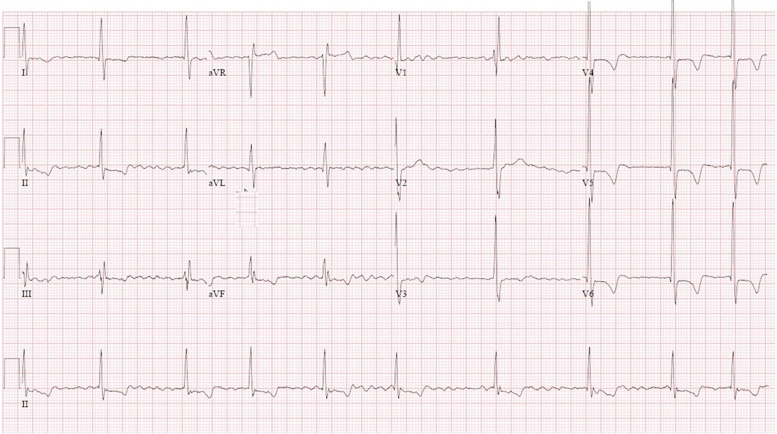
A 74-year-old man is having a preoperative ECG performed. What is your interpretation of his ECG?
a)
Atrial fibrillation
b)
Atrial flutter
c)
Normal sinus rhythm
d)
Sins tachycardia
9.

A 26-year-old woman presents with dizziness and palpitations. She reports episodes of these symptoms beginning about 1 week ago, which initially only lasted a few minutes. However, for the past two days, she has had about 4 episodes a day which last about 20 minutes each. Her social history is significant for heavy caffeine intake. Her pulse is 166 bpm and her blood pressure is 140/70. Her rhythm strip is seen above. Which of the following best describes the most likely underlying cardiac pathology responsible for this patient’s symptoms?
a)
Paroxysmal supraventricular tachycardia (PSVT)
b)
Wolff-Parkinson-White syndrome
c)
Sinus tachycardia
d)
Multifocal Atrial Contractions
10.
What is the long-term treatment for paroxysmal supraventricular tachycardia (PSVT)?
a)
Calcium channel blockers, beta-blockers and radiofrequency catheter ablation.
b)
Beta-blockers, anticoagulation
c)
Radiofrequency ablation and debrillation
d)
Vagal maneuvers
11.

A 58-year old man is brought to the ED for chest pain that started 30 minutes prior to arrival while he was jogging in the park. Initially, the patient’s cardiac monitor shows sinus tachycardia with a rate of 120 beats per minute. However, while you are interviewing the patient in the resuscitation bay, he suddenly becomes pale, pulseless, and the above rhythm is seen on the cardiac monitor. What does the ECG represent and which of the following is the definitive next step to manage this rhythm?
a)
A. Asystole- Chest compression
b)
B. Torsades De Pointes- IV Magnesium
c)
C. Ventricular fibrillation- Defibrillation
d)
D. Ventricular fibrillation- Synchronized Cardioversion
100 %

