
 Worksheets
VUS Hist. SOL Review: WW2, Cold War, Civil Rights, Contemp.
Total questions: 137
Worksheet time: 1hrs 18mins
Name
Class
Date
1.

Match the leader with his country.
Franklin Roosevelt
Franklin Roosevelt
a)
United States
b)
United Kingdom
c)
Soviet Union
d)
Germany
2.

Match the leader with his country.
Winston Churchill
Winston Churchill
a)
United States
b)
United Kingdom
c)
Soviet Union
d)
Germany
3.

Match the leader with his country.
Joseph Stalin
Joseph Stalin
a)
United States
b)
United Kingdom
c)
Soviet Union
d)
Germany
4.

Match the leader with his country.
Adolf Hitler
Adolf Hitler
a)
United States
b)
United Kingdom
c)
Soviet Union
d)
Germany
5.

Match the leader with his country.
Hideki Tojo
Hideki Tojo
a)
Japan
b)
Italy
c)
Soviet Union
d)
Germany
6.

Match the leader with his country.
Benito Mussolini
Benito Mussolini
a)
Japan
b)
Italy
c)
Soviet Union
d)
Germany
7.

If you were a school-aged boy in Germany, you may have been required to join this organization, to show your support for Hitler.
a)
Nazis for kids
b)
Sieg Heil
c)
Hitler Youth
d)
Germans for Hitler
8.

The United States government used Japanese internment camps to _____________.
a)
train Japanese-American soldiers.
b)
hold Japanese-American citizens prisoner for fear of spying.
c)
protect Japanese-Americans.
d)
collect information on Japan.
9.

After declaring war on Japan, the United States put American citizens with Japanese heritage, living on the west coast of the United States, into these.
a)
Prisons
b)
Resorts
c)
Concentration Camps
d)
Japanese Internment Camps
10.

This was the name of the secret German code machine that the Allies eventually captured; the use of this machine allowed the Germans to pass messages that we couldn’t understand.
a)
The Enigma
b)
Deutsche Geheimnis
c)
The Secret Keeper
d)
The Encoder
11.

This German scientist helped the United States develop the first atomic bomb.
a)
Albert Einstein
b)
Charles Lindbergh
c)
Josef Mengele
d)
Warner van Bran
12.

After the Battle of the Bulge, Germany's army was left with no option but to retreat back to Germany.
a)
True
b)
False
13.

_________________ was used on war time recruitment posters to encourage women to join the work force and construct materials to fight the war.
a)
Wendy the Welder
b)
Molly the Miner
c)
Stella the Steelworker
d)
Rosie the Riveter
14.

After defeating Germany in World War II, the United States assumed all power over Germany's land.
a)
True
b)
False
15.

"Remember Pearl Harbor" became the United States' battle cry for World War II.
a)
True
b)
False
16.

Was Germany part of the Axis or Allied Powers at the end of WWII?
a)
Allied
b)
Axis
17.

What side did Great Britain fight for at the end of WWII?
a)
Allied
b)
Axis
18.

Was Italy part of the Axis or Allied Powers at the end of WWII?
a)
Allied
b)
Axis
19.

Was the Soviet Union part of the Axis or Allied Powers at the end of WWII?
a)
Allied
b)
Axis
20.

Was the United States of America part of the Axis or Allied Powers at the end of WWII?
a)
Allied
b)
Axis
21.

Two atomic bombs were dropped on Japan in 1945. What were their names?
a)
Big Bertha and Tiny Ted
b)
Little Boy and Little Girl
c)
Little Boy and Fat Man
d)
Big Bertha and Large Marge
22.

Hitler was the leader of a political party called...
a)
the Federalists
b)
the Fascists
c)
the Nazis
d)
he German Supremacy Party
23.

American, Canadian, and British forces staged an amphibious assault on Nazi-controlled Normandy, France. First paratroopers were sent in, then the main assault.
a)
Battle of Midway
b)
Battle of the Bulge
c)
Battle of Iwo Jima
d)
D-Day (Operation Overlord)
24.

This battle, fought over the winter months of 1944 – 1945, was the last major Nazi offensive against the Allies in World War Two. The battle was a last ditch attempt by Hitler to split the Allies in two in their drive towards Germany and destroy their ability to supply themselves.
a)
Battle of Midway
b)
Battle of the Bulge
c)
Battle of Iwo Jima
d)
D-Day (Operation Overlord)
25.

Fought in June 1942, this battle effectively destroyed Japan’s naval strength when the Americans destroyed four of Japan's aircraft carriers.
a)
Battle of Midway
b)
Battle of the Bulge
c)
Battle of Iwo Jima
d)
D-Day (Operation Overlord)
26.

This battle took place in February 1945 on a Japanese Island. Japanese fought underground and the Americans fought above ground.
a)
Battle of Midway
b)
Battle of the Bulge
c)
Battle of Iwo Jima
d)
D-Day (Operation Overlord)
27.

China's invasion of Manchuria was China's first step toward dominating Japan.
a)
True
b)
False
28.

The German military strategy, Kristallnacht, used new advances in tanks, artillery, and air power to defeat enemies.
a)
True
b)
False
29.

Kristallnacht ("Night of Broken Glass"), the persecution of Jews, and concentration camps were all a part of ___________________.
a)
the Holocaust
b)
post-war Germany.
c)
being a soldier in WWII.
d)
the rule of Hideki Tojo.
30.

Hitler believed the welfare of his country was more important than personal freedoms.
a)
True
b)
False
31.

Before declaring war against Germany, Joseph Stalin and Adolf Hitler made an agreement to divide what country in half? (Germany and the Soviet Union would each receive half of the country)
a)
Poland
b)
France
c)
the Middle East
d)
Turkey
32.

After more than 200,000 people died as a result of the atomic bombs dropped on Hiroshima and Nagasaki, Japan surrendered.
a)
True
b)
False
33.

This major invasion of French beaches at Normandy, helped the Allies punch holes in the German defenses, leading to Germany's surrender in World War II.
a)
D-Day
b)
VE Day
c)
VJ Day
d)
French Invasiion
34.

Which event led the United States to declare war in World War II ?
a)
Pearl Harbor
b)
Battle of the Atlantic
c)
Battle of Britain
d)
German defeat of France
35.

While Hitler was in prison, he wrote a book, Mein Kampf, that blamed the problems of Germany on ____________________ .
a)
the Jewish people
b)
the economy
c)
the Republicans
d)
the Facists
36.

Franklin Delano Roosevelt made the decision to drop the atomic bomb on Japan in 1945.
a)
True
b)
False
37.

All of the following were benefits of dropping the atomic bomb on Japan,EXCEPT:
a)
saving American soldiers from fighting a longer war
b)
killing innocent people
c)
ending the war with Japan quickly
d)
saving the United States money
38.

Prejudice against or hostility towards Jews is called...
a)
Anti-Semitism
b)
Hitlerism
c)
Anti-Judaism
d)
Naziism
39.

The United States fought for democracy, so we refused to let any dictators join the Allies.
a)
True
b)
False
40.

According to Franklin D. Roosevelt, the day that Pearl Harbor was attacked, December 7, 1941, was the "day that will live in infamy."
a)
True
b)
False
41.

People from this Native American Tribe used their native language to help the Americans pass secret messages in the South Pacific; they were one of the main reasons we were able to defeat Japan.
a)
the Chippewa
b)
the Niagara
c)
the Navajo
d)
the Delaware
42.

In the 1930's, BEFORE the start of World War II, Japan invaded
a)
eastern China (Manchuria)
b)
Germany
c)
Australia
d)
Pearl Harbor
43.
Which of these is not a cause of WW 2 ?
a)
Hitler comes to power in Germany
b)
Japan wishes to expand empire
c)
League of Nations is working correctly
d)
Hitler blames Jews for WW1lose
44.
He was leader of the Soviet Union during WW 2
a)
VI Lenin
b)
Vladimir Chewocoff
c)
Joseph Stalin
d)
Austin Cave
45.
This type of warfare relied on speed and being able to move rapidly with planes, tanks, men
a)
trench warfare
b)
blitzkrieg
c)
fighting in ranks
d)
fixed fortations
46.
Before WW2, Japan bought a lot of ------------- from the United States
a)
oil
b)
scrap metal
c)
card oard
d)
Both a @ b
47.
Which organization was formed after World War 2 to promote world peace?
a)
League of Nations
b)
Justice League
c)
United Nations
d)
World Council of Churches
48.
Which event happened first?
a)
Fall of Poland
b)
Battle of Britain
c)
Fall of France
d)
Battle of the Bulge
49.
Which event happened last?
a)
Battle of the Coral Sea
b)
Germany surrenders
c)
FDR dies
d)
Battle of Midway
50.
What world changing event occurred on August 6, 1945?
a)
atomic weapons used
b)
massive food shortages
c)
Germany surrendered
d)
new leaders in Britain
51.
He lead Nazi Germany from 1933-1945
a)
Paulus
b)
Himmel
c)
Stalin
d)
Hitler
52.
Which of the following is not true about Stalingrad?
a)
Fought house to house
b)
Fought in open terrority
c)
Won by the Soviets
d)
Fought in bitter cold
53.
What was the end date of the war in Europe?
a)
V-E Day
b)
V-J Day
c)
V-8 day
d)
VH 1 day
54.
december 7, 1941 .....
a)
was when Germany invaded poland
b)
Great Britain and Zfrance declared war
c)
japan attacked pearl harbor
d)
Germany invaded Soviet Zunion
55.
The decision to drop atonic bomb was made by ...
a)
FDR
b)
Truman
c)
einstein
d)
Oppenheimer
56.
Who ruled as a dictator and leader of the Nazi party and wanted to build a powerful military and make his country a strong nation?
a)
Hitler
b)
Mussolini
c)
Stalin
57.
The Allies and Hitler reached an agreement that Hitler could keep the land he had already taken if he did not invade any more countries. Hitler broke this promise when he invaded __________________.
a)
Denmark
b)
Sweden
c)
France
d)
Poland
58.
Who was the prime minister of England?
a)
Roosevelt
b)
Churchill
c)
Hitler
d)
Truman
59.

Kamikaze Attacks were...
a)
Japanese Suicide Pilots
b)
Japanese Suicide Bomb Vests
c)
Japanese Samurai Sword Attacks
d)
Japanese Bombing Raids
60.

The end of WW2 in Europe was celebrated as...
a)
V-E Day
b)
V-J Day
c)
Memorial Day
d)
Armistice Day
61.

The first city to be attacked with a Nuclear Bomb was....
a)
Hiroshima
b)
Nagasaki
c)
Tokyo
d)
Berlin
62.

Why did President Truman decide to drop the Atomic Bomb?
a)
To prevent soldier casualties .
b)
To kill lots of Japanese civilians to weaken their moral.
c)
To destroy Japanese Industry
d)
To Weaken Japanese Army
63.

The end of WW2 in the Pacific was celebrated as
a)
V-J Day
b)
V-E Day
c)
Memorial Day
d)
Veterans Day
64.

Why did the United States decide to join the United Nations?
a)
Promote World Peace
b)
To Form An Alliance against the Soviets
c)
To End The War against Germany
d)
To End The War against Japan
65.

Who was the US President for the Great Depression and most of World War II (1932-1945)?
a)
Franklin D. Roosevelt
b)
Theodore Roosevelt
c)
Harry Truman
d)
Ronald Reagan
66.

The successful Allied invasion of France was known as
a)
Battle of Midway
b)
Battle of the Bulge
c)
D-Day
d)
Battle of El Alamein
67.

Which of the following were NOT victims of the Holocaust?
a)
Homosexuals
b)
Jews
c)
African-Americans
d)
Mentally Disabled
68.

Genocide is the deliberate killing of a group of people based on their group identity.
a)
True
b)
False
69.

What was Kristallnacht?
a)
Night of Broken Glass (Destruction of Jewish Property)
b)
Lightning War (Quick German War Strikes)
c)
Name of a Nazi Concentration Camp
d)
Name of a Jewish Ghetto
70.
What was the Lend-Lease Act?
a)
The US sent money and supplies to the Allies and kept neutrality
b)
Georgians built ships to lend to Germany
c)
It was a peace agreement between America and the rest of the world
d)
the United Kingdom loaned war materials to the United States during World War II
71.
Benito Mussolini was the Fascist leader of:
a)
Germany
b)
Italy
c)
United States
d)
Soviet Union
72.

Where was Korea divided?
a)
18 parallel
b)
34 parallel
c)
38 parallel
d)
15 parallel
73.

Where was Vietnam divided?
a)
17th Parellel
b)
20thParellel
c)
38th Parellel
d)
34th Parellel
74.

How did the US respond to finding out that the Soviets had missiles in Cuba?
a)
They sent the Air Force to bomb Cuba
b)
They began placing missiles in the Soviet Union.
c)
They placed a naval blockade around Cuba.
d)
They invaded Cuba and the Soviet Union.
75.

What was the name of the first satellite in space launched by the Soviet Union?
a)
Gagarin
b)
Apollo 11
c)
Sputnik
d)
Apollo 13
76.
What is Communism?
a)
people taking a chance to start a new business
b)
the government having complete control of businesses and property
c)
free enterprise and economic growth encouraged by the government
d)
a democratic government with personal freedoms and economic opportunities
77.
Why did the Soviet Union build the Berlin Wall?
a)
They built it to keep Soviet people from going to Western Europe.
b)
They built it to try to keep East Germans from going to West Germany.
c)
The Soviet Union and the United States divided Berlin in two parts after the war.
d)
The Soviet Union was trying to put people back to work by building the Berlin Wall.
78.

What was the mutual defense alliance of non communist nations?
a)
NATO
b)
Warsaw Pact
c)
Truman Doctrine
d)
Open Skies
79.
What was the name for the 1955 alliance of Soviet-dominated countries of Eastern Europe that were the counterpart to the western alliance?
a)
NATO
b)
Warsaw Pact
c)
European Alliance
d)
Iron Curtain
80.
Leader of communism in China
a)
Mao Zedong
b)
Hirohito Showa
c)
Xi Jinping
d)
Pu Yi
81.
In 1946, the British Prime Minister said in a speech that an "Iron Curtain" had fallen across the European continent. This "Iron Curtain" was ______________.
a)
a wall built between countries controlled by Nazi Germany and ones that weren't.
b)
another name for the Alps, which protected it from the USSR during the Cold War.
c)
an imaginary line separating Europe's communist and non-communist countries.
d)
a divider between the good and the evil.
82.

I was a senator in the 1950s.
I wanted to find Communists in the US.
My work was part of the Red Scare.
My ideas became unpopular.
Who am I?
I wanted to find Communists in the US.
My work was part of the Red Scare.
My ideas became unpopular.
Who am I?
a)
Henry Ford
b)
Charles Lindbergh
c)
Joseph McCarthy
d)
General Eisenhower
83.
Ordinary people & businesses control the production of goods and services is called _________________________.
a)
capitalism
b)
free trade
c)
marketing
d)
communism
84.
A competition between nations to build powerful weapons is called ___________.
a)
Arms Race
b)
Blockade
c)
Space Race
d)
Atomic Bomb
85.

What organization was created by Congress to hunt for communist spies?
a)
Federal Civil Defense Administration (FCDA)
b)
Central Intelligence Agency (CIA)
c)
North Atlantic Treaty Organization (NATO)
d)
House Un-American Activites Commitee (HUAC)
86.

What major historical event is represented in this map?
a)
Attack on Pearl Harbor
b)
The Cuban Missile Crisis
c)
The Wright Brother's first flight
d)
The building of the Panama Canel
87.
Why did Joseph Stalin block the city of Berlin from getting supplies after WWII?
a)
He wanted to make the people dependent on communist Germany for their needs
b)
He hated Berlin
c)
The railroads were broken and still needed to be fixed after the war
d)
The people of Berlin were very wealthy and did not need his help
88.
Which country was the aggressor that started the Korean War?
a)
North Korea
b)
South Korea
c)
Neither - they were forced into war by Germany
d)
Japan
89.
Which country was Nikita Khrushchev the leader of in the 1950's?
a)
United Stated
b)
France
c)
Soviet Union
d)
Germany
90.
Who was the first man to set foot on the moon?
a)
Louis Armstrong
b)
Neil Armstrong
c)
Yuri Gagarin
d)
Charles Lindbergh
91.

Why is the Cold War called a "cold" war?
a)
The areas affected were in the polar regions of the world
b)
The war was fought during winter months only
c)
Leaders of the superpowers were sick with coughs and fevers
d)
There was never direct fighting between the two superpowers
92.

Images like this one refer to what theory about the spread of Communism?
a)
The Mar$hall Plan
b)
The Domino Theory
c)
Proxy Wars
d)
Flexible Response
93.

Who was put in charge of the American forces in Korea and even wanted to use the atomic bomb against China?
a)
John Bassilone
b)
Douglas MacArthur
c)
Harry Truman
d)
Richard Nixon
94.

How did the Soviet Union respond to the formation of NATO?
a)
started the Cold War
b)
created the Warsaw Pact
c)
ended the Cold War
d)
launched Sputnik
95.
What is the term for the invisible division between East & West Europe?
a)
Berlin Wall
b)
Iron Curtain
c)
38th parallel
d)
Maginot Line
96.
The Marshall Plan provided for--
a)
Massive financial aid to rebuild the European economies after WWII
b)
The creation of the United Nations
c)
Equal job opportunities for women and African Americans
d)
Restructuring of borders in most of Western Europe
97.
Which of these events ended LAST?
a)
The Korean War
b)
The Cuban Missile Crisis
c)
The Vietnam War
d)
World War II
98.
Which of the following resulted from McCarthyism during the 1950s?
a)
Membership in the US Communist Party increased
b)
US Citizens were arrested for being suspected communists
c)
Recruitment procedures for the US military branches were reformed
d)
US diplomats began to express dissenting political viewpoints more freely
99.
What was the mutual defense alliance of non comminist nations?
a)
NATO
b)
Warsaw Pact
c)
Truman Doctrine
d)
Open Skies
100.

Post World War II tensions increased between these two nations?
a)
United States and United Kingdom
b)
Japan and the Soviet Union
c)
United States and the Soviet Union
d)
Germany and Japan
101.

The Truman Doctrine's main goal was to:
a)
Contain communism
b)
Provide weapons to democratic countries
c)
Destroy communism
d)
Provide collective security
102.

Why is the Cold War called a "cold" war?
a)
The areas affected were in the polar regions of the world
b)
The war was fought during winter months only
c)
Leaders of the superpowers were sick with coughs and fevers
d)
There was never direct fighting between the two superpowers
103.

What does NATO stand for?
a)
North Atlantic Treaty Organization
b)
North American Trade Organization
c)
Northern Alliance Trade Origins
d)
Native American Tribal Organization
104.

What country was the head of the Warsaw Pact?
a)
Germany
b)
Soviet Union
c)
China
d)
North Korea
105.
The Cold War was mainly focused on the U.S and their fight against ___.
a)
Socialism
b)
Fascism
c)
Communism
d)
Exorcisms
106.

What type of economy did the Soviet Union have?
a)
socialist
b)
capitalist
c)
mercantile
d)
feudal
107.

What was the term 'iron curtain' used to describe the division of?
a)
North and South Vietnam
b)
East and West Asia
c)
North and South Korea
d)
East and West Europr
108.

The United States got involved in conflicts like Korea and Vietnam because they were afraid of the domino theory. What is the domino theory?
a)
If one country fell to democracy, others would follow
b)
If one country fell to communism, others would follow
109.

Why did the United States become involved in the Korean War?
a)
to contain communism
b)
to colonize Korea
c)
to spread communism
d)
to Christianize Koreans
110.
Where was Korea divided?
a)
18 parallel
b)
34 parallel
c)
38 parallel
d)
15 parallel
111.
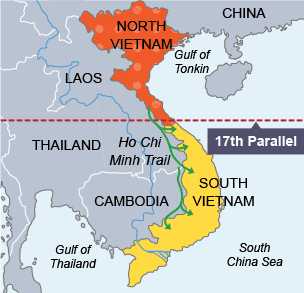
In the 1950s, the United States became involved in the Vietnam War. Why did the United States become involved in this war?
a)
to prevent the collapse of the government of North Vietnam
b)
to stop Vietnam from taking over Hong Kong
c)
to stop the spread of communism to South Vietnam
d)
to prevent attacks against United States shipping
112.
How did the US respond to finding out that the Soviets had missiles in Cuba?
a)
They sent the Air Force to bomb Cuba
b)
They began placing missiles in the Soviet Union.
c)
They placed a naval blockade around Cuba.
d)
They invaded Cuba and the Soviet Union.
113.

Why was the Cuban Missile Crisis one of the MOST important events of John Kennedy’s presidency?
a)
The US almost started a war with Cuba.
b)
The US and the USSR almost started a nuclear war.
c)
The US landed a person on the moon.
d)
The USSR broke apart into nation-states.
114.
What is Communism?
a)
people taking a chance to start a new business
b)
the government having complete control of businesses and property
c)
free enterprise and economic growth encouraged by the government
d)
a democratic government with personal freedoms and economic opportunities
115.
What major historical event is represented in this map?
a)
Attack on Pearl Harbor
b)
The Cuban Missile Crisis
c)
The Wright Brother's first flight
d)
The building of the Panama Canel
116.
A competition between nations to build powerful weapons is called ___________.
a)
Arms Race
b)
Blockade
c)
Space Race
d)
Atomic Bomb
117.
Ordinary people & businesses control the production of goods and services is called _________________________.
a)
capitalism
b)
free trade
c)
marketing
d)
communism
118.
How did the Soviet Union respond to the formation of NATO?
a)
started the Cold War
b)
created the Warsaw Pact
c)
ended the Cold War
d)
launched Sputnik
119.
The Cold War made _______ a major issue in every presidential election during the period.
a)
foreign policy
b)
international relief
c)
spreading communism
d)
the space race
120.
Which two areas of Virginia have benefited because of the heavy military expenditures throughout the Cold War?
a)
Hampton Roads and Southwest Virginia
b)
Southwest Virginia and Richmond area
c)
Richmond Area and Hampton Roads
d)
Hampton Roads and Northern Virginia
121.
4. Which of the following is something that can be used to decide whether a person can vote?
a)
person is a U.S. citizen
b)
owns a home
c)
race
d)
male or female
122.

Brown v. Board of Education was famous because the court ruled that it is illegal
a)
allow children to work.
b)
to pay black people less than white people.
c)
to return a slave.
d)
to segregate schools.
123.
Outlawed racial discrimination *Got rid of "Jim Crow" laws *Racial segregation made illegal
a)
19th Amendment
b)
Civil Rights Act of 1964
c)
14th Amendment
d)
Montgomery Bus Boycott
124.

After the Civil Rights Act of 1964 was passed, it was no longer legal to
a)
let African Americans ride the bus.
b)
deny someone of a job because of their race.
c)
fire someone for not doing their job.
d)
kick someone out of the military.
125.
Which event is MLK, Jr. most known for?
a)
being President during the Civil Rights Movement.
b)
not giving up his seat to a white man.
c)
creating Jim Crow laws.
d)
March on Washington
126.

MLK led a protest called the Montgomery Bus Boycott. They were protesting...
a)
blacks paid more to ride the bus than whites.
b)
blacks could not ride the bus.
c)
blacks had to sit separately from whites on the bus.
d)
blacks had to sit next to whites on the bus.
127.

Which of the following actions would MLK Jr. support?
a)
segregation in the US military.
b)
African Americans carrying guns while protesting.
c)
the arrest of Rosa Parks.
d)
blacks sitting at an all white lunch counter waiting to be served.
128.
What did the court case Brown vs Board of Ed establish?
a)
Public buses could not discriminate.
b)
Segregation is not legal in theaters and hotels.
c)
Public schools could not segregate.
d)
All-black schools must be equal to all-white schools.
129.

Rosa Parks is most associated with
a)
March on Washington
b)
militant movements.
c)
Montgomery Bus Boycott
d)
Brown v. Board of Education
130.

Dr. Martin Luther King Jr. was
a)
a militant Civil Rights leaders.
b)
a lawyer for the NAACP.
c)
a leader who believed in nonviolent protesting.
d)
the first black protester.
131.
ALL citizens have always had the right to vote in the U.S..
a)
TRUE
b)
FLASE
132.
These kept African Americans from voting.
a)
literacy tests and poll taxes
b)
citizenship and writing
c)
having a job and car.
d)
being born in the South.
133.

What do John F.Kennedy, Martin Luther King Jr., and Robert Kennedy all have in common?
a)
they were all assassinated.
b)
All of them went in to space.
c)
They all ran for president.
d)
All spoke at the March on Washington.
134.

This banned the use of literacy tests.
a)
Civil Rights Act
b)
Civil Rights Movement
c)
Voting Rights Act
d)
Jim Crow Law
135.
The U.S. began doing this in the 1960's.
a)
Allowing women to have a job outside the home
b)
Inventing television
c)
space exploration
d)
Desegregating schools
136.
Which invention had the greatest impact on America in the 1950's?
a)
Radio
b)
Television
c)
Telephone
d)
Cars
137.

The lawyer who represented Linda Brown and her family in their case against the school system.
a)
Malcolm X
b)
MLK Jr.
c)
Thurgood Marshall
d)
Rosa Parks
100 %

