
 Worksheets
Transformations, Similarity, and Tessellations
Total questions: 30
Worksheet time: 25mins
Name
Class
Date
1.
A turn is also called a ___________.
a)
Translation
b)
Reflection
c)
Rotation
d)
Transformation
2.
What is a translation?
a)
When you turn an object around a point.
b)
When you slide an object from one place to another.
c)
When you flip or mirror an object across a line.
d)
When you resize an object.
3.
What is a reflection?
a)
When you turn an object around a point.
b)
When you slide an object form one place to another.
c)
When you flip or mirror an object across a line.
d)
When you resize an object.
4.
Congruent geometric figures have the:
a)
Same size
b)
Sides Equal
c)
Same Size and Same Shape
d)
Angles Equal
5.

Identify the transformation from C to D.
a)
90o Counter Clockwise Rotation
b)
180o Rotation
c)
270o Counter clockwise Rotation
d)
360o Rotation
6.

Identify the transformation.
a)
Reflection across y axis
b)
Reflection across x-axis
c)
180 Rotation
d)
Translation 2 units down
7.

Identify the transformation.
a)
Reflection across y-axis
b)
90 Rotation counter clockwise
c)
Translation 5 units left, 1 unit up.
d)
Translation 5 units right, 1 unit down
8.

Write a rule for the translation.
a)
(x -1, y + 2)
b)
(x -2, y + 1)
c)
(x +2, y - 1)
d)
(x +1, y - 2)
9.
Point (-5,2) is reflected over the y axis. Where is the new point located?
a)
(5,2)
b)
(-5,-2)
c)
(-5,2)
d)
(5,-2)
10.

Which of the following describes the sequence of transformations shown?
a)
Reflect across the x-axis and then rotate -90 degrees around the origin
b)
Rotate -90 degrees around the origin and then translate down.
c)
Reflect across the x-axis and then reflect across the y-axis.
d)
Translate up and then rotate 90 degrees about the origin.
11.
Which type of symmetry involves turning an image?
a)
Rotational Symmetry
b)
Transformation Symmetry
c)
Line symmetry
d)
Reflection Symmetry
12.
Which letter does NOT have symmetry? G H O E
a)
G
b)
H
c)
O
d)
E
13.
Which letter has point (rotational) symmetry? A S T W
a)
A
b)
S
c)
T
d)
W
14.
Which letter has both point and line symmetry? N S Z H
a)
N
b)
S
c)
Z
d)
H
15.

How many lines of symmetry are in the figure?
a)
0
b)
1
c)
2
d)
3
16.

How many lines of symmetry does this shape have?
a)
1
b)
2
c)
3
d)
4
17.
Give one example of a figure having no line of symmetry but having rotational symmetry.
a)
equilateral triangle
b)
rhombus
c)
square
d)
parallelogram
18.

What type of transformation does the picture represent?
a)
Dilation
b)
Rotation
c)
Reflection
d)
Translation
19.
Which of the following words shows vertical line symmetry?
a)
DEED
b)
WOW
c)
SWIMS
d)
COOKBOOK
20.

The playing card shown shows what kind of symmetry?
a)
Line symmetry
b)
Rotational symmetry with order 4
c)
Point symmetry
d)
No symmetry
21.
A tessellation is...
a)
a repeating pattern
b)
a repeating pattern with no overlaps
c)
a repeating pattern with no gaps or overlaps
d)
a repeating pattern with no gaps
22.
To decide if given figures will tessellate, I look at the shape(s) __________.
a)
number of sides
b)
angle measures
c)
number of vertices
d)
size
23.
In a tessellation, the measures of the angles that meet at each vertex must add up to 360 degrees.
a)
True
b)
False
24.
Because the angle measures of a _________ add up to 360 degrees, it can always be used to tessellate.
a)
Triangle
b)
Quadrilateral
c)
Pentagon
d)
Hexagon
25.
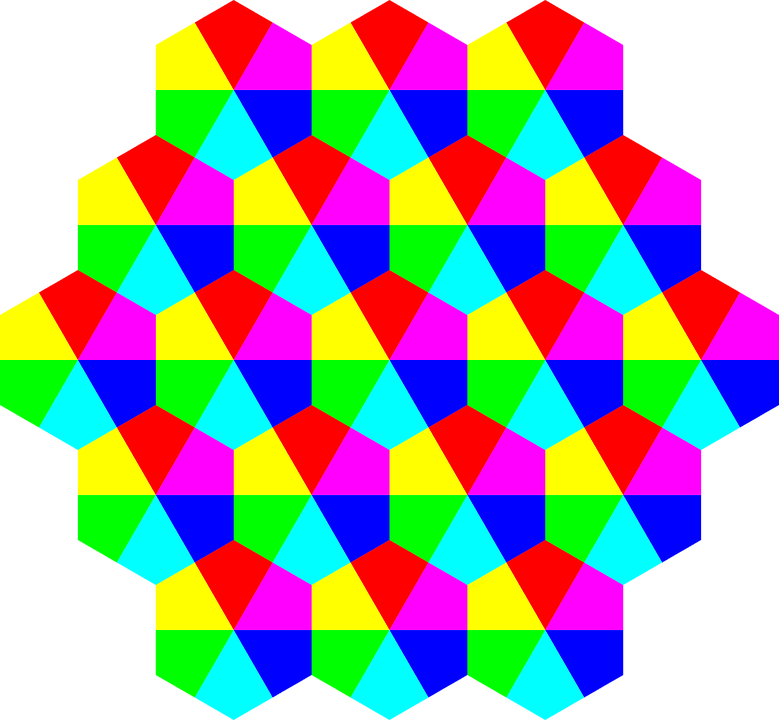
This figure is a tessellation.
a)
True
b)
False
26.
Which of the following is NOT an example of a tessellation?
a)
Brick wall
b)
Flower petals
c)
Bee hive
d)
Soccer ball
27.

Name three types of tessellations used by Escher in his artwork
a)
rotation, translation, dilation
b)
rotation, reflection, translation
c)
reflection, dilation, translation
28.

Would the octagon and square tessellate?
a)
No; two octagons and one square would not meet at each vertex
b)
Yes; two octagons and one square meet at each vertex
135+135+90=360
135+135+90=360
c)
Yes; two octagons and one square meet at each vertex 130+130+100=360
d)
Yes; two octagons and one square meet at each vertex; 140+140+80=360
29.

Would the octagon and the equilateral triangle tessellate?
a)
Yes; two octagons and one triangle meet at each vertex; 150+150+60=360
b)
Yes; two octagons and one triangle meet at each vertex
135+135+60=360
135+135+60=360
c)
Yes; one octagon and two triangles meet at each vertex
135+60+60=360
135+60+60=360
d)
No; there is no combination of 135 and 60 that adds up to exactly 360
30.

Would you classify this tessellation as regular, semiregular, or neither?
a)
regular
b)
semiregular
c)
neither
100 %

