

wayground logo

Free Printable Worksheets

Font size

S
M
L
XL
Worksheets

LHS HB Water and pH

Total questions: 19

Worksheet time: 14mins
Name
Class
Date
1.

Attractions between different water molecules are called

a)
Covalent bonds
b)
Ionic bonds
c)
Polar bonds
d)
Hydrogen bonds
2.

Water has an uneven distribution of charges across the molecule.  Which property is being described?

a)
density
b)
polarity
c)
capillary action
d)
specific heat
3.

What two elements make up water?

a)
Helium and oxygen
b)
Hydrogen and oxygen
c)
helium and carbon
d)
oxygen and carbon
4.

Why is the Oxygen portion of a water molecule negative?

a)
Electrons spend less time orbiting the smaller oxygen atom
b)
Electrons spend more time orbiting the larger oxygen atom
c)
Oxygen is always negative because it is an unstable element
5.

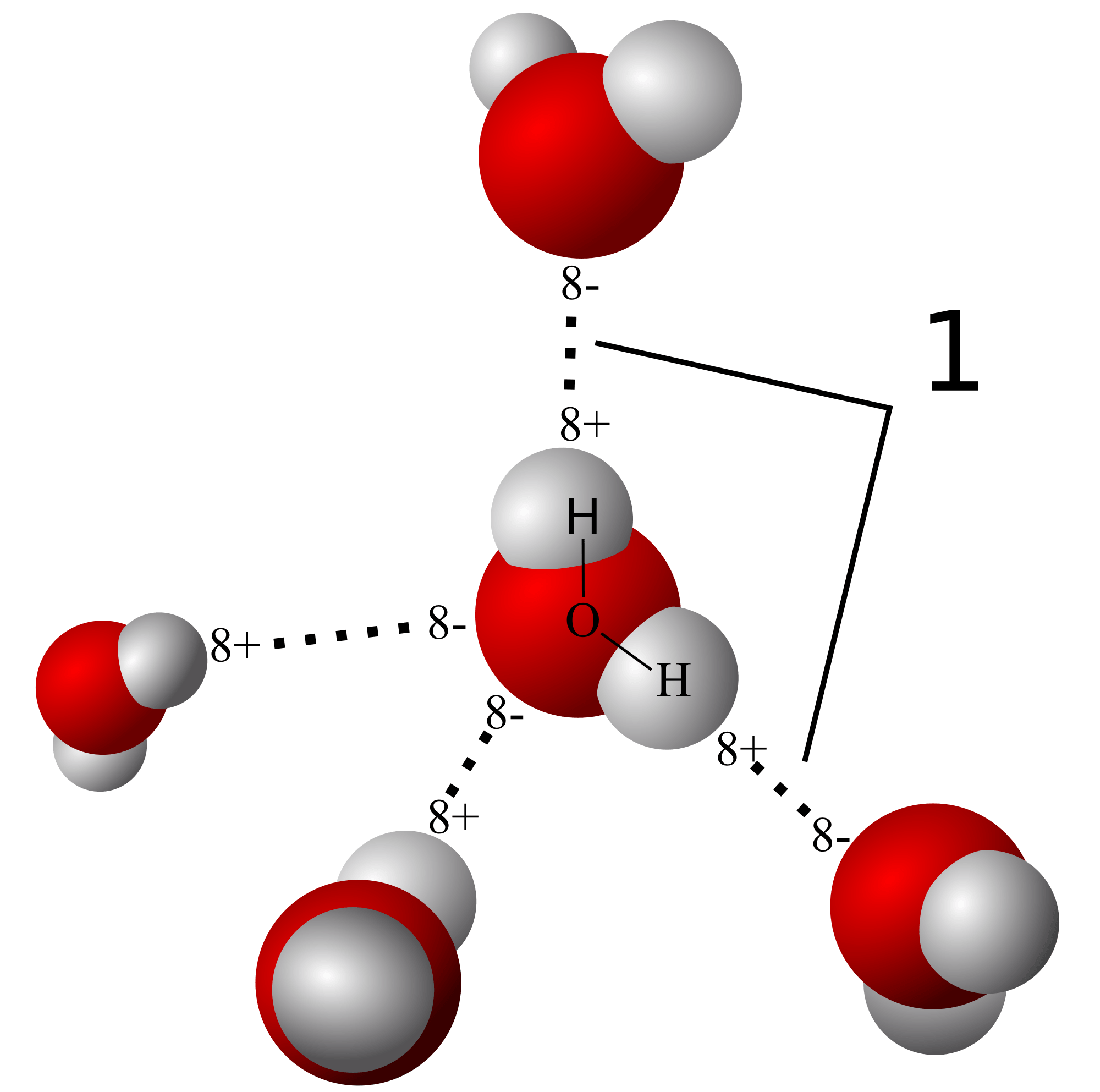
What type of bond is depicted in the image holding the oxygen to the hydrogen within a water molecule

a)
Covalent
b)
Ionic
c)
Hydrogen
6.

What property of water allows it to be such a versatile solvent that it is often called the "universal solvent?"

a)
Purity
b)

Polarity

c)
High heat capacity
d)
Expansion upon freezing
7.

Large bodies of water do not quickly fluctuate in temperature. Why?

a)
Water is a solvent.
b)
Water has a high heat capacity.
c)
Water acts as a buffer.
d)
Water is non-polar.
8.

What word describes when water is attracted to other substances?

a)
cohesion
b)
adhesion
c)
capillary action
d)
surface tension
9.

The attraction that causes water and other liquids to form drops on thin films is called ________________. This is also water’s ability to be attraction to other water molecules.

a)
adhesion
b)
capillary action
c)
cohesion
d)
surface tension
10.

A water strider can skate along the top of a pond because:

a)
covalent bonds result in water cohesion
b)
hydrogen bonds result in water cohesion (surface tension)
c)
water striders have adapted to take advantage of water cohesion
d)
low surface tension of water
11.

The pH scale is a range from:

a)
1-7
b)
0-14
c)
1-5
d)
1-20
12.

A(n) ______ is a substance with a pH less than 7

a)
Acid
b)
Alkaline
c)
Base
d)
Buffer
13.

A(n) _______ is a substance with a pH greater than 7.

a)
Base
b)
Acid
c)
Buffer
d)
Water
14.

If the H3O+ > OH- the solution is...

a)
acidic 
b)
basic
c)
neutral
15.

If the H3O+ < OH- the solution is...

a)
acidic 
b)
basic
c)
neutral
16.

This substance releases OH- into solution

a)
Acid
b)
Base
c)
Neutral
17.

The pH scale is based off of the concentration of _________ ions.

a)
Oxygen
b)
Hydronium (H+)
c)
Nitrogen
d)
None of the others
18.
T12 - What ions does water dissociate into?
a)
OH- and OH-
b)
H+ and H+
c)
H+ and OH-
d)
HOH
19.
T12 - The lower the pH, the greater the concentration of :
a)
OH-
b)
H+